• HOME
  • NEWS
  • EXPLORE
    • CAREER
      • Companies
      • Jobs
    • EVENTS
    • iGEM
      • News
      • Team
    • PHOTOS
    • VIDEO
    • WIKI
  • BLOG
  • COMMUNITY
    • FACEBOOK
    • INSTAGRAM
    • TWITTER
Thursday, October 29, 2026
BIOENGINEER.ORG
No Result
View All Result
  • Login
  • HOME
  • NEWS
  • EXPLORE
    • CAREER
      • Companies
      • Jobs
        • Lecturer
        • PhD Studentship
        • Postdoc
        • Research Assistant
    • EVENTS
    • iGEM
      • News
      • Team
    • PHOTOS
    • VIDEO
    • WIKI
  • BLOG
  • COMMUNITY
    • FACEBOOK
    • INSTAGRAM
    • TWITTER
No Result
View All Result
Bioengineer.org
No Result
View All Result
Home NEWS Science News Chemistry

Atomically dispersed platinum catalyst resists sintering at high loadings

by
October 28, 2026
in Chemistry
Reading Time: 2 mins read
0
Atomically dispersed platinum catalyst resists sintering at high loadings

Atomically dispersed platinum catalyst resists sintering at high loadings

Share on FacebookShare on TwitterShare on LinkedinShare on RedditShare on Telegram

Chemists have developed a way to pack unusually large amounts of platinum into a catalyst while keeping every metal atom individually dispersed, a combination that has long eluded materials scientists. The new material, described in Nature Synthesis, retains its structure even under the harsh reducing conditions that normally destroy finely dispersed catalysts.

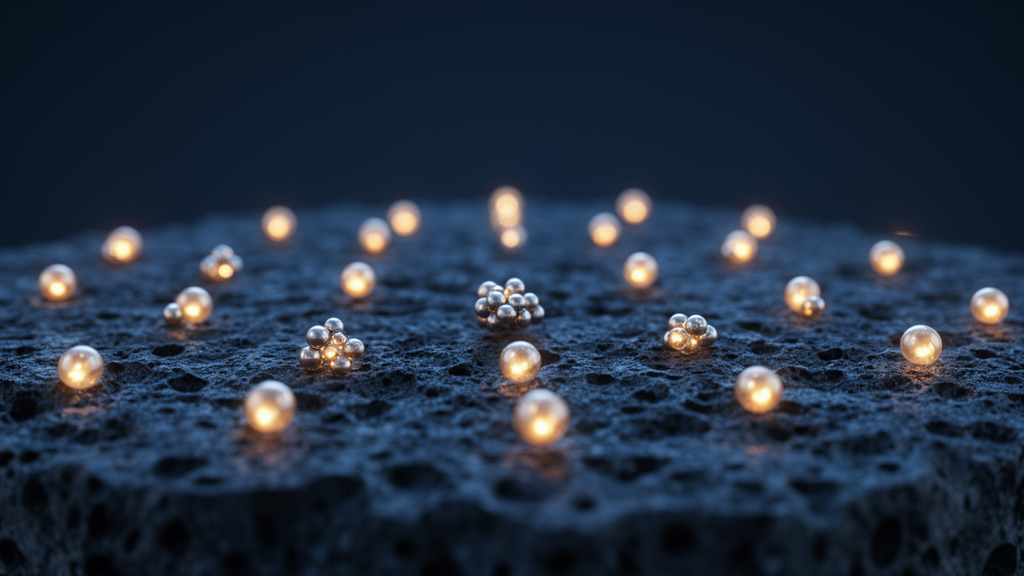
The strategy, called reticular coordination, uses a metal–organic framework as a molecular scaffold. Platinum atoms are anchored one at a time onto cerium-oxo clusters within the framework. When the material is then calcined, the framework converts into a ceria-based support, PtRC/CeOx, in which the platinum is atomically dispersed at a loading of 14.9 weight percent.

High loadings above 10 weight percent are generally difficult to reconcile with atomic dispersion, because densely packed metal atoms tend to migrate and fuse into larger particles, a process known as sintering.

In the new catalyst, the ceria lattice itself confines the platinum. When the material was treated at temperatures above 300 degrees Celsius under hydrogen, the isolated platinum species did not undergo uncontrolled sintering. Instead, their migration was suppressed after limited restructuring into flat, strongly confined ultrasmall clusters.

The researchers tested the treated material in proton exchange membrane water electrolysers. Using a platinum loading of 0.15 milligrams per square centimetre, the catalyst showed a degradation rate of 25 microvolts per hour.

For comparison, a commercial 40 weight percent platinum-on-carbon catalyst degraded at 106 microvolts per hour while operating at a higher platinum loading of 0.40 milligrams per square centimetre. The new catalyst also retained its structural integrity after 500 hours of operation at a current density of 1 ampere per square centimetre.

The reticular coordination approach was not limited to platinum. According to the reported figures, the strategy could be extended to other precious metals, suggesting a general route for anchoring single atoms of catalytically valuable elements onto oxide supports.

The work addresses a fundamental challenge in catalyst design: maximizing the utilization of scarce and expensive precious metals.

The resulting lattice confinement appears to be the key to durability, holding the platinum in place even when the catalyst is subjected to high temperatures and strongly reducing atmospheres.

The reported electrolyser results, obtained over hundreds of hours of continuous operation, indicate that the confined platinum clusters remain stable under the demanding conditions of water electrolysis, where catalyst degradation is a major obstacle to long-term hydrogen production.

Subject of Research: A reticular coordination strategy for highly loaded, sintering-resistant atomically dispersed platinum catalysts in ceria

Article Title: Durable, highly loaded atomically dispersed catalysts via a reticular coordination strategy

Article References: Jung, Y., Moon, J., Shim, J., Hwang, S., Bang, S.-U., Heo, S., Ahn, H., Yoo, S., Shin, D., Chun, S. E., Bootharaju, M. S., Ryu, J., Kim, D. H., Cho, S.-P., Sung, Y.-E., Kim, M., Hyeon, T., & Lee, B.-H. (2026). Durable, highly loaded atomically dispersed catalysts via a reticular coordination strategy. Nature Synthesis. https://doi.org/10.1038/s44160-026-01204-3

Image Credits: AI Generated

DOI: 10.1038/s44160-026-01204-3

Keywords: platinum, single-atom catalysts, ceria, metal-organic frameworks, sintering, reticular coordination, electrocatalysis, water electrolysis, catalyst stability, precious metals, Durable, highly

News Source: Bethany Barker. (October 28, 2026). Atomically dispersed platinum catalyst resists sintering at high loadings. Scienmag.


Tags: catalyst stabilityceriaDurableelectrocatalysishighlyMetal-Organic Frameworksplatinumprecious metalsreticular coordinationsingle-atom catalystssinteringwater electrolysis
Share12Tweet7Share2ShareShareShare1

Related Posts

New Graph Descriptors Predict Graph Energy Across Graphene Allotropes

New Graph Descriptors Predict Graph Energy Across Graphene Allotropes

October 29, 2026
Scientists Decode the Chemistry Behind Baijiu's Aged Aroma Across Seven Brewing Rounds

Scientists Decode the Chemistry Behind Baijiu’s Aged Aroma Across Seven Brewing Rounds

October 29, 2026

Gamma Irradiation Reshapes the Volatile Chemistry and Antibacterial Power of Mugwort Leaf Oil

October 29, 2026

Computational design yields magnetic polymers that rapidly capture aging markers in Baijiu

October 29, 2026

POPULAR NEWS

  • One Transformer Reads Three Brain-Signal Types at Once, Hitting 71% Accuracy

    One Transformer Reads Three Brain-Signal Types at Once, Hitting 71% Accuracy

    29 shares
    Share 12 Tweet 7
  • Research report: Case Report: Probable paroxysmal sympathetic hyperactivity during vascular and postoperative critical illness with bilateral white matter abnormalities

    29 shares
    Share 12 Tweet 7
  • Propionate, Not Extra Protein, Drives Reproductive Gains in Young Range Cows

    29 shares
    Share 12 Tweet 7
  • Deep Learning Model Predicts Adhesive Hydrogel Strength Under Distribution Shift

    29 shares
    Share 12 Tweet 7

About

We bring you the latest biotechnology news from best research centers and universities around the world. Check our website.

Follow us

Recent News

Early rehabilitation restored jaw function in a dog after severe TMJ surgery

EZH2 Blockade Restores Glioblastoma Sensitivity to Radiotherapy in Preclinical Models

Early TTR Rise on Tafamidis Tied to Lower Death Risk in ATTR-CM Trial Analysis

Subscribe to Blog via Email

Enter your email address to subscribe to this blog and receive notifications of new posts by email.

Join 85 other subscribers
  • Contact Us

Bioengineer.org © Copyright 2023 All Rights Reserved.

Welcome Back!

Login to your account below

Forgotten Password?

Retrieve your password

Please enter your username or email address to reset your password.

Log In
No Result
View All Result
  • Homepages
    • Home Page 1
    • Home Page 2
  • News
  • National
  • Business
  • Health
  • Lifestyle
  • Science

Bioengineer.org © Copyright 2023 All Rights Reserved.