• HOME
  • NEWS
  • EXPLORE
    • CAREER
      • Companies
      • Jobs
    • EVENTS
    • iGEM
      • News
      • Team
    • PHOTOS
    • VIDEO
    • WIKI
  • BLOG
  • COMMUNITY
    • FACEBOOK
    • INSTAGRAM
    • TWITTER
Friday, October 30, 2026
BIOENGINEER.ORG
No Result
View All Result
  • Login
  • HOME
  • NEWS
  • EXPLORE
    • CAREER
      • Companies
      • Jobs
        • Lecturer
        • PhD Studentship
        • Postdoc
        • Research Assistant
    • EVENTS
    • iGEM
      • News
      • Team
    • PHOTOS
    • VIDEO
    • WIKI
  • BLOG
  • COMMUNITY
    • FACEBOOK
    • INSTAGRAM
    • TWITTER
No Result
View All Result
Bioengineer.org
No Result
View All Result
Home NEWS Science News Biology

Devonian shark relative reveals how ancient fin spines grew in length and width

by
October 28, 2026
in Biology
Reading Time: 2 mins read
0
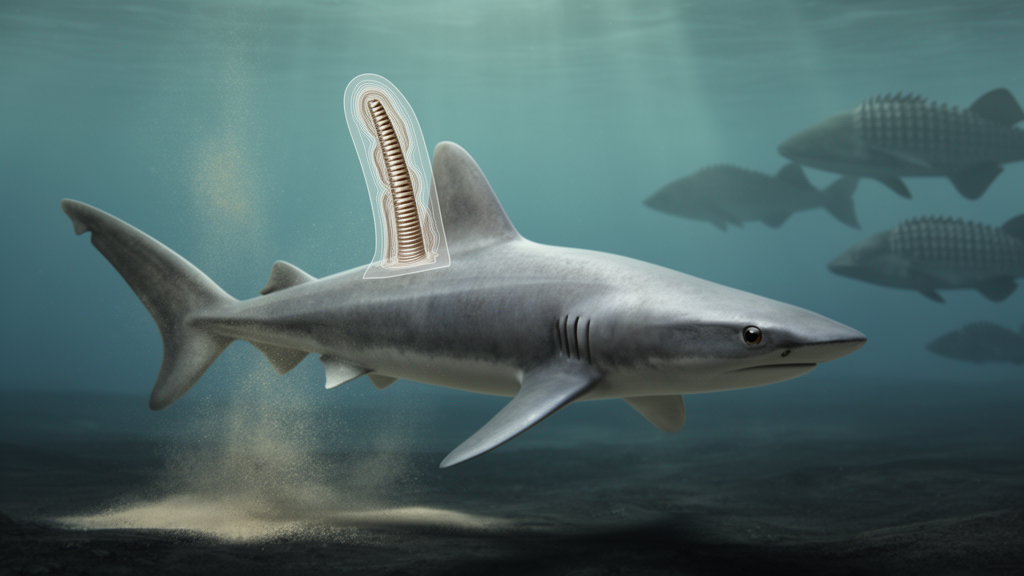
Devonian shark relative reveals how ancient fin spines grew in length and width

Devonian shark relative reveals how ancient fin spines grew in length and width

Share on FacebookShare on TwitterShare on LinkedinShare on RedditShare on Telegram

The study, published in Developmental Biology Advances, focuses on Wellerodus priscus, a Middle Devonian chondrichthyan recovered from the Cairo Quarry Lagerstätte in New York State, USA.

Although previous research had described the morphology and histology of these elements, their developmental patterns remained poorly understood. The research team, led by Richard Flament with Nathaniel Bertrand-Maltais, Daniel Potvin-Leduc and Richard Cloutier, set out to close that gap by combining paleohistological thin sections with micro-CT scanning, scanning electron microscopy and light microscopy.

Based on the ornamentation pattern of the spines and their paleohistological characteristics, the researchers identified two distinct modes of growth: a longitudinal component, in which the spine grows in length, and a transverse component, in which it grows in width. Each mode was associated with specific zones of tissue production in the pectoral and dorsal fin spines of Wellerodus priscus.

This dual-growth architecture means the spines did not simply elongate from a single growth zone but added material along both axes through spatially separated regions of tissue formation. The finding provides a concrete developmental framework for interpreting how these prominent dermal structures were built during the animal’s lifetime.

To place the result in an evolutionary context, the team compared the developmental patterns observed in Wellerodus with those of other Paleozoic total-group chondrichthyans, a group that includes both the stem-chondrichthyans traditionally called “acanthodians” and the crown group that contains modern sharks, rays and chimaeras.

The authors report that their framework offers a new line of evidence for understanding the evolution of fin spine development, showing that Wellerodus priscus fin spines grew in both length and width. They state that the work enhances comprehension of developmental similarities between early chondrichthyans and more derived Carboniferous, Permian and even extant chondrichthyans.

Beyond reconstructing the biology of a single species, the study carries methodological value. The histo-morphological criteria used to describe the developmental pattern provide characters that the researchers suggest are potentially suitable for phylogenetic analyses, meaning they could be coded as traits in future studies of relationships among early jawed vertebrates.

Because the article is being shared early to provide faster access to peer-reviewed, accepted research, it is citable and carries a permanent DOI, though the published version remains subject to further edits before the final Version of Record replaces it.

Subject of Research: Developmental growth patterns of fin spines in the Devonian chondrichthyan Wellerodus priscus

Article Title: Fin spine ontogeny in the Devonian chondrichthyan Wellerodus priscus: Paleo-Evo-Devo insights into early chondrichthyan dermal skeleton development

Article References: Flament, R., Bertrand-Maltais, N., Potvin-Leduc, D., & Cloutier, R. (2026). Fin spine ontogeny in the Devonian chondrichthyan Wellerodus priscus: Paleo-Evo-Devo insights into early chondrichthyan dermal skeleton development. Developmental Biology Advances. https://doi.org/10.1186/s13227-026-00273-x

Image Credits: AI Generated

DOI: 10.1186/s13227-026-00273-x

Keywords: Wellerodus priscus, chondrichthyans, Devonian, fin spines, paleohistology, micro-CT, paleo-evo-devo, dermal skeleton, Cairo Quarry, growth zones, phylogenetics, acanthodians

News Source: Gavin Prescott. (October 28, 2026). Devonian shark relative reveals how ancient fin spines grew in length and width. Scienmag.

Tags: acanthodiansCairo Quarrychondrichthyansdermal skeletonDevonianfin spinesgrowth zonesmicro-CTpaleo-evo-devopaleohistologyphylogeneticsWellerodus priscus
Share12Tweet7Share2ShareShareShare1

Related Posts

Common Immunosuppressant Disrupts Blood Vessel Growth in Zebrafish Embryos

Common Immunosuppressant Disrupts Blood Vessel Growth in Zebrafish Embryos

October 30, 2026
Drought Then Fire Pushed Big Bend's Piñon-Juniper Forests Toward Collapse

Drought Then Fire Pushed Big Bend’s Piñon-Juniper Forests Toward Collapse

October 30, 2026

Wild Lion Gut Microbiome Yields Hundreds of Novel Microbial Genomes

October 30, 2026

Tumor cells may revert to stem-like states, review argues

October 30, 2026

POPULAR NEWS

  • Inflammation-Weighted Nutrition Score Predicts Survival After Liver Cancer Surgery

    Inflammation-Weighted Nutrition Score Predicts Survival After Liver Cancer Surgery

    29 shares
    Share 12 Tweet 7
  • RAS Inhibitor Daraxonrasib Redefines Pancreatic Cancer Treatment After FDA Approval

    29 shares
    Share 12 Tweet 7
  • Few Ethiopian Mothers Receive Quality Care Across Maternity Continuum

    29 shares
    Share 12 Tweet 7
  • Particle Swarm Optimization Steers Client Selection in Decentralized Federated Learning

    29 shares
    Share 12 Tweet 7

About

We bring you the latest biotechnology news from best research centers and universities around the world. Check our website.

Follow us

Recent News

Ethosomal nanocarriers aim to reprogram skin cancer microenvironment through transdermal drug delivery

Common Immunosuppressant Disrupts Blood Vessel Growth in Zebrafish Embryos

Community co-design reshapes a Malawi mini-grid toward clean cooking

Subscribe to Blog via Email

Enter your email address to subscribe to this blog and receive notifications of new posts by email.

Join 86 other subscribers
  • Contact Us

Bioengineer.org © Copyright 2023 All Rights Reserved.

Welcome Back!

Login to your account below

Forgotten Password?

Retrieve your password

Please enter your username or email address to reset your password.

Log In
No Result
View All Result
  • Homepages
    • Home Page 1
    • Home Page 2
  • News
  • National
  • Business
  • Health
  • Lifestyle
  • Science

Bioengineer.org © Copyright 2023 All Rights Reserved.