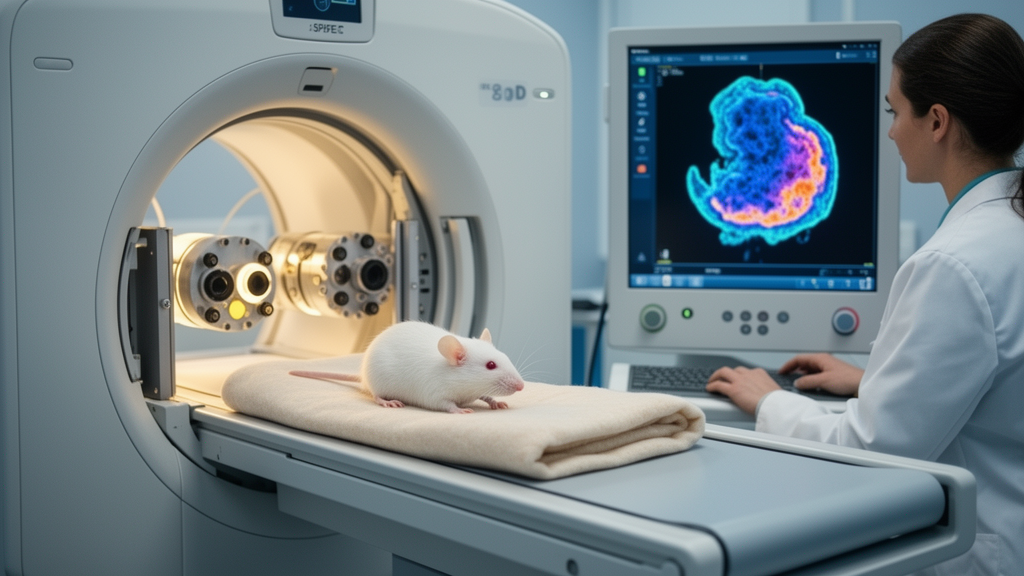
Researchers have mapped out how little radioactive tracer a mouse cancer study actually needs, reporting that a small-animal SPECT scanner can produce usable tumour images with as little as 4 megabecquerels of a 177Lu-labelled peptide for short-term imaging, and 8 megabecquerels for studies stretching out to a full week after injection. The finding, published as open-access original research in EJNMMI Physics, comes from a systematic performance evaluation of the γ-CUBE preclinical SPECT system, a scanner designed for theranostic studies in laboratory animals.
The study, led by Davide Tosoni and colleagues, set out with two goals: to characterise how the γ-CUBE performs with both 99mTc, a workhorse of nuclear medicine imaging, and 177Lu, a radionuclide increasingly central to peptide receptor radionuclide therapy, and to determine the minimum administered activity of a novel 177Lu-labelled peptide in a mouse cancer model without compromising image quality.
System performance was assessed in terms of uniformity, spatial resolution and contrast-to-noise ratio, using syringes and Derenzo phantoms, with 177Lu compared directly against 99mTc. The scanner accepts three interchangeable collimators, each with a different trade-off between sensitivity and resolution: a general-purpose-rat collimator (GP-R), a general-purpose-mouse collimator (GP-M) and a high-sensitivity-mouse collimator (HS-M). The team tested all three while varying the number of iterations of the reconstruction algorithm, an important variable because iterative reconstruction can sharpen images but also degrade uniformity as iterations accumulate.
The uniformity results illustrate that trade-off. With 99mTc, integral uniformity measured 18.3 percent for the GP-R collimator, 23.6 percent for GP-M and 17.3 percent for HS-M at 50 iterations. Increasing the number of iterations degraded uniformity, and 99mTc consistently showed better uniformity values than 177Lu across the tested conditions.
Spatial resolution followed a different pattern. The GP-M collimator resolved all Derenzo rods, down to the finest 1 millimetre rods, for both radionuclides. The HS-M collimator resolved rods of 1.6 millimetres and larger at 500 iterations, while the GP-R collimator resolved rods of at least 1.4 millimetres for 99mTc and at least 2 millimetres for 177Lu at 500 iterations. These phantom measurements define the practical limits of what each collimator configuration can distinguish in a small animal.
Quantitative accuracy for 177Lu was determined at 50 iterations using a biomimetic mouse phantom and polypropylene tubes filled with activity concentrations ranging from 0.095 to 2.36 megabecquerels per millilitre. The HS-M collimator delivered superior quantitative accuracy, exceeding 90 percent, for all tested activity concentrations. That accuracy figure is central to the scanner’s usefulness for biodistribution studies, where the goal is not just to see where a tracer accumulates but to measure how much of it is there.
To establish the activity threshold, the researchers injected three tumour-bearing mice with 16.0 plus or minus 1.3 megabecquerels of the 177Lu-labelled peptide and scanned them with the HS-M collimator at different time points after injection. Lower activities, from 1.6 to 12 megabecquerels, were then simulated by retrospective reconstructions of the acquired data. Tumour contrast-to-noise ratio was calculated at 48 hours and 168 hours post-injection, and image quality was assessed by five independent readers using a 5-point scale.
The results showed that tumour contrast-to-noise ratio worsened as injected activity was reduced, as expected. The panel of readers and the CNR analysis converged on 8 megabecquerels as the threshold for good image quality up to 7 days after injection, while 4 megabecquerels was deemed acceptable for short-term studies of less than 48 hours. In other words, the injected activity of the 177Lu-peptide in the experimental paradigm used for the study can be significantly reduced while still maintaining adequate image quality for longitudinal biodistribution studies.
On the basis of these measurements, the authors conclude that the γ-CUBE system offers versatile performance for imaging with both 99mTc and 177Lu. They recommend the HS-M collimator for low-activity studies, and they identify 50 iterations as the best compromise for routine applications. The study is limited to the preclinical setting and the specific experimental paradigm described, so the thresholds reported here apply to this scanner, these collimators and this peptide rather than to clinical imaging. The article was published on 5 October 2026 as a peer-reviewed, accepted manuscript shared ahead of final copyediting.
Subject of Research: Performance evaluation of a preclinical SPECT scanner and optimization of imaging protocols for 177Lu-labelled radiopharmaceuticals in mouse cancer models
Article Title: Performance evaluation of a preclinical SPECT system and optimization of imaging protocols for 177Lu-labelled radiopharmaceuticals
Article References: Tosoni, D., Piai, A., Roletto, A., Valtorta, S., Belloli, S., Curnis, F., Chiti, A., Moresco, R. M., & del Vecchio, A. (2026). Performance evaluation of a preclinical SPECT system and optimization of imaging protocols for 177Lu-labelled radiopharmaceuticals. EJNMMI Physics. https://doi.org/10.1186/s40658-026-00950-9
Image Credits: AI Generated
DOI: 10.1186/s40658-026-00950-9
Keywords: SPECT, 177Lu, preclinical imaging, radiopharmaceuticals, theranostics, γ-CUBE, collimators, image quality, mouse cancer model, biodistribution, 99mTc, quantitative accuracy
News Source: Nathaniel Bowman. (October 28, 2026). Preclinical SPECT scanner cuts 177Lu dose needed for sharp mouse tumour imaging. Scienmag.