


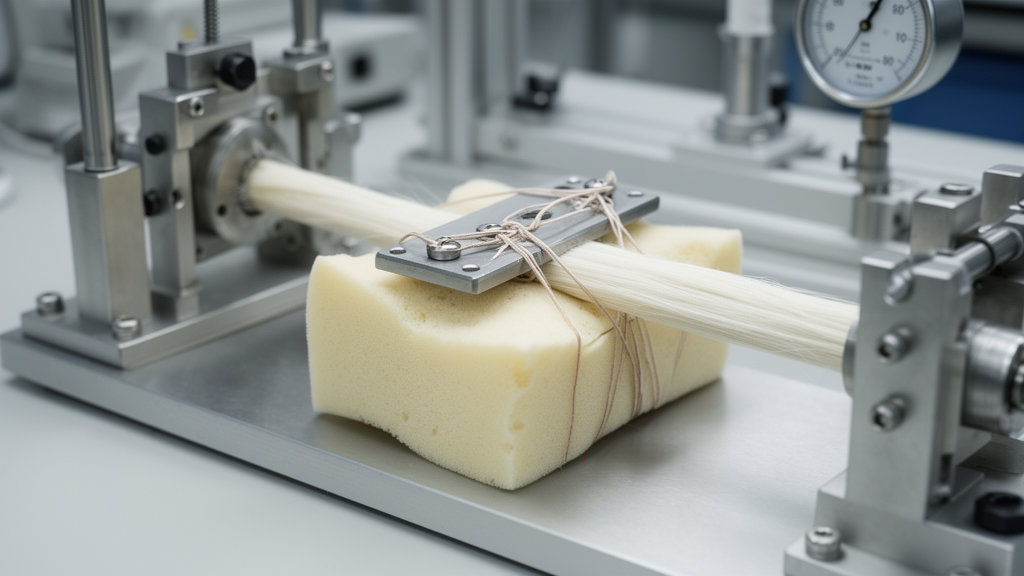
Rotator cuff repair can fail before the tendon has a chance to heal, particularly in patients with poor bone quality. In osteoporotic bone, the two most common repair methods are especially vulnerable: suture anchors can pull out of the bone, and transosseous sutures can cut through weakened bone. A new biomechanical study, published in BMC Musculoskeletal Disorders, tested an alternative device called an anchor plate, which is designed to dissipate stress more evenly across a larger surface area of bone rather than concentrating it at a single fixation point.
The research team, led by Amirhasan Amini and colleagues, performed twenty-seven biomechanical tests on spatially distinct regions of a standardized polyurethane foam block, a laboratory material commonly used to model bone in mechanical testing. Three fixation techniques were compared: the anchor plate, a conventional suture anchor, and transosseous fixation. Each technique was tested with three suture types: a 0.2 mm round suture, a 0.5 mm round suture, and a 0.5 mm flat suture tape, with three tests for each combination of technique and suture. All constructs were loaded to failure under identical conditions, and the researchers recorded the ultimate failure load and the mode of failure for every construct.
The results showed a consistent pattern across every suture type tested. The anchor plate construct achieved higher failure loads than both conventional techniques in all comparisons. Among the anchor plate configurations, the construct using the 0.5 mm flat suture tape performed best, reaching a mean ultimate failure load of 437 ± 24 N. By contrast, the suture anchor and transosseous constructs with the same suture type reached only 162 ± 12 N and 163 ± 16 N respectively, meaning the anchor plate more than doubled the failure load in that comparison.
The way the constructs failed also differed markedly between groups, and this difference may be as important as the load numbers. Suture anchor constructs failed mainly by anchor pull-out from the foam, while transosseous constructs failed by foam cut-through, the mechanism expected in weak bone. Anchor plate constructs, in contrast, failed primarily by suture rupture, with only localized indentation of the foam surface. In other words, the anchor plate shifted the weak point of the repair away from the bone-implant interface and toward the suture itself, which is precisely the behavior the device was designed to achieve in poor-quality bone.
The authors are careful to frame these findings as preliminary. The conclusions state that in this preliminary biomechanical model, the anchor plate construct showed higher mean ultimate failure loads than both suture anchor and transosseous repair techniques under the tested monotonic loading conditions. The findings suggest the anchor plate may have potential in this model, but the authors emphasize that further cadaveric and clinical studies are needed before any clinical recommendation can be made.
Several limitations follow directly from the study design. The tests used a single standardized polyurethane foam block rather than human cadaveric bone, so the model cannot capture the full variability of real osteoporotic bone. Each technique and suture combination was tested only three times, a small sample size for biomechanical comparison. The loading was monotonic, meaning each construct was loaded to failure in a single continuous application rather than through the cyclic loading that repairs experience during repeated shoulder movement in the weeks after surgery. The study therefore reports mechanical behavior under one specific laboratory condition, not clinical outcomes.
Within those limits, the study offers a clear mechanical comparison of three fixation strategies under identical conditions. If the anchor plate’s larger footprint continues to distribute stress effectively in cadaveric and eventually clinical settings, it could address a recognized problem in rotator cuff surgery, where fixation failure in osteoporotic bone remains a barrier to reliable healing. For now, the evidence supports the device’s promise in a foam-block model and defines the direction for the next stages of testing.
Subject of Research: Biomechanical comparison of anchor plate, suture anchor and transosseous constructs for rotator cuff repair
Article Title: Comparison of an anchor plate with suture anchor and transosseous constructs for rotator cuff repair in a polyurethane foam block: a biomechanical study
Article References: Amini, A., Nourani, A., Ahangar, P., Ahmadpour Joeini, E., Mojadam Mofrad, S., & Naderi, M. N. (2026). Comparison of an anchor plate with suture anchor and transosseous constructs for rotator cuff repair in a polyurethane foam block: a biomechanical study. BMC Musculoskeletal Disorders. https://doi.org/10.1186/s12891-026-10634-1
Image Credits: AI Generated
DOI: 10.1186/s12891-026-10634-1
Keywords: rotator cuff repair, anchor plate, suture anchor, transosseous fixation, biomechanics, polyurethane foam, failure load, suture rupture, osteoporotic bone, orthopedic surgery, Comparison, anchor
News Source: Ophelia Keating. (October 29, 2026). Anchor plate outperforms suture anchors in foam-block rotator cuff repair test. Scienmag.



