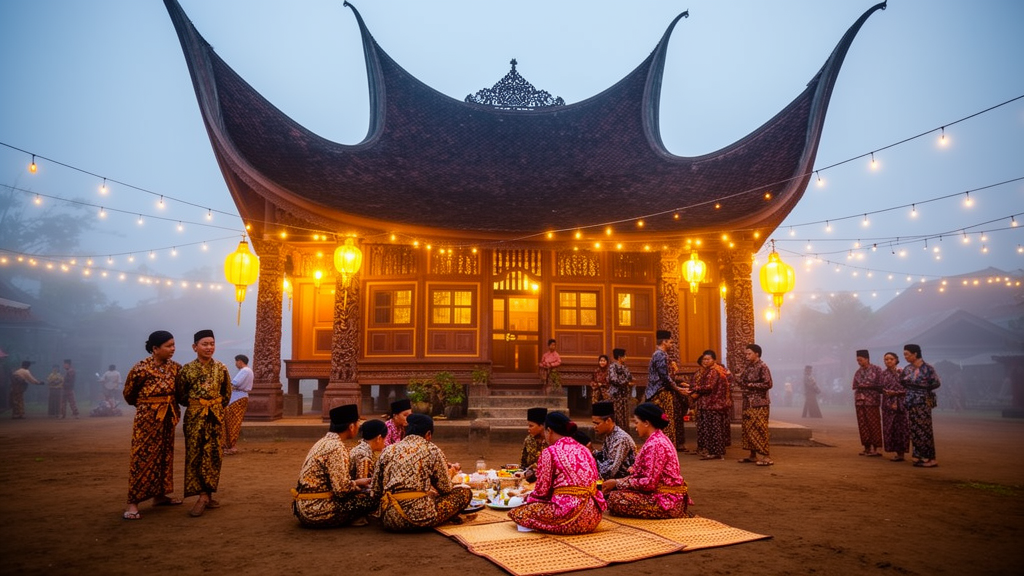
In Koto Sentajo, a settlement in Riau, Indonesia, traditional architecture and customary practice remain woven into everyday life rather than preserved as museum pieces. A new ethnographic study examines how this living settlement, shaped by matrilineal kinship and indigenous governance, sustains its vernacular heritage in the face of modernisation. The research focuses on the community’s core spatial elements: the Rumah Godang, the traditional house; the mosque; and the Balai Adat, the customary hall, which together function as anchors of cultural continuity.
The study documents how the Rayo Duo festival, held on the second day of Eid al-Fitr, mobilises community members across generations to reactivate customary roles and restore ancestral houses. According to the researchers, the festival acts as a recurring mechanism through which social obligations are renewed and the physical fabric of the settlement is maintained.
The findings indicate that cultural sustainability in Koto Sentajo depends on integrating social structure, spatial form and philosophical values. Two indigenous concepts are central to this integration: Tungku Tigo Sajorangan and Tali Tigo Sapilin. These principles, the study argues, link the arrangement of buildings and communal spaces to the kinship system and customary governance that organise daily life, so that architecture and social practice reinforce one another.
The authors conclude that the endurance of the Rumah Godang is not merely architectural but rooted in living practices. Because the houses continue to host the rituals and roles that give them meaning, Koto Sentajo is presented as a model of community-led conservation and indigenous resilience. The study, published open access in the journal City, Territory and Architecture, is based on ethnographic fieldwork in the community and offers a case of heritage maintenance driven from within rather than imposed from outside.
Subject of Research: How the Rayo Duo festival sustains the traditional Rumah Godang architecture and customary spatial culture of the Sentajo community in Riau, Indonesia.
Article Title: The Rayo Duo festival and the spatial meaning of Rumah Godang in the inhabited culture of the Sentajo Community, Riau, Indonesia
Article References: Faisal, G., Subroto, T. Y. W., & Rahmi, D. H. (2026). The Rayo Duo festival and the spatial meaning of Rumah Godang in the inhabited culture of the Sentajo Community, Riau, Indonesia. City, Territory and Architecture. https://doi.org/10.1186/s40410-026-00320-z
Image Credits: AI Generated
DOI: 10.1186/s40410-026-00320-z
Keywords: Rumah Godang, Rayo Duo festival, Koto Sentajo, Riau, vernacular architecture, cultural sustainability, matrilineal kinship, indigenous governance, ethnography, heritage conservation, Eid al-Fitr, Indonesia
News Source: Courtney Benton. (October 29, 2026). Rayo Duo Festival Keeps Indonesia’s Rumah Godang Houses Alive. Scienmag.