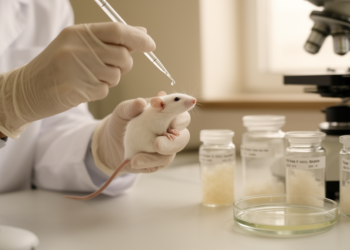
When mice bearing lung or mammary tumors were acclimatized to the hypobaric hypoxia of 3,466 meters altitude, their tumors did not shrink or grow faster, but their chemistry changed in striking ways. A new study published in Cancer & Metabolism reports that high-altitude exposure suppressed hepatic bile acid metabolism and remodeled the lipid composition of tumors, even though primary tumor growth itself was unaffected.
The animals were compared with tumor-bearing mice kept at low altitude, allowing the investigators to isolate the metabolic consequences of chronic systemic hypoxia.
The central negative result is notable: high altitude did not alter primary tumor growth, terminal tumor weight, necrosis, or hemorrhage in either cancer model. Tumors looked broadly the same by these conventional measures whether their hosts breathed thin mountain air or normal lowland conditions.
Yet molecular profiling told a different story. LLC1 tumors from high-altitude-acclimatized mice displayed a distinct lipid-metabolic profile, characterized by altered sterol and glycerophospholipid species, a tendency toward reduced free fatty acid content, and, most strikingly, an absence of detectable bile acids that were present in most low-altitude tumors. The tumors also showed altered expression of lipid-handling genes, including increased Abca1 and Vdr and reduced Ptgs2 after false discovery rate correction.
The changes extended beyond the tumors themselves. Tumor-bearing mice at high altitude exhibited lower plasma bile acid levels, normalization of tumor-associated hepatomegaly, and reduced circulating IL-6, an inflammatory signaling molecule. This suggests that the host liver and systemic inflammatory state respond to altitude even when the tumor’s gross growth does not.
In the liver, the researchers found that high altitude and tumor burden produced overlapping, non-additive changes in bile acid synthesis, conjugation, and transport programs. In other words, the two conditions did not simply stack their effects; instead, they appeared to converge on the same regulatory pathways, with one partially masking or duplicating the other.
Hypoxia and pharmacologic stabilization of HIF, the hypoxia-inducible factor, reproduced the bile acid-related transcriptional changes seen in vivo.
The authors conclude that hepatic bile acid metabolism is a hypoxia-sensitive host pathway that links high-altitude acclimatization to tumor lipid remodeling without necessarily altering primary tumor growth. This framing is deliberately cautious: the study identifies an association between systemic hypoxia and tumor lipidome changes, not a therapeutic effect on cancer.
Several limitations deserve emphasis. The findings come from two mouse cancer models and one human liver cell line, and the article is being shared ahead of final production as a peer-reviewed, accepted manuscript that may still undergo editorial edits. Whether similar bile acid and lipid changes occur in humans living at or traveling to high altitude, and whether the remodeled tumor lipidome has any functional consequence for cancer progression or treatment response, remains unknown. The study’s value lies in mapping a previously underdefined connection between whole-body oxygen availability, liver bile acid regulation, and the metabolic environment of tumors, providing a foundation for future mechanistic work rather than clinical guidance.
Subject of Research: Effects of high-altitude hypobaric hypoxia on hepatic bile acid metabolism and tumor lipid profiles in mice
Article Title: Hypobaric hypoxia at 3,466 m suppresses hepatic bile acid metabolism and remodels the tumor lipidome in mice
Article References: Aboouf, M. A., Rütten, M., Chaachouay, H., Osto, E., Gassmann, M., & Thiersch, M. (2026). Hypobaric hypoxia at 3,466 m suppresses hepatic bile acid metabolism and remodels the tumor lipidome in mice. Cancer & Metabolism. https://doi.org/10.1186/s40170-026-00458-x
Image Credits: AI Generated
DOI: 10.1186/s40170-026-00458-x
Keywords: hypobaric hypoxia, high altitude, bile acids, tumor lipidome, liver metabolism, HIF signaling, HNF4A, LLC1 lung carcinoma, E0771 mammary carcinoma, hepatomegaly, IL-6, mice
News Source: Nathaniel Bowman. (October 28, 2026). High-altitude hypoxia reshapes tumor lipid metabolism and liver bile acid pathways in mice. Scienmag.