Chemists and enzymologists have long relied on mechanism-guided design to create new enzymatic reactions, but a team writing in Nature Catalysis reports a complementary strategy: systematically screening enzyme–photocatalyst pairings to let unexpected reactivity surface on its own. The study, led by Liu-Peng Zhao, Binh Khanh Mai, Rui Guo, Lei Cheng, Huichong Liu, Ken Lin, Yunlong Zhao, Peng Liu and Yang Yang, was published on 28 October 2026 and demonstrates that cooperative action between two catalysts can unlock chemistry that neither the enzyme nor the photocatalyst can achieve alone.
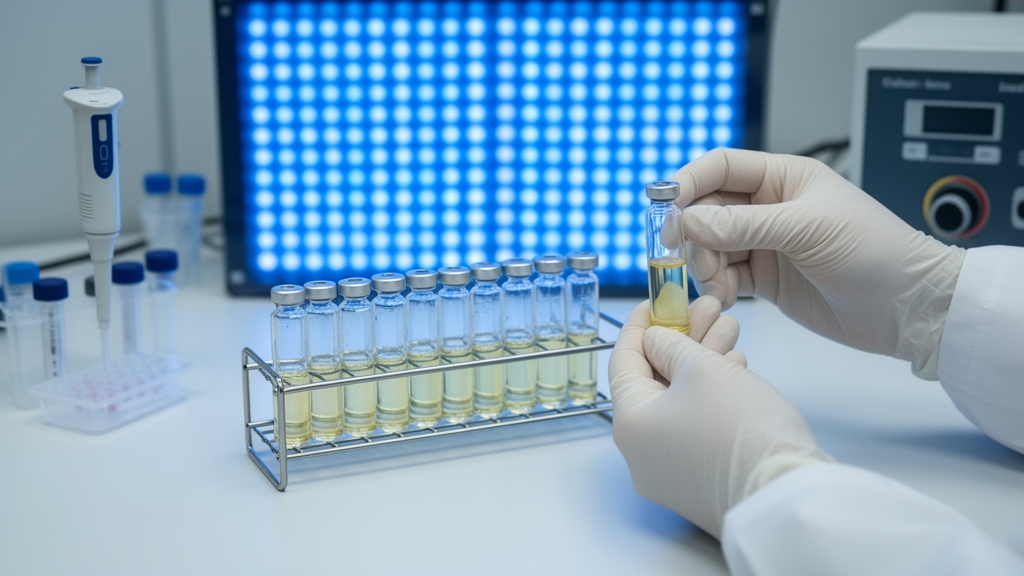
The researchers evaluated combinations of diverse γ-functionalization pyridoxal 5′-phosphate (PLP) enzymes with a panel of photocatalysts whose excited-state redox potentials span a broad range. Among the emergent reactions were a previously unknown migratory β-cross-coupling and a canonical γ-cross-coupling, divergent pathways arising from the same cooperative catalytic setup.
Building on these discoveries, the team applied directed evolution through substrate tunnel engineering. This effort afforded an orthogonal set of biocatalysts that selectively produced either branched or linear non-canonical amino acids, with further enhanced control over both the reaction pathway and the stereochemical outcome. The evolved enzymes, including GfuFub7β and GfuFub7γ, enabled divergent C(sp3)–C(sp3) cross-coupling, and the reported substrate scope extended across a range of coupling partners for this transformation.
Because the reactions couple radical photochemistry with enzyme catalysis, the authors probed how the two catalytic cycles cooperate and what determines which product branch predominates. Mechanistic and spectroscopic studies were used to investigate the reaction mechanism and the origin of the divergent activity, while computational DFT and molecular dynamics analyses examined the radical enzyme reactivity and the basis of pathway selectivity. These investigations, presented alongside the reaction development, support the picture that the enzyme’s active-site environment and the photocatalyst’s redox properties jointly shape which C–C bond is formed and with what stereocontrol.
The broader significance claimed by the authors is methodological rather than a single reaction. They argue that exploring multicatalytic cooperativity can uncover synthetically valuable and previously unrecognized enzymatic reactivity, providing a complementary approach to biocatalytic reaction discovery. Instead of predicting productive enzyme–photocatalyst combinations in advance, the screening approach allows useful reactivity to emerge from an unbiased evaluation of pairings, and directed evolution can then sharpen the selectivity of whatever new activity is found. The work appears in Nature Catalysis under the title “Multicatalytic cooperativity enables divergent photobiocatalytic C–C couplings for scaffold diversification.”
Subject of Research: Discovery of divergent photobiocatalytic C–C coupling reactions through screening of enzyme–photocatalyst pairs and directed evolution of PLP enzymes
Article Title: Multicatalytic cooperativity enables divergent photobiocatalytic C–C couplings for scaffold diversification
Article References: Zhao, L.-P., Mai, B. K., Guo, R., Cheng, L., Liu, H., Lin, K., Zhao, Y., Liu, P., & Yang, Y. (2026). Multicatalytic cooperativity enables divergent photobiocatalytic C–C couplings for scaffold diversification. Nature Catalysis. https://doi.org/10.1038/s41929-026-01629-1
Image Credits: AI Generated
DOI: 10.1038/s41929-026-01629-1
Keywords: photobiocatalysis, enzyme–photocatalyst cooperativity, pyridoxal 5′-phosphate enzymes, C–C coupling, non-canonical amino acids, directed evolution, radical enzymology, stereocontrol, Nature Catalysis, reaction discovery, Multicatalytic, cooperativity
News Source: Bethany Barker. (October 28, 2026). Enzyme–photocatalyst pairing screen uncovers divergent C–C couplings for non-canonical amino acids. Scienmag.