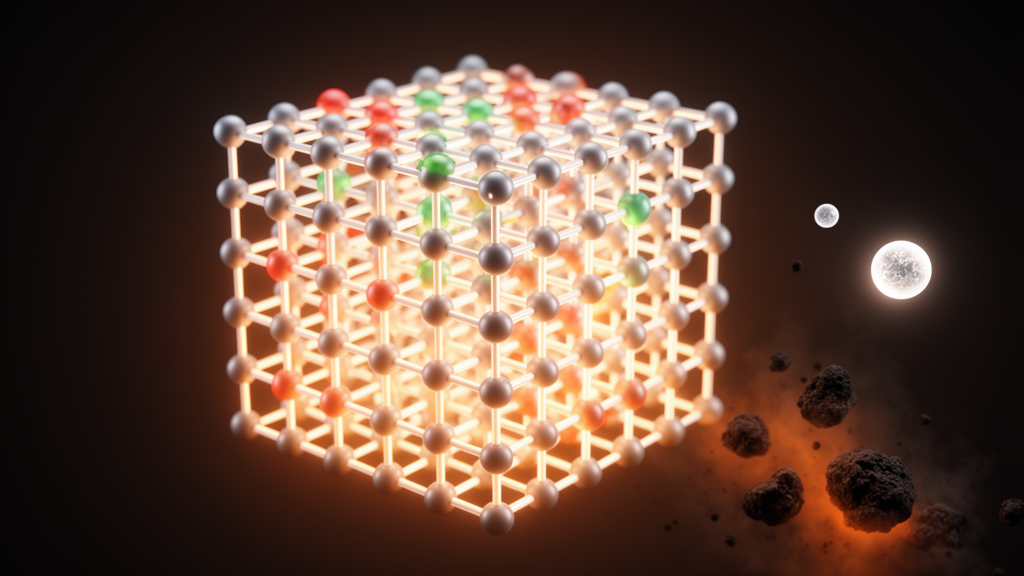
Their conclusion is deceptively simple: dopants fall into three functional classes, and only by mixing elements from different classes can designers unlock a synergy that pushes oxygen release temperatures sharply downward.
Ceria is a workhorse of catalytic combustion. Its usefulness stems from the reversible Ce4+/Ce3+ redox cycle, which lets the material store and release lattice oxygen on demand. That labile oxygen feeds reactions such as the oxidation of volatile organic compounds, the treatment of automotive exhaust and the burning of soot trapped in diesel particulate filters. The catch is that pristine CeO2 still releases its oxygen at temperatures and rates that limit performance under low-temperature conditions, so improving the oxygen release behavior of ceria-based materials has remained a central challenge in the field.
Elemental doping is the standard remedy, and the team built on a body of prior work to motivate their classification scheme. Zirconium, with its small ionic radius, introduces free volume into the lattice and compensates for the expansion that occurs when Ce4+ is reduced to the larger Ce3+ ion, a lattice-stabilization effect that facilitates further reduction. Praseodymium, by contrast, is itself reducible and directly participates in redox processes. Trivalent dopants such as lanthanum induce oxygen vacancies through charge balance, promoting oxygen diffusion. What had been missing, the authors argue, is a systematic understanding of how these roles combine, largely because conventional hydrogen temperature-programmed reduction with a thermal conductivity detector cannot distinguish the reduction of individual elements in a multi-component oxide.
To overcome that limitation, the group prepared a series of binary, ternary and quaternary oxides by substituting Ce sites with early transition metal and lanthanide cations, and characterized them thoroughly. X-ray diffraction showed single-phase fluorite solid solutions without secondary phases, with systematic peak shifts confirming substitution at cerium lattice sites by atoms of different sizes. One exception was Ce5Ti5Ox, which contained roughly 16 percent of a TiOx impurity phase that the authors report did not significantly affect its reduction behavior. Dopant fractions calculated from diffraction angles using Vegard’s law matched the expected stoichiometry, and HAADF-STEM-EDX mapping of the quaternary CePrZrSmOx sample showed uniform distribution of cerium, praseodymium, zirconium and samarium throughout the particles with compositions close to the intended formula. X-ray absorption fine structure spectroscopy confirmed that doping modified both long-range periodicity and local coordination geometry.
The three dopant categories emerged from physicochemical properties: cations with stronger intrinsic reducibility such as Pr and Tb; cations with small ionic radii such as Zr and Ti that stabilize the expanding fluorite lattice during cerium reduction; and trivalent cations such as Sm and La that induce oxygen vacancies. The optimal loading differed by class. For the reducible cations and the small-radius cations, 50 percent doping gave better oxygen release, while trivalent dopants performed best at 10 percent, because excessive vacancy formation at high loading actually diminished the overall oxygen release capacity. In every case, doped binary oxides outperformed pristine CeO2, showing lower reduction temperatures and larger released oxygen amounts.
The mechanistic core of the study came from in operando XANES-TPR, which tracked the valence of each element separately as the temperature rose. In CePrOx, the extent of cerium reduction was comparable to that of pure CeO2, but praseodymium was substantially reduced to the 3+ state, and the simultaneously measured water signal showed that lattice oxygen was genuinely released as hydrogen reacted with the oxide. In CeZrOx the opposite pattern held: zirconium itself was not reduced under the tested conditions below 700 degrees Celsius, yet cerium reduction was markedly enhanced, confirming that the small zirconium cation works by lattice stabilization rather than by direct redox participation. Trivalent dopants similarly promoted cerium reduction while remaining unreduced themselves, acting through vacancy-mediated oxygen diffusion.
The synergy test was straightforward in design: a ternary oxide counts as synergistic if its reduction temperature falls below those of both corresponding single-doped oxides. Pairing two cations from the same category, whether Pr with Tb, Zr with Ti or Sm with La, produced no such effect, and the ternary oxides behaved roughly like the average of their binary counterparts. Pairing cations from different categories, however, consistently lowered the oxygen release temperature. The authors also verified that this was not an artifact of unequal dopant concentrations: Ce4.5Pr4.5Zr1Ox, matched in composition to its binary counterparts, still reduced at a lower temperature than either Ce5Pr5Ox or Ce9Zr1Ox, and the same held for Pr-Ti, Tb-Zr and Tb-Ti combinations.
XANES-TPR revealed how the cooperation works. In CePrZrOx, praseodymium reduction was completed by 400 degrees Celsius, compared with 550 degrees in the binary cerium-praseodymium oxide, and cerium reduction was also enhanced. The large size mismatch among cerium, praseodymium and zirconium induced lattice strain and oxygen vacancies, which lowered the initial valence of praseodymium; because Pr4+/Pr3+ has a higher electrochemical reduction potential than Ce4+/Ce3+, the excess electrons from vacancy formation preferentially reduced praseodymium. The trade-off was a smaller total oxygen release amount than in the binary oxides, which is why the team found that keeping zirconium at low concentration restored a release amount of 1.3 millimoles per gram, exceeding both binary counterparts. In the praseodymium-samarium pair, trivalent samarium induced vacancies that lowered the reduction temperature of praseodymium and enhanced cerium reduction, raising the total release above either binary oxide.
Combining all three classes produced the study’s champion. The quaternary oxide CePrZrSmOx released oxygen at as low as 428 degrees Celsius with a capacity of 1.4 millimoles per gram, the lowest temperature and highest capacity among all synthesized oxides. The proposed mechanism assigns each element its role: readily reducible praseodymium contributes oxygen through its own reduction, a small amount of trivalent samarium generates vacancies that lower the reduction temperatures of both cerium and praseodymium, and small zirconium cations stabilize the crystal while the larger reduced states of cerium and praseodymium would otherwise expand the lattice. Notably, the team showed that crystal size was not the driver: oxygen release temperature stayed nearly unchanged across a crystallite range of 10 to 60 nanometers, and the best oxide actually had a relatively large 31-nanometer crystallite size and a low specific surface area of 3 square meters per gram.
Finally, the oxygen release properties translated into combustion performance. In temperature-programmed surface reactions using carbon black as a model soot under inert argon, both the combustion temperature and the amount of carbon burned correlated strongly with the oxygen release temperature and capacity of the oxides. CePrZrSmOx again led the field, igniting carbon at 346 degrees Celsius and combusting 1.21 millimoles of carbon per gram, the best values recorded. The authors are candid about limits: under loose-contact conditions, which better mimic how catalyst and soot meet in a real diesel particulate filter, the combustion peak shifted to higher temperatures and less carbon was consumed, so the tight-contact ranking may not transfer directly to practice. They also note that their classification framework was established for group 3 and 4 dopants with stable oxidation states, and that elements such as manganese and iron, which may release oxygen through different mechanisms, will require further experimental validation before the design rule can be extended to them.
Subject of Research: Rational design of ceria-based mixed oxides using dopant synergy for enhanced oxygen release and soot combustion
Article Title: Rational design of Ce-based mixed oxides via dopant synergy for enhanced oxygen release and combustion
Article References: Li, D., Zhang, F., Nakaya, Y., & Furukawa, S. (2026). Rational design of Ce-based mixed oxides via dopant synergy for enhanced oxygen release and combustion. Catal, 2(1), Article 15. https://doi.org/10.1007/s44422-026-00027-9
Image Credits: AI Generated
DOI: 10.1007/s44422-026-00027-9
Keywords: ceria, mixed oxides, dopant synergy, oxygen release, soot combustion, XANES-TPR, fluorite lattice, oxygen vacancies, catalysis, diesel particulate filters, zirconium doping, praseodymium
News Source: Bethany Barker. (October 28, 2026). Dopant synergy in ceria oxides lowers oxygen release and soot combustion temperatures. Scienmag.