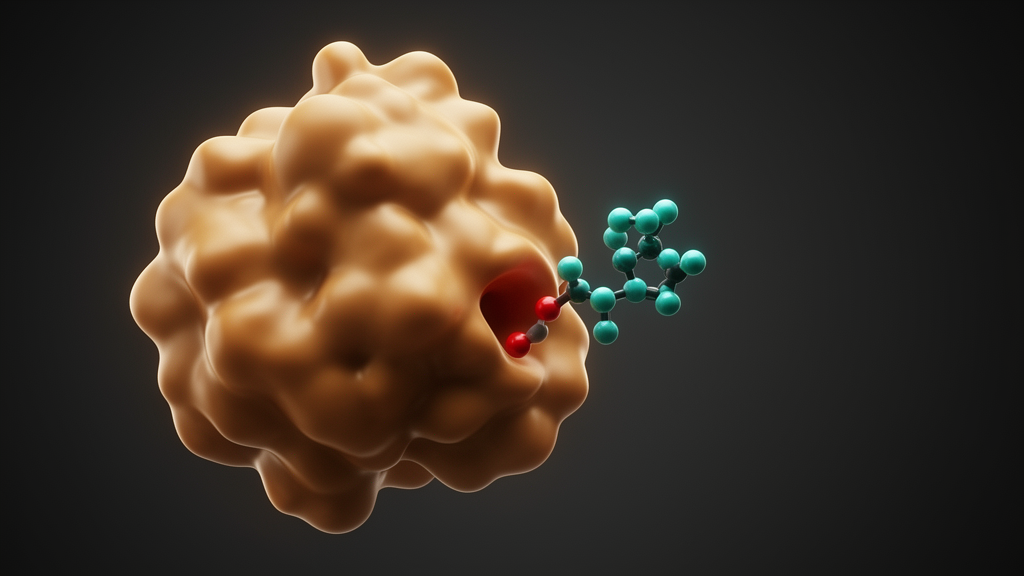
Covalent inhibitors of the cancer-driving KRAS G12C protein, including the approved drugs sotorasib and adagrasib, work by locking an electrophilic chemical group onto a mutant cysteine residue. A new computational study argues that the decisive factor in whether such a reaction can succeed is not how close a ligand’s reactive group sits to the cysteine in a static docking model, but whether that favorable geometry survives the constant thermal motion of the protein in a realistic, water-filled environment. The work, published in Discover Molecules, combines iterative ligand design, molecular docking and explicit-solvent molecular dynamics simulations to probe why most candidate ligands that look covalent-ready on a computer screen fail to stay that way once the system is allowed to move.
The research team, led by Saroj Khanal, built a library of acrylamide-containing ligands modeled on the clinically validated KRAS G12C inhibitor sotorasib. Starting from the KRAS G12C crystal structure with PDB identifier 5V9O, they generated candidate molecules using RDKit, systematically varying aromatic scaffolds, linker architectures and substituent patterns while keeping the acrylamide electrophilic warhead intact. Each round of design, labeled R1 through R18, was guided by the previous round’s docking results, with candidates evaluated on two geometric criteria: the distance between the electrophilic carbon and the sulfur atom of Cys12, and the SG–Cβ–C=O angle describing the nucleophilic attack trajectory, which should fall near the Bürgi–Dunitz geometry required for productive bond formation.
The iterative campaign produced steady but incomplete progress. Early scaffolds occupied the Switch-II pocket, the transient binding site adjacent to Cys12 that clinically approved inhibitors exploit, yet consistently pointed their electrophiles away from the reactive sulfur. A redesigned linker topology in the R4 series delivered the first meaningful improvement in cysteine accessibility, and the R5 series, built around a fluoro-phenyl anchoring motif, produced a ligand called R5_A3 that combined stable pocket occupancy with one of the closest electrophile approaches seen at that stage. Even so, R5_A3 held a non-reactive sulfur-to-electrophile separation of roughly 6.3 angstroms and formed stabilizing contacts near glycine 60 that trapped it in a non-productive orientation. Later rounds introduced cyano-acrylamide warheads and substituent-driven preorganization strategies, and the most advanced candidate, R18_A4, achieved one of the closest near-reactive docking geometries of the entire study while maintaining favorable pocket occupancy.
Crucially, none of the evaluated docking poses fully reproduced the productive covalent geometry observed in crystallographic KRAS G12C inhibitor complexes. The study’s central finding emerged when the most promising docked configurations were subjected to molecular dynamics simulations in explicit TIP3P water using the AMBER ff14SB protein force field and GAFF2 ligand parameters. Ligands that initially sat near the cysteine rapidly relaxed away from the pre-reactive geometry. Electrophile–cysteine distances grew progressively over the trajectories, with final separations typically reaching 5 to 6 angstroms and average distances well outside the reactive regime. This drift occurred even though the ligands remained bound in the Switch-II pocket, showing that a favorable docking pose does not correspond to a dynamically stable pre-reactive state.
Analysis of the cysteine sulfur’s own mobility sharpened the picture. Across the simulated trajectories, the SG atom of Cys12 fluctuated within only about 2 angstroms of its average position, a spatially restricted motion that proved insufficient to compensate for electrophile misalignment or to restore a productive attack angle once the reactive configuration had relaxed. For the R18_A4 complex specifically, the sulfur-to-electrophile distance fluctuated predominantly between 6 and 8 angstroms, and favorable attack angles and short sulfur distances were never maintained simultaneously during the trajectory. Transiently favorable orientations appeared, but the coupled distance-and-angle requirements for covalent bond formation were never satisfied at the same time.
To test whether a geometrically perfect starting configuration could survive without a covalent bond, the researchers turned to sotorasib itself as a benchmark. In the crystallographic KRAS G12C–sotorasib complex, the sulfur atom of Cys12 forms a covalent bond with the electrophilic carbon C25 of the drug at a distance of approximately 1.81 angstroms, and the reaction vector extracted from the structure was calculated as [0.5428, 0.6048, −0.5827]. The team removed the covalent linkage and ran the reconstructed non-covalent complex through explicit-solvent dynamics. The sulfur–C25 distance fluctuated between roughly 3.5 and 5.8 angstroms, and the SG–C25–C24 attack angle sampled a broad range of about 75 to 128 degrees, with only transient occupancy of Bürgi–Dunitz-like orientations. Even the clinically validated inhibitor’s reactive geometry, once the covalent bond was deleted, proved dynamically unstable under equilibrium conditions.
The researchers also manually reconstructed a sotorasib-derived ligand, placing a new electrophilic carbon along the crystallographic reaction vector approximately 2.40 angstroms from the Cys12 sulfur with an attack angle near 105 degrees. Under non-covalent dynamics this engineered geometry collapsed as well: the sulfur–carbon distance drifted to a non-reactive range of roughly 8 to 10 angstroms, and the predefined reactive threshold of less than 4 angstroms was never sampled during production dynamics. The result demonstrates that restoring a crystallographically correct electrophilic trajectory is geometrically achievable but dynamically unstable unless the ligand scaffold provides the energetic stabilization needed to hold the configuration in place.
By contrast, when an explicit covalent bond was introduced, stability returned dramatically. In the covalent KRAS–sotorasib benchmark, approximately 830 picoseconds of cumulative production sampling across 418 analyzed frames showed the SG–C25 bond distance tightly centered at an average of 1.82 angstroms, fluctuating only between 1.74 and 1.90 angstroms, with no frame exceeding 2.0 angstroms. The attack angle averaged 117.48 degrees within a range of 107.7 to 128.6 degrees, and protein backbone RMSD stayed low at roughly 0.77 angstroms. Hydrogen-bond analysis revealed only transient ligand–protein hydrogen bonds with occupancies near 0.24 percent, suggesting the complex’s stability arises primarily from covalent anchoring supplemented by hydrophobic and van der Waals contacts rather than persistent classical hydrogen bonding. A similar picture held for the covalently anchored reconstructed ligand over approximately 2 nanoseconds of production simulation, where the SG–C31 bond held at 1.844 ± 0.032 angstroms and the SG–C31–C32 angle at 119.56 ± 3.12 degrees, with low protein and ligand RMSD values confirming structural integrity throughout.
The authors are careful to frame the work as a mechanistic computational analysis rather than a drug-development pipeline. The simulations cover relatively short timescales that may miss slower conformational rearrangements or rare reactive events, no quantum mechanical treatment of transition states or activation barriers was performed, and the reconstructed ligand was designed as a mechanistic probe, not an optimized therapeutic candidate with validated synthetic accessibility, selectivity or pharmacokinetic properties. Force-field-based dynamics also approximate electronic polarization and reactive chemistry, and the authors call for QM/MM studies and experimental validation to strengthen the conclusions. Within those limits, the study argues that covalent feasibility in KRAS G12C should be treated as a dynamic property requiring simultaneous satisfaction of pocket occupancy, electrophilic trajectory preservation and thermal stabilization, and that incorporating short-timescale molecular dynamics validation and coupled distance–angle analysis into early screening could reduce false-positive docking predictions for both covalent and non-covalent KRAS inhibitor campaigns.
Subject of Research: Computational analysis of dynamic geometric constraints governing covalent inhibitor feasibility in KRAS G12C
Article Title: Dynamic geometric constraints govern covalent feasibility in KRAS G12C ligands
Article References: Khanal, S. (2026). Dynamic geometric constraints govern covalent feasibility in KRAS G12C ligands. Discover Molecules, 3(1), Article 28. https://doi.org/10.1007/s44345-026-00072-w
Image Credits: AI Generated
DOI: 10.1007/s44345-026-00072-w
Keywords: KRAS G12C, covalent inhibitors, molecular dynamics, sotorasib, docking, Switch-II pocket, Bürgi–Dunitz geometry, acrylamide warhead, drug design, computational chemistry, Cys12, explicit-solvent simulation
News Source: Bethany Barker. (October 29, 2026). Molecular dynamics show docking proximity alone cannot guarantee KRAS G12C covalent inhibition. Scienmag.