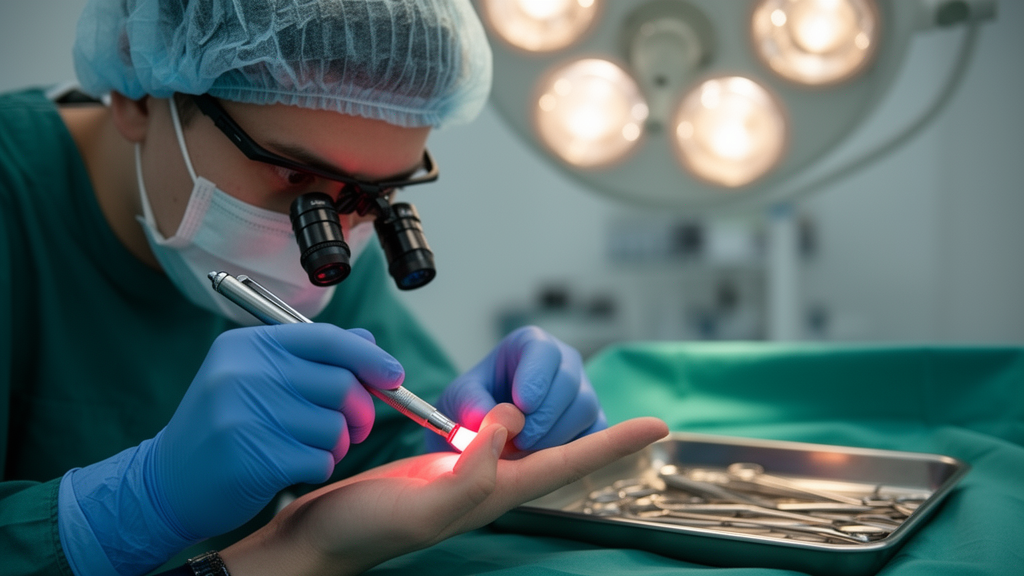
Surgeons testing a simple light-based technique have reported that shining a light through the finger during operations identified nearly nine in ten histopathologically confirmed subungual glomus tumors, according to a retrospective study published in BMC Surgery. The technique, known as intraoperative transillumination, was evaluated alongside established clinical tests and magnetic resonance imaging in a single-center series of 32 patients.
The study, led by Yavuz Önel, was a retrospective study of 32 patients who underwent transungual surgical excision between January 2024 and January 2026. All participants were over 18 years old and had at least six months of follow-up.
Every patient in the cohort received the same diagnostic workup before and during surgery. The researchers assessed the Love test, the Hildreth test, preoperative transillumination, intraoperative transillumination, and preoperative magnetic resonance imaging, and compared how often each method was positive in tumors later confirmed by histopathology.
The results showed a clear hierarchy of positivity rates. The Love test was positive in all 32 patients, at 100 percent. Preoperative magnetic resonance imaging followed at 96.9 percent, intraoperative transillumination at 87.5 percent, and both the Hildreth test and preoperative transillumination at 78.1 percent. After applying the exact McNemar test for paired binary data with Bonferroni correction for multiple pairwise comparisons, the authors reported no statistically significant differences between the diagnostic methods.
The study population had a mean age of 37.6 years with a standard deviation of 9.1 years, and 68.8 percent of the patients were women. Surgical outcomes in the cohort included a complication rate of 6.2 percent and a recurrence rate of 9.4 percent. The authors reported that no significant associations were found between demographic variables and clinical outcomes.
The appeal of transillumination lies in its simplicity and cost. The authors suggest it may represent a promising, simple, and low-cost adjunctive localization tool for surgeons excising these tumors.
However, the study’s design places firm limits on what can be concluded. Because it included only patients with confirmed glomus tumors and no disease-negative comparison group, the researchers could not calculate diagnostic accuracy measures such as sensitivity or specificity.
The authors are explicit about this boundary. In their conclusion they state that transillumination should not be considered a validated alternative to established clinical and imaging modalities, and that its diagnostic and intraoperative utility requires prospective validation. The article was published as an open-access paper on 23 October 2026, and the published version notes it is being shared early as a peer-reviewed, accepted manuscript subject to further edits before the final version of record.
The Love test and magnetic resonance imaging remain the most consistently positive methods in this cohort, while intraoperative transillumination showed a positivity rate of 87.5 percent in the same patients. Whether the technique improves surgical outcomes such as recurrence rates, which stood at 9.4 percent in this series, will require the prospective comparative studies the authors themselves call for.
Subject of Research: Intraoperative transillumination for localizing subungual glomus tumors
Article Title: Intraoperative transillumination as an adjunctive localization technique for subungual glomus tumors
Article References: Önel, Y. (2026). Intraoperative transillumination as an adjunctive localization technique for subungual glomus tumors. BMC Surgery. https://doi.org/10.1186/s12893-026-04307-y
Image Credits: AI Generated
DOI: 10.1186/s12893-026-04307-y
Keywords: subungual glomus tumor, transillumination, hand surgery, nail surgery, diagnostic tests, magnetic resonance imaging, Love test, Hildreth test, retrospective study, BMC Surgery, Intraoperative, adjunctive
News Source: Ophelia Keating. (October 28, 2026). Simple light test helps surgeons locate subungual glomus tumors during surgery. Scienmag.