


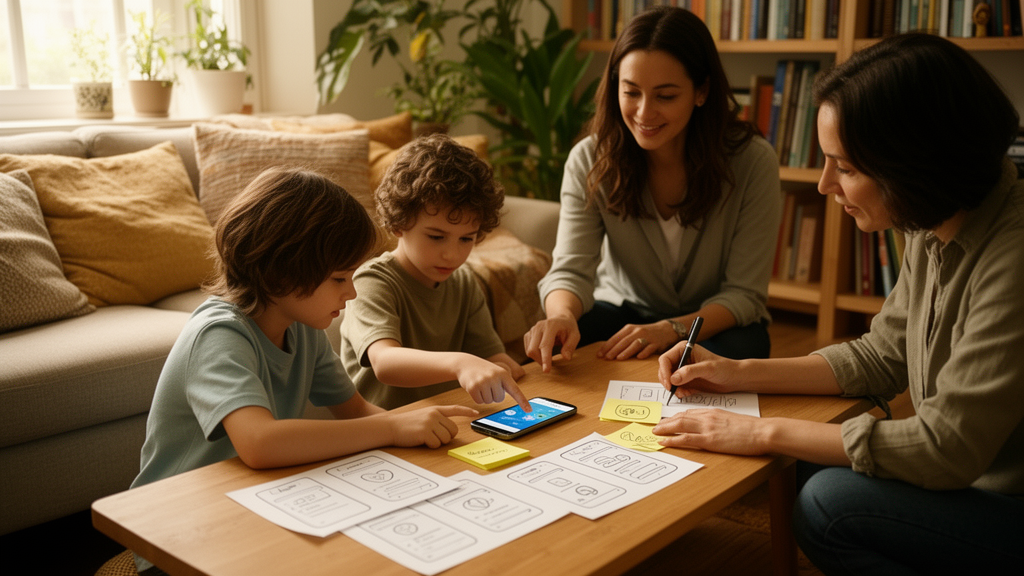
Researchers at the University of the West of Scotland have turned a paper-based school homework programme into a smartphone app by building it alongside the people expected to use it. In a co-design study published in BMC Digital Health, the team ran three rounds of iterative workshops with primary school children, teachers and parents to shape Happy Homework, a mobile health intervention designed to promote physical activity, reduce sedentary time and support healthy sleep at home. The stakeholder process surfaced eighteen distinct software enhancements that the research team had not anticipated, reshaping the app’s content, navigation, incentives and appearance before any formal testing begins.
The original Happy Homework intervention was developed in 2019 as a school-based programme of homework activities aimed at improving children’s daily activity-related behaviours, alongside key dietary behaviours such as fruit and vegetable consumption. Its physical activity tasks were informed by World Health Organization recommendations for children, which state that the majority of children’s activity should be vigorous-intensity and aerobic, with muscle- and bone-strengthening activities at least three times weekly. The first iteration also included activities to disrupt sedentary behaviour by standing or moving, to limit recreational screen time to no more than two hours per day, to achieve sufficient sleep durations of between nine and eleven hours per night, and to maintain consistent wake and bed times. While those activities were consistent with the 24-hour movement guidelines, the authors note they were not fully representative of them. The activities required no equipment or open spaces, were mapped against the Scottish Curriculum for Excellence, and were underpinned by Self-Determination Theory.
The rationale for going digital rests on a well-documented health picture. Higher levels of physical activity, lower sedentary behaviour and sufficient sleep are associated with lower adiposity, improved cardiometabolic health and reduced anxiety and depressive symptoms in children, and published guidelines recommend quantifying all three behaviours across the full 24-hour day because of their interdependence. Yet adherence to those guidelines is low, which the researchers cite as the impetus for interventions targeting all movement behaviours together. Mobile health interventions have shown promise for improving physical activity and sleep and reducing sedentary behaviour in adult populations, but evidence in children remains limited though emerging, with some improvements reported in pre-school children and modest physical activity gains, with no effects on sedentary behaviour or sleep, in broader youth samples. A preceding qualitative study by the same team, in which eleven children, eight parents and ten teachers discussed the paper-based version, had already flagged that the programme should offer age-appropriate, accessible and flexible activities, an equitable reward structure requiring minimal parental involvement, and an online or app-based format.
The study was conducted with one primary school in South Lanarkshire, Scotland, recruited in December 2024, roughly three months before the first workshop. The school sits in an area of high deprivation in an urban location, with a school roll of over three hundred children, according to Scottish Index of Multiple Deprivation data. Children were recruited from a single mixed P6/7 class, where all 27 children were eligible; adults were recruited more broadly, with all classroom teachers in the school and all parents of children in P5 to P7 invited. Purposive convenience sampling drew on an existing relationship with the school. The final participant groups comprised eleven children aged 10 to 11, with a mean age of 10.27 years, nine parents, some of them parents of participating children, and eight head teachers and classroom teachers. Children’s workshops took place in school, teachers attended in person at school, and parents met in person at the university campus at their own request.
Each stakeholder group completed three workshops between February 2025 and June 2025, with stages spaced five to six weeks apart and each session lasting roughly twenty to sixty minutes. The first two workshops focused on paper-based low-fidelity prototypes: participants reviewed activity content, design and usability, then used blank wireframe templates in a feature prioritisation exercise to propose new functions. The second round used updated prototypes reflecting the first round’s feedback. Workshop three shifted to an online, interactive version of the app, which stakeholders tested on a variety of smartphones and tablets in sessions of no longer than one hour, providing feedback on design and perceived usability and consolidating suggestions into a final minimal viable product. Teachers were asked specifically about a dashboard for monitoring pupil engagement and task completion, while parents advised on a guidance section to support children’s use of the app at home. All groups contributed to activity content. Discussions were audio recorded, transcribed verbatim and anonymised, then coded in NVivo 12 using thematic analysis with both inductive and deductive coding, deductive codes following the workshop guide questions on features, usability and engagement, and inductive codes capturing new priorities.
The initial prototype contained a landing screen, a homework activity and the avatar creation process. Feedback from the first workshops endorsed the leaderboard idea across all stakeholder groups but also called for changes to it, for updating activity content to include a clear rationale for both children and parents, and for removing the activity progress bar, which both children and parents found confusing. Overall, the paper prototypes were received positively: bright colours, user-friendly designs and a flexible task structure increased stated willingness to use the app, children expected a digital version to be more interactive than the paper format, parents valued the requirement for children to type text into each activity as making tasks more meaningful, and teachers appreciated the flexibility of no set completion day, aided by activity time estimates.
The second development sprint removed customisable avatars in favour of a bank of avatars and dropped the leaderboard feature altogether. In the second round of workshops, participants proposed adding reminders to drive engagement, a suggestion from all stakeholder groups; teachers and parents asked for a clearly identified settings menu; and stakeholders wanted a clear onboarding walk-through to explain the app layout and boost children’s engagement. Children suggested a text-to-speech feature for activities. Teachers found the activities more concise, parents judged the activity images more age-appropriate and engaging and enjoyed the inclusion of awards, and children responded well to the flame icon representing streaks, the ability to type their own responses, and the confetti celebration that appears when a new reward is earned, a function added on the developer’s own experience. The general message was that stakeholders would understand the app better once they could use it on an actual mobile device.
Workshop three tested those alterations in the online app. Despite a few initial technical bugs, the bright colours and clean, organised format were praised for usability by all stakeholders, and teachers described the app as child-friendly but not “baby-ish”, comparing it favourably with platforms they already use in schools such as SumDog and Education City. Final suggestions included navigation changes: letting children go back and view the previous week’s activities, clear signposting from activity pages back to the home screen, and improved navigation from the home screen to activity pages. Parents also suggested letting users view all available rewards or trophies to drive engagement. Assuming the suggested alterations were made, participants said they would use the app and perceived it would positively influence children’s movement behaviours.
Underpinning the content, two authors independently mapped the activities to the taxonomy of motivation and behaviour change techniques, coding each activity across 21 taxonomy categories with a binary presence-or-absence scheme. Inter-rater agreement, quantified with Cohen’s kappa, was moderate at 0.502 with a 95% confidence interval of 0.42 to 0.58, which the authors describe as reasonable but not complete consistency, with some variability in how activities were categorised. The updated content was also aligned with the Curriculum for Excellence and the 24-hour movement recommendations. Development followed an Agile approach, with the researcher and app developer discussing the technical feasibility of each round’s proposed modifications and the research team making final implementation decisions. Time and budget constraints meant some suggestions were deferred to future studies, including an in-app mascot proposed by children, integrated leaderboards allowing classrooms and schools to compete, proposed by teachers, and the ability to message class teachers, proposed by parents. Technically, the app was built in Dart using the Flutter cross-platform framework for iOS and Android, with a Firebase non-relational database server for live data storage, per-user sandboxing enforced through Firebase security rules, encryption of data both in transit and at rest, and UK-based storage repositories.
The authors conclude that stakeholder involvement was essential for identifying usability and design concerns and for outlining solutions the research team had not foreseen, and that concerns raised in the initial workshops did not reoccur after changes were made. They argue the process minimised software development waste by catching issues early, though they acknowledge limitations: participation was limited to one school, which may affect generalisability to other populations or education settings, and resource constraints meant only the most feasible and impactful features were prioritised. The app has not yet been tested for effect. The refined version will undergo formal pilot testing to evaluate user experience and feasibility, with a planned pilot trial intended to assess whether the software is fit for purpose, whether engagement can be sustained over time, and whether the app can influence physical activity, sedentary behaviour and sleep in applied settings.
Subject of Research: Co-design of a home-based mHealth app promoting 24-hour movement behaviours in primary school children
Article Title: Developing a home-based mHealth homework app for the promotion of 24-hour movement behaviours: a co-design study
Article References: Forrest, A., Buchan, D. S., Sculthorpe, N., & Robinson, S. (2026). Developing a home-based mHealth homework app for the promotion of 24-hour movement behaviours: a co-design study. BMC Digital Health, 4(1), Article 60. https://doi.org/10.1186/s44247-026-00290-9
Image Credits: AI Generated
DOI: 10.1186/s44247-026-00290-9
Keywords: co-design, mHealth, 24-hour movement behaviours, physical activity, sedentary behaviour, sleep, primary school children, Happy Homework, participatory design, app development, Self-Determination Theory, BMC Digital Health
News Source: Denise Maddox. (October 30, 2026). Children, Parents and Teachers Help Co-Design a Home mHealth App for 24-Hour Movement Behaviours. Scienmag.



