


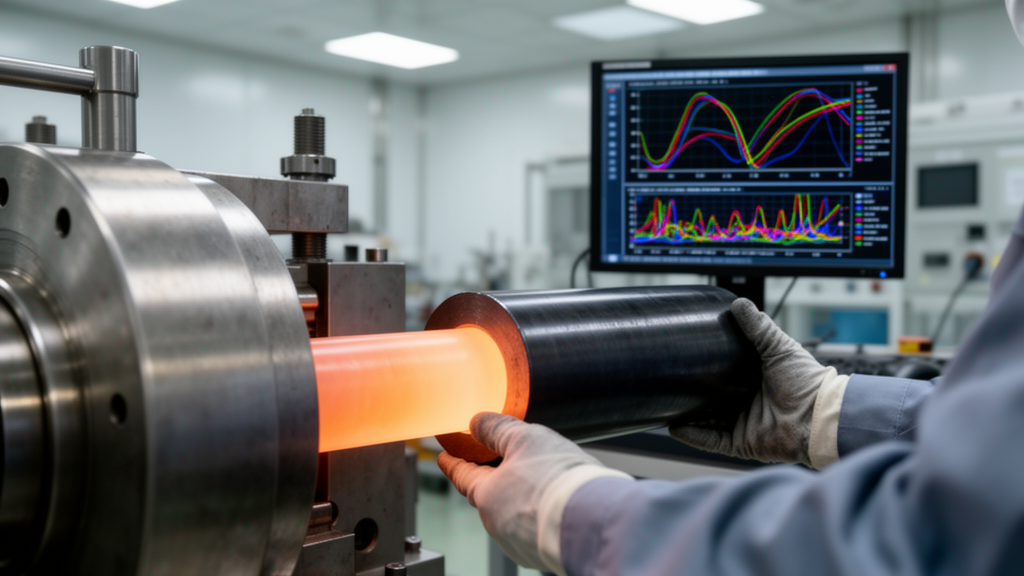
Engineers have combined statistical modelling with a genetic algorithm to squeeze more performance out of a bismuth-antimony thermoelectric alloy processed by severe plastic deformation, and the resulting recipe points to eight extrusion passes at a processing temperature of about 73.8 °C as the best compromise among competing transport properties. The work, published in Discover Mechanical Engineering, targets Bi85Sb15, an n-type alloy valued for cryogenic thermoelectric applications because its narrow band gap, high electron mobility and low thermal conductivity can deliver useful performance below roughly 200 K. Rather than testing processing conditions one at a time, the team built a framework that treats the extrusion process itself as an optimizable system.
The study integrated Response Surface Methodology based on a Central Composite Design with a Multi-Objective Genetic Algorithm executed in MATLAB R2017b. Three processing variables were varied systematically: the temperature at which thermoelectric properties are measured, the temperature of the Equal Channel Angular Extrusion (ECAE) process, and the number of extrusion passes. The responses tracked were electrical resistivity, thermal conductivity, Seebeck coefficient, power factor and the dimensionless figure of merit ZT, which governs conversion efficiency and is defined as ZT = S²T/ρk. Because the Seebeck coefficient, resistivity and thermal conductivity often move in opposing directions when processing conditions change, the researchers needed a method that could quantify those trade-offs rather than chase a single property.
The experimental design used 20 runs: eight factorial points and five replications at the center of the design, with five levels for each factor. Some theoretical design points had to be adjusted to remain physically feasible. The axial levels for processing temperature were shifted from 29.5 and 170.5 °C to 27 and 180 °C, and because fractional extrusion passes cannot be performed, the theoretical 0.54 and 7.46 passes were implemented as 1 and 7 passes. Second-order regression models were fitted for each response, and analysis of variance at a 95 percent confidence level assessed their significance. The regression p-values were 0.009813 for resistivity, 0.000004 for the Seebeck coefficient, 0.018984 for power factor, 0.000302 for thermal conductivity and 0.000624 for ZT, all below the 5 percent threshold for significance. The coefficient of determination exceeded 80 percent for every response, reaching 92 percent for resistivity, 97 percent for the Seebeck coefficient, 90 percent for power factor, 98 percent for thermal conductivity and 95 percent for ZT.
The alloy itself was synthesized by solid-state reaction, ball-milled for 60 hours at 400 rpm with a ball-to-powder ratio of 20:1 under argon, cold-compacted into billets of 13.5 × 13.5 × 60 mm³ at 55 MPa, and hot isostatically pressed at 505 K for 2 hours under 200 MPa of argon. Extrusion was then carried out on a Shimadzu 100kNXplus universal testing machine at 50, 100 and 150 °C, with the billet rotated 90 degrees around its long axis between passes along route Bc, up to seven passes, at a ram speed of 1 mm/s. The die channel angle was 90 degrees with a 1 mm fillet radius. In preliminary trials, more passes at low temperature caused cracking, while higher temperatures produced dynamic recrystallization and grain coarsening, so the investigated range represents the practically accessible regime for this brittle alloy.
Microstructural characterization supported the modelling assumptions. X-ray diffraction showed single-phase rhombohedral Bi85Sb15 without obvious impurity phases in all specimens, and scanning electron microscopy revealed that going from two to six passes broke coarse lamellar grains down to only several microns at each processing temperature. With rising temperature, grain growth and tighter stacking of fine grains occurred, and after the optimal condition the average grain size had fallen to about 5 μm after eight passes. All transport measurements were taken along the extrusion direction on bars cut parallel to it, using a ULVAC-RIKO ZEM-2 system with a low-temperature modification for resistivity and Seebeck coefficient, a TC-7000 laser flash apparatus for thermal diffusivity and specific heat, and Archimedes density measurement. The authors note that these are direction-dependent effective values rather than isotropic bulk properties, and that quantitative texture analysis was not performed, so the contribution of texture is discussed qualitatively.
The contour analysis showed distinct behaviors for each response. Electrical resistivity fell from 3.80 to 2.60 µΩ m as measuring temperature increased while responding only weakly to processing temperature, yet a strong interaction emerged between processing temperature and pass number: at low processing temperatures more passes reduced resistivity, whereas above 120 °C more passes raised it. The Seebeck coefficient, by contrast, showed nearly parallel contours indicating weak interactions, responding mainly to the main effects of measuring and processing temperature. Power factor was dominated by measuring temperature, with the highest values at high measuring and processing temperatures and a peak near 225 K at the lowest pass number. Thermal conductivity displayed non-linear interactions with an optimal region near 100–120 °C and 4–6 passes, while ZT showed a localized optimum in the processing-temperature and pass-number plane, centered around 110–130 °C and 5–6 passes in the contour geometry.
Hall measurements at 300 K added mechanistic context. Carrier concentration converged near 1.14 × 10¹⁹ cm⁻³ at 100 °C across conditions, confirming that ECAE does not substantially alter bulk carrier density; instead, the transport changes stem from microstructure. Mobility behaved non-monotonically, with the six-pass condition showing a pronounced minimum at 100 °C where accumulated defect and sub-grain boundary density maximizes carrier scattering, before recovering at 150 °C as dynamic recrystallization removed those obstacles. The authors interpret the enhanced sensitivity of the responses in the 200–230 K measuring region as a crossover regime in carrier transport, where processing-induced defect and grain-boundary scattering and acoustic-phonon scattering become comparable, not as evidence of a structural transition, since XRD confirmed the rhombohedral phase under all conditions.
The multi-objective optimization produced a Pareto front of trade-off solutions, with maximization objectives such as ZT transformed into minimization functions, so negative ZT values in the optimization output are transformed objective values rather than physically negative figures of merit. The near-optimum solution identified 73.8 °C processing temperature, eight passes and a measurement temperature of 276.7 K. Confirmation experiments at that setting measured the actual thermoelectric characteristics and compared them with the model predictions, yielding errors between 2.5 and 12.5 percent. The predicted maximum ZT of 0.32 was 12 percent higher than the experimentally measured value, a gap the authors attribute to model extrapolation beyond the fitted data rather than a failure of the approach. Fracture surfaces of the optimal sample showed equiaxial grains with tear ridges and elongated lamellae along the extrusion direction, a mixed morphology the authors describe as the microstructural basis of the optimized behavior rather than an intermediate state toward a fully equiaxed structure.
The framework has limits the authors acknowledge. The regression models were trained on data extending only to seven passes, so predictions at eight passes and beyond represent extrapolation, and more experimental data, especially over a wider thermoelectric working-temperature range, would be needed to improve model performance. The optimized microstructure, being refined, defect-rich and textured, may be thermally metastable: prolonged exposure or thermal cycling could promote defect recovery, grain growth and texture evolution, altering carrier scattering and lattice thermal conductivity, and thermal cycling could also generate thermomechanical stresses in the brittle alloy. The optimization therefore identifies favorable initial transport properties within the investigated domain rather than guaranteed long-term device stability. Compared with other Bi–Sb results, such as melt-spun Bi85Sb15 reaching ZT near 0.6 at 100–150 K or magnetically assisted single-crystal Bi88Sb12 reaching 2.6 at 100 K, the authors caution that those systems differ in composition, crystallinity and transport configuration and are not directly comparable with zero-field bulk ECAE-processed material.
What the study delivers is a reproducible, data-efficient route to process-window design. By coupling a designed experiment with surrogate models and a genetic algorithm, the team quantified main, quadratic and interaction effects across five coupled responses with only 20 experimental runs, replacing what would otherwise be a lengthy trial-and-error search through extrusion conditions. The authors position the method as a template for accelerating the development of thermoelectric materials for waste-heat recovery, solid-state cooling and decentralized power generation, where the balance between electrical transport and phonon scattering must be tuned simultaneously. For Bi–Sb alloys specifically, the result confirms that severe plastic deformation can push performance upward when pass number and processing temperature are chosen with the coupled responses in view, and that the optimal structure is a deliberately layered, defect-bearing one rather than the finest possible grain size.
Subject of Research: Data-driven multi-response optimization of ECAE-processed Bi85Sb15 thermoelectric materials using response surface methodology and a multi-objective genetic algorithm
Article Title: Data driven parametric modelling and multi response optimization of ECAE processed Bi85Sb15 thermoelectric materials
Article References: Abouhabaga, O. O., & El-Asfoury, M. S. (2026). Data driven parametric modelling and multi response optimization of ECAE processed Bi85Sb15 thermoelectric materials. Discover Mechanical Engineering, 5(1), Article 199. https://doi.org/10.1007/s44245-026-00394-6
Image Credits: AI Generated
DOI: 10.1007/s44245-026-00394-6
Keywords: thermoelectric materials, Bi85Sb15, ECAE, severe plastic deformation, response surface methodology, genetic algorithm, figure of merit, power factor, grain refinement, multi-objective optimization, ANOVA, cryogenic cooling
News Source: Neil Sanderson. (October 30, 2026). Data-driven model finds optimal extrusion recipe for Bi85Sb15 thermoelectric alloy. Scienmag.



