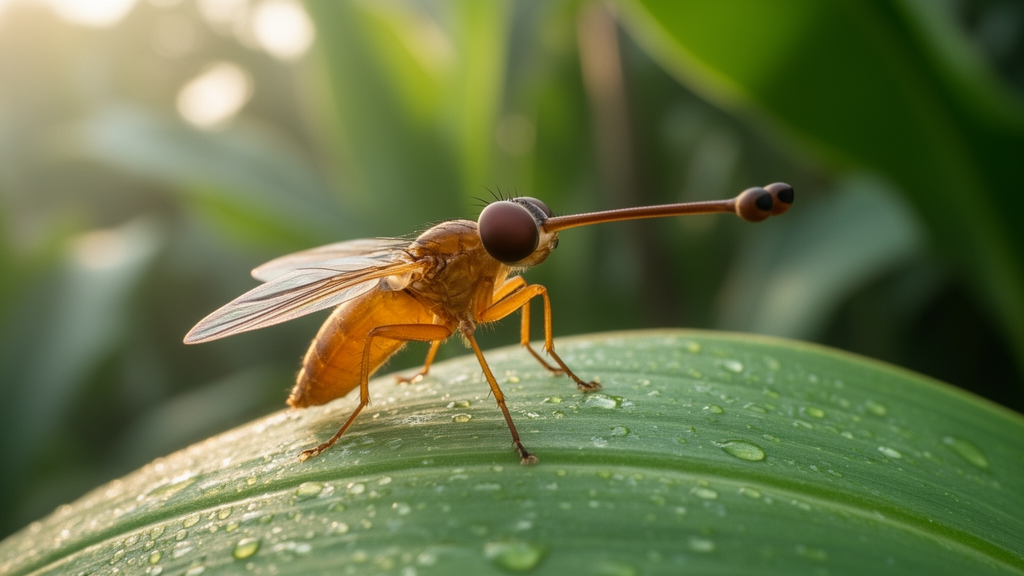
Such ornaments are often assumed to carry a cost, because extra width should raise rotational inertia and make rapid turns harder. Yet a new study reports that these elaborate structures do not come at the price of escape performance when the flies face a simulated predator.
Researchers from the University of Colorado Denver and the College of Charleston tested whether ornament size and compensatory morphology influence how stalk-eyed flies evade threats. They quantified evasive behavior and flight performance by measuring reaction time, changes in velocity, and the curvature of flight trajectories. Each individual was categorized by response type, yaw versus non-yaw, by sex, and by compensation status based on its position relative to the relationship between eyespan and wingspan.
The flies proved remarkably quick. They initiated escape responses within approximately 82 milliseconds of the simulated predator interaction, and they frequently performed yaw-turn maneuvers, rapid rotations that redirect the flight path.
The ornament itself showed no measurable penalty. Males in the study exhibited approximately 41 percent greater eyespan than females, a difference that might be expected to hinder their aerial agility. Despite this, escape performance did not differ between the sexes.
Compensation also appeared to do its job. In stalk-eyed flies, wing and thorax morphology can shift to offset the biomechanical burden of long eyestalks, and the researchers sorted flies into groups according to how their wingspan scaled with their eyespan. These compensation groups differed in ornament size relative to wing size, but they exhibited little difference in escape performance.
Response type appeared to be associated with the centrifugal force generated by the flight trajectory prior to the predator interaction, suggesting that the way a fly was already flying may have shaped which evasive maneuver it could execute.
The findings add a twist to a long-standing question in sexual selection: how animals can evolve exaggerated traits without paying a locomotor price.
The study, published in Frontiers in Ethology, was conducted as original research on stalk-eyed flies under laboratory conditions with a simulated predator, so it captures evasive responses to an artificial stimulus rather than encounters with real hunters. Within that scope, the results indicate that sexual ornamentation in stalk-eyed flies does not impair predator evasion, and that the mechanics of the flight path leading into an encounter may matter more than the ornament itself.
Subject of Research: Predator evasion and flight performance in stalk-eyed flies with sexually selected eyestalk ornaments
Article Title: Sexual ornaments do not impair predator evasion in stalk-eyed flies
Article References: Acakpo, C. J., Pehl, K., Swallow, J. G., & Vance, J. T. (2026). Sexual ornaments do not impair predator evasion in stalk-eyed flies. Frontiers in Ethology, 5, 1978275. https://doi.org/10.3389/fetho.2026.1978275
Image Credits: AI Generated
DOI: 10.3389/fetho.2026.1978275
Keywords: stalk-eyed flies, sexual selection, ornaments, predator evasion, flight performance, compensatory morphology, eyestalks, reaction time, yaw turns, biomechanics, Sexual, impair
News Source: Drew Townsend. (October 28, 2026). Big Eyes, Fast Escapes: Stalk-Eyed Flies Keep Their Edge. Scienmag.