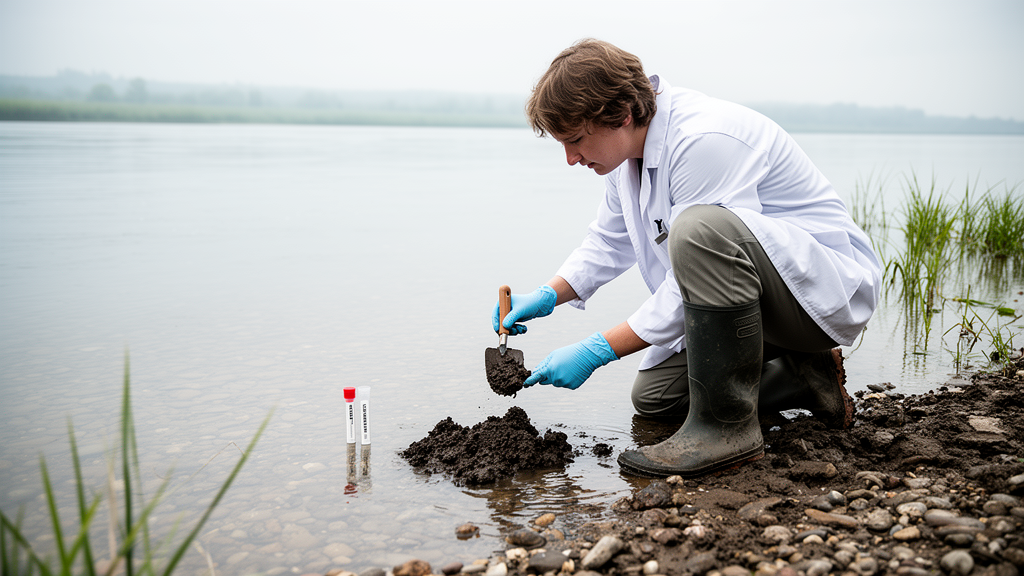
Scientists have identified a previously unknown bacterial species from the sediment of the Fenhe River Basin in China, proposing the name Acinetobacter fenheensis for the freshwater-dwelling microorganism. The discovery, published in Annals of Microbiology, is based on a single strain designated FR7-9ᵀ, which was isolated from river sediment and characterized through a combination of classical microbiological tests, chemotaxonomic profiling, and whole-genome sequencing.
Under the microscope and in culture, the new organism presented a familiar Acinetobacter profile: it is Gram-stain-negative, non-motile, and shaped as a short rod. Notably, it is facultatively anaerobic, meaning it can grow with or without oxygen. Laboratory testing showed that the strain tolerates a broad range of conditions, growing at temperatures from 10 to 40 degrees Celsius, at pH values between 5.0 and 9.5, and in the presence of up to 8.0 percent sodium chloride by weight.
Determining whether an isolate truly represents a new species requires more than appearance and growth behavior. The research team turned to genome-based phylogenetics, an approach that compares large sets of genes rather than a handful of markers. Using single-copy orthologous proteins across the genus Acinetobacter, they built a genus-wide phylogenomic tree. The analysis placed strain FR7-9ᵀ within the genus Acinetobacter but on its own independent branch, most closely related to Acinetobacter zhairuonensis, Acinetobacter kanungonis, and Acinetobacter tibetensis, yet clearly distinct from each of them.
The draft genome itself provided further evidence. It consists of 40 contigs totaling 3,332,809 base pairs, with a DNA guanine-plus-cytosine content of 42.1 percent. To quantify how different the new strain is from known species, the researchers calculated average nucleotide identity and digital DNA–DNA hybridization values against selected reference type strains. Both metrics are standard yardsticks for bacterial species boundaries, and the results were decisive: identity values ranged from 75.0 to 84.0 percent, and hybridization values from 20.6 to 26.7 percent, all well below the accepted thresholds for membership in the same species.
Chemotaxonomic features reinforced the picture. The major cellular fatty acids were C16:0, C18:1 ω9c, and summed feature 3, a pattern consistent with the genus. The dominant polar lipids were phosphatidylethanolamine, phosphatidylglycerol, and diphosphatidylglycerol, and the respiratory quinones were identified as Q-8 and Q-9. Taken together with the phylogenomic data and genome relatedness figures, these phenotypic and chemical characteristics support the formal description of a novel species, for which the name Acinetobacter fenheensis sp. nov. is proposed. The type strain has been deposited in multiple culture collections as FR7-9ᵀ (= CICC 25278ᵀ = MCCC 1K08999ᵀ = KCTC 8398ᵀ).
Beyond taxonomy, the genome analysis offered a functional glimpse into what this sediment dweller might be capable of. These findings are descriptive: the presence of such genes indicates potential metabolic capacity, and the authors position the genome as a baseline for further investigation rather than a demonstration of ecological function in the field.
The genome also carried multiple putative antimicrobial-resistance determinants, dominated by genes linked to efflux, the cellular machinery that pumps compounds out of the cell. Importantly, these are predicted resistance-associated loci identified by sequence annotation, not experimentally measured resistance phenotypes. Still, the genomic context was striking: several of these resistance-associated loci were located near genes annotated as transposase-, recombination-, plasmid-, or phage-associated. Such neighborhoods hint at possible mobility of these determinants, a pattern of interest to microbiologists studying how resistance traits move through bacterial communities, though the study did not demonstrate transfer.
The authors note that members of the genus Acinetobacter occur widely in aquatic and sedimentary habitats, yet the taxonomic diversity and genomic features of freshwater sediment-associated lineages remain incompletely characterized.
As with any description based on a single isolate, the findings represent one strain from one location. The authors frame the genome as a taxonomic and functional starting point for future work on nutrient-acquisition and resistance-associated traits in freshwater sediment Acinetobacter, rather than a conclusion about the ecology or public-health significance of the organism. The article was published as an open-access original article on 29 September 2026, and is being shared early as a peer-reviewed, accepted version subject to further edits before the final version of record.
Subject of Research: Taxonomic description and genomic characterization of a novel Acinetobacter species from freshwater river sediment
Article Title: Acinetobacter fenheensis sp. nov., isolated from freshwater sediment of the Fenhe River Basin, China: polyphasic characterization and genomic analysis
Article References: Gao, K., & Zhang, G. (2026). Acinetobacter fenheensis sp. nov., isolated from freshwater sediment of the Fenhe River Basin, China: polyphasic characterization and genomic analysis. Annals of Microbiology. https://doi.org/10.1186/s13213-026-01880-8
Image Credits: AI Generated
DOI: 10.1186/s13213-026-01880-8
Keywords: Acinetobacter, taxonomy, new species, freshwater sediment, genomics, phylogenomics, Fenhe River, antimicrobial resistance, polyphosphate, China, fenheensis, isolated
News Source: Violet Maxwell. (October 28, 2026). New Acinetobacter species found in freshwater sediment of China’s Fenhe River. Scienmag.