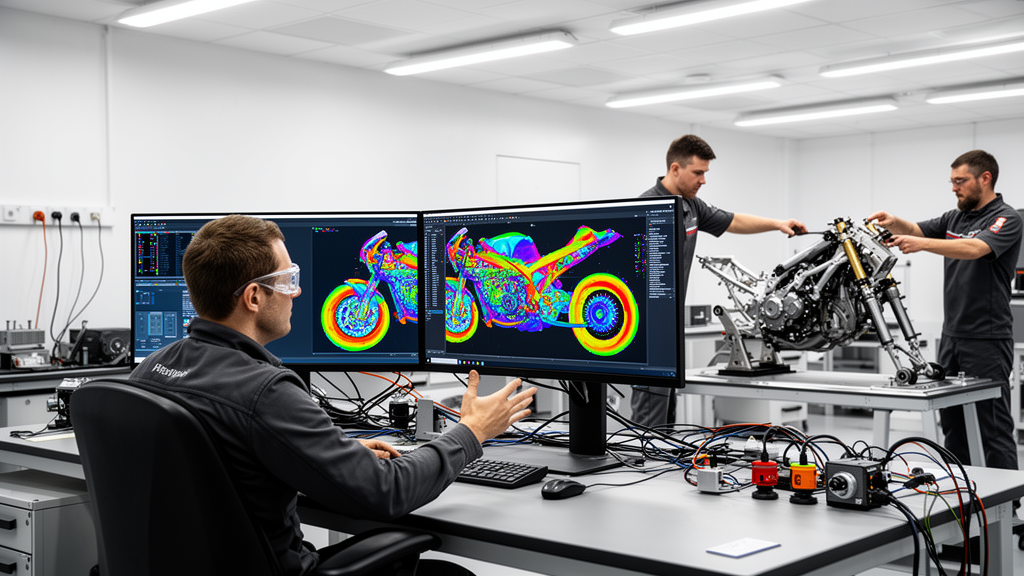
Motorcycle riders face a risk of dying in a crash that is 20 to 40 times higher than that of car occupants per distance travelled, and roughly 28 percent of all road traffic deaths worldwide—around 250,000 each year—involve two-wheeler riders. A new open-access study published in Discover Vehicles on 29 September 2026 argues that the missing ingredient is not another isolated gadget but a unified functional-safety architecture, adapted from the automotive standard ISO 26262 and the SOTIF methodology, that ties together sensing, prediction, rider warnings and automated emergency response into a single traceable system for powered two-wheelers.
The study, led by Sudhakar Hallur with Bettahalli Veeranna Gajendra, responds to a well-documented gap. Previous research indicates that 35 percent of multi-vehicle crashes involving powered two-wheelers occur because the rider takes no evasive action, and poor braking contributes in 43 percent of cases where riders did attempt to avoid a collision. In the United States, 5,968 motorcyclists died in crashes in 2022, accounting for 22 percent of all driver fatalities and the highest figure recorded since 1975. In India, two-wheelers were involved in 44.5 percent of all fatal accidents in 2021 while making up about 75 percent of the registered vehicle population—a disparity the authors use to justify choosing dense South and Southeast Asian mixed traffic as their primary design context.
The proposed architecture is organised into five layers. A sensing layer combines a 200-hertz inertial measurement unit, a 30-frames-per-second forward-facing camera and 10-hertz short-range radar with smart-helmet sensors. Raw streams are pre-conditioned—camera pseudo-ranges are derived by flat-ground homography and smoothed over three frames, radar returns are amplitude-gated with a two-metre nearest-neighbour association gate, and IMU biases are removed before a 20-hertz low-pass Butterworth filter—then fused by an Extended Kalman Filter. The EKF produces a state vector containing vehicle speed, lean angle, yaw rate, lateral acceleration and estimated time-to-collision, the quantities on which everything downstream depends.
On top of that fused state sits an LSTM neural network for collision prediction. The network consumes a 40-timestep sequence of fused states sampled at 20 hertz, corresponding to a two-second observation window, and outputs a collision probability. An alert fires when the probability reaches 0.70. The authors justify the choice of LSTM over 1D-CNN, GRU and transformer alternatives on grounds of temporal modelling capability, data availability and the prospect of real-time implementation on a motorcycle ECU, while explicitly declining to claim universal superiority and flagging cross-architecture benchmarking as future work. When the alert triggers, a rider-intervention layer delivers visual alerts, haptic helmet feedback, forward collision warnings and pre-crash braking advisories, designed so that rider input always overrides system commands within 50 milliseconds.
The fifth layer handles the aftermath. Post-crash detection relies on the resultant three-axis acceleration from the IMU: a crash candidate is registered only when acceleration reaches or exceeds 3 g and stays above that threshold for at least 150 milliseconds, a persistence requirement meant to filter out potholes and aggressive but non-crash manoeuvres. Once a crash is confirmed, the system retrieves GPS position and generates an SOS message over GSM. In simulation, automated notification latency averaged 2.4 seconds, compared with an estimated 8 to 12 minutes for manual notification reported in earlier research—a delay that matters because late medical intervention is known to worsen injury outcomes.
Quantitatively, the framework was evaluated across six canonical urban scenarios, each run 200 times with randomised initial conditions, for a total of 1,200 Monte Carlo trials in a MATLAB/Simulink and CarSim co-simulation environment. The system achieved a mean collision detection rate of 88 percent (standard deviation 3.1 percent), a false alarm rate of 5.4 percent (standard deviation 1.2 percent), a mean time-to-collision alert margin of 2.19 seconds (standard deviation 0.34 seconds), and an average reduction in simulated impact speed of 32.7 percent (standard deviation 4.8 percent). Impact-speed reduction was modelled with a 0.8-second rider reaction delay followed by 4.5 m/s² deceleration. The cut-in and pedestrian scenarios produced the largest reductions, at 38.7 and 41.3 percent respectively.
The results are not uniformly rosy, and the authors are unusually candid about it. In the S5 rain and low-visibility scenario, camera signal-to-noise degradation dragged the detection rate down to 82.5 percent—below the 85 percent target—raised the false alarm rate to 7.6 percent, above the 7 percent ceiling, and shortened the TTC margin to 1.97 seconds, just under the 2.0-second requirement. The team treats this as a residual limitation of camera-dependent perception rather than hiding it inside the aggregate figures, and points to greater reliance on radar, adaptive sensor-confidence weighting and real adverse-weather training data as remedies. Sensor fusion itself held up well: lean-angle estimation error was 1.8 degrees root-mean-square (2.7 degrees in rain), within the 3-degree bound cited for safety-relevant instability detection, and TTC estimation error was 0.14 seconds.
The functional-safety scaffolding is arguably the paper’s central contribution. A Hazard Analysis and Risk Assessment assigns Automotive Safety Integrity Levels to defined hazards: failure to warn of an imminent collision (H9) receives ASIL C, and failure to transmit a timely post-crash notification (H10) receives ASIL D. Notably, the authors state that these ASILs are deliberately elevated above what the standard ISO 26262 severity-exposure-controllability risk graph would yield—a conservative, framework-level allocation reflecting the fact that a rider has no crash structure, restraint system or airbag to mitigate a sensing or control failure. The simulation results are presented as verification evidence for selected safety goals under simulated conditions, explicitly not as ISO 26262 compliance or product certification.
The limitations section is equally forthright. All evaluation is at Fidelity Level 2, meaning everything runs in software validated against published motorcycle dynamics data, with no physical hardware in the loop. The 5,400 synthetic training sequences and the 1,200 evaluation trials are entirely artificial; traffic agents follow statistical car-following models rather than real sensor logs; a single representative rider profile was used despite documented inter-individual variability; sensor placement is idealised; and the 2.4-second notification latency ignores real-world network congestion, GSM handover delays and GPS cold-start. The authors also estimate a possible 5 to 12 percent drop in detection accuracy under domain shift when the synthetic-trained model meets real sensor inputs, and up to 1.2 additional false alerts per 100 kilometres from the G-force classifier misreading aggressive manoeuvres.
What the study delivers, then, is a structured blueprint rather than a proven product: a HARA-derived, ASIL-traceable, dual-stage pre-crash and post-crash architecture whose novelty, by the authors’ own account, lies in safety-driven integration and traceability rather than in any individual EKF, LSTM, IMU, camera, radar, GPS or GSM technology. Hardware-in-the-loop testing, instrumented-motorcycle trials and on-road validation are designated as the necessary next steps before any of the simulated performance figures can be generalised to production specifications. Until then, the framework stands as a methodological template for bringing formal functional-safety discipline—long standard in passenger cars—to the most vulnerable vehicles on urban roads.
Subject of Research: A simulation-based functional safety framework for powered two-wheelers integrating sensor fusion, LSTM collision prediction and automated emergency response
Article Title: A multi-layer functional safety framework integrating sensor fusion predictive collision detection and intelligent emergency response for powered two-wheelers in urban traffic
Article References: Hallur, S., & Gajendra, B. V. (2026). A multi-layer functional safety framework integrating sensor fusion predictive collision detection and intelligent emergency response for powered two-wheelers in urban traffic. Discover Vehicles, 2(1), Article 45. https://doi.org/10.1007/s44465-026-00047-8
Image Credits: AI Generated
DOI: 10.1007/s44465-026-00047-8
Keywords: powered two-wheelers, functional safety, ISO 26262, sensor fusion, Extended Kalman Filter, LSTM, collision prediction, emergency response, Monte Carlo simulation, ASIL, motorcycle safety, urban traffic
News Source: Denise Maddox. (October 28, 2026). Simulation framework brings ISO 26262-style functional safety to motorcycles. Scienmag.