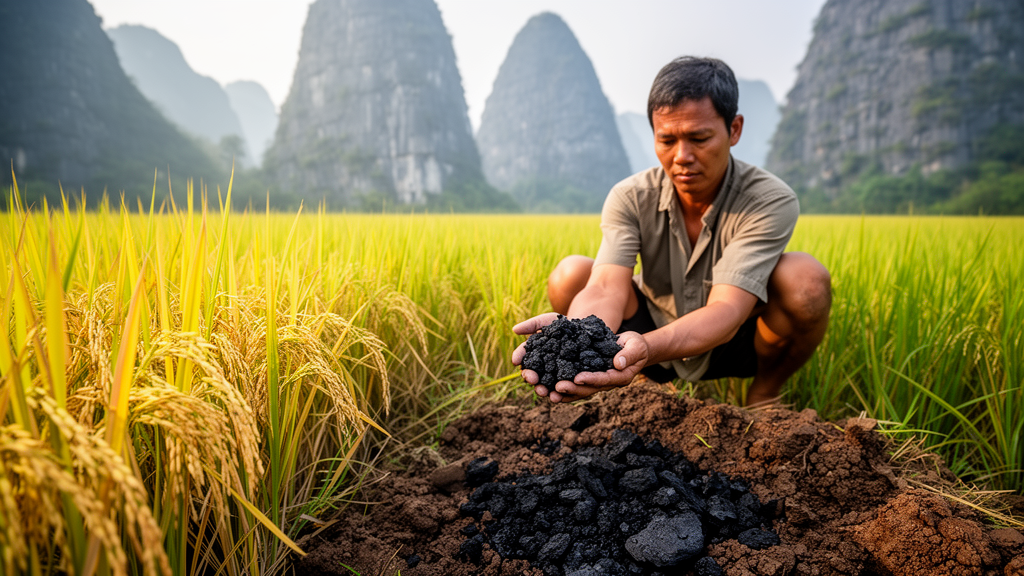
In a limestone-derived rice paddy in Southwest China, where the soil naturally carries both a problematic heavy metal and a scarce essential nutrient, a two-season field trial has shown that carefully engineered biochar mixtures can do two jobs at once: lock cadmium away from the rice grain while pulling selenium into it. The study, published as open access research in the journal Biochar, reports that three biochar-based amendments reduced cadmium accumulation in rice grains by 42.3 to 85.4 percent across two growing seasons, while raising grain selenium by 91.6 to 357.5 percent. The work addresses a stubborn agricultural dilemma in karst landscapes, where the same geological processes that enrich soils with toxic cadmium also enrich them with selenium that plants struggle to take up.
The region under study is a classic karst watershed, a landscape shaped by the dissolution of soluble carbonate bedrock such as limestone. Cadmium and selenium both occur as impurities in the non-acid-soluble fraction of limestone, and as the rock weathers into soil these insoluble elements remain in place and concentrate during pedogenesis. The result is soil that exceeds global averages for both elements: the experimental field had a cadmium concentration of 0.51 milligrams per kilogram, above the Chinese national standard of 0.4 milligrams per kilogram for rice paddies, and a naturally elevated selenium concentration of 5.61 milligrams per kilogram. The soil was slightly acidic, with a pH of 5.8, and classified as an Anthrosol. The site sits in a major rice-growing region with a subtropical monsoon climate, about 1,790 millimeters of annual precipitation and a mean annual temperature of 20.9 degrees Celsius.
The geochemistry of the two elements points in opposite directions in acidic soils, and the researchers exploited that divergence. Cadmium, a positively charged cation, is highly mobile under acidic conditions and readily enters rice roots. Selenium, by contrast, exists mainly as an anion and is poorly mobile in acid soils, which is why selenium-rich geology does not automatically translate into selenium-rich food. The team reasoned that an amendment raising soil pH and adding reactive surfaces could simultaneously precipitate and adsorb cadmium while shifting selenium into more soluble, plant-available forms. Dietary selenium deficiency, sometimes called hidden hunger, affects more than one billion people worldwide, and modeling studies cited in the paper estimate that 66 percent of global croplands could lose 8.7 percent of their selenium under climate change, with atmospheric selenium deposition in the Northern Hemisphere projected to fall by 55 to 80 percent by the end of this century.
Three amendments were formulated to represent distinct immobilization pathways. BC-Clay combined corncob biochar pyrolyzed at 300 degrees Celsius, which preserves oxygen-containing surface functional groups, with the 2:1 clay mineral palygorskite and lime (CaO) in a 4:3:3 mass ratio, targeting surface complexation of cadmium. BC-Manure paired cow manure biochar pyrolyzed at 700 degrees Celsius with dried cow manure and CaO at 3:4:3, betting on both complexation and precipitation from ash components. BC-ZVI, the most expensive option, mixed high-temperature rice husk biochar with zero-valent iron and MgO at 5:2:3, adding iron-mediated co-precipitation and reductive stabilization to physical adsorption on the high-surface-area char. All materials were milled to pass a 2-millimeter sieve and applied once, on April 3, 2023, to the top 20 centimeters of soil at rates of 5, 10, and 20 tonnes per hectare.
The trial followed a randomized block design with three replicates per treatment, each plot measuring 4.5 by 2 meters and separated by raised ridges to prevent cross-contamination. A locally common rice variety, Wanqianxiangzhan, was transplanted for an early season harvested on July 7 and a late season harvested on October 23. Because no fresh amendment was added before the second season, the late-season results reflect the residual and aging behavior of the materials rather than a renewed dose. Standard NPK compound fertilizer at 0.75 tonnes per hectare was applied each season. Soil and grain samples were analyzed by ICP-MS after microwave digestion, with a certified rice reference material yielding cadmium and selenium recoveries of 96.8 to 101.1 percent and 92.1 to 96.4 percent, respectively.
The headline result is a clean decoupling of the two elements. Cadmium in water leachates, measured with a standardized batch extraction applied identically to both elements, fell by 25.9 to 62.4 percent after amendment, while selenium leaching rose by 36.0 to 267.0 percent. In grain, cadmium dropped by 44.3 to 79.0 percent in the early season and 42.3 to 85.4 percent in the late season, and selenium rose by 93.7 to 211.1 percent early and 91.6 to 357.5 percent late. Yields climbed as well, by an average of 29.7 to 69.2 percent, an effect the authors attribute to the nutrient-releasing and carbon-supplying properties of biochar, palygorskite, and manure. A negative correlation between cadmium and selenium accumulation in grains emerged, and similar trends appeared when the team compiled literature data for corn, rape, and wheat under various management strategies.
Timing separated the three formulations. BC-ZVI at 10 or 20 tonnes per hectare was the only treatment to push grain cadmium below the national safety threshold of 0.2 milligrams per kilogram in the very first season, and it held that performance in both seasons. BC-Clay at 20 tonnes per hectare also cleared the threshold in season one, but BC-Clay and BC-Manure needed the second season to reach comparable cadmium performance at all application rates, consistent with a slower activation of exchange sites through weathering. The authors suggest this reflects different mechanisms: iron-mediated sorption and co-precipitation act quickly, whereas mineral-organic composites require prolonged aging. Notably, higher application rates did not reliably improve cadmium immobilization; raising BC-Manure from 5 to 10 tonnes per hectare actually produced slight increases in water-extractable cadmium, possibly because fresh organic matter released dissolved organic carbon that mobilized the metal.
Soil chemistry explained much of the pattern. Every treatment raised soil pH, moving the field from acidic toward near-neutral conditions, and pH changes correlated significantly with both cadmium immobilization and selenium mobilization. Liming is well known to precipitate cadmium as hydroxides, carbonates, and phosphates, while rising pH can oxidize insoluble selenium species into more soluble oxyanion forms. Cation exchange capacity and available phosphorus also emerged as key correlates: higher CEC favored cadmium retention through cation exchange, and available phosphorus both precipitated cadmium as sparingly soluble phosphate minerals and competed with selenium oxyanions for ligand-exchange sites on mineral surfaces, displacing selenium into solution. Most treatments left total organic carbon largely unchanged, though BC-ZVI at 10 tonnes per hectacre significantly increased the TOC pool, apparently by suppressing positive priming of native soil carbon that the less stable manure-derived materials induced.
Importantly, all grain selenium concentrations stayed below the upper limit of 0.30 milligrams per kilogram set by the Chinese national standard for selenium-rich grains, staying within the recommended 0.04 to 0.30 range and avoiding toxicity concerns, a relevant point given selenium’s narrow window between deficient intake, below 40 micrograms per day, and toxic levels above 400 micrograms per day. The trial grains surpassed average selenium contents reported for rice from various countries and matched levels in rice sold in China with selenium-enriched labels, all without any artificial selenium spiking by soil application or foliar spray. The authors also report that limestone from the region has geometric mean concentrations of 0.419 milligrams per kilogram of cadmium and 0.790 milligrams per kilogram of selenium, underscoring that total co-enrichment in soil does not predict the mobile or plant-accumulated pools of the two elements.
The study’s practical economics differ sharply among the options. BC-Clay and BC-Manure cost roughly 110 and 75 US dollars per tonne respectively and rely on widely available feedstocks, while BC-ZVI costs about 550 dollars per tonne and depends on an industrially supplied iron component that may constrain scale-up. The authors recommend BC-Clay or BC-Manure for moderately contaminated soils applied well ahead of transplanting, reserving BC-ZVI for cases requiring rapid first-season immobilization, while cautioning that its reactive iron phase may deplete and need periodic replenishment. The findings carry clear limits: the trial ran at a single site and soil type over two seasons, and the synergy may not transfer to karst soils with different lithology or cadmium-to-selenium ratios. The authors call for multi-year monitoring of amendment persistence, economic and life-cycle assessment, trials across contrasting soils, and investigation of microbial community responses before the strategy is generalized.
Subject of Research: Biochar-based soil amendments for simultaneous cadmium immobilization and selenium mobilization in a geogenically enriched karst rice paddy
Article Title: Field application of biochar-based amendments for safe crop production in karst paddy with a high geological background: Unraveling Cd-Se dynamics
Article References: Zhou, P., Xu, Y., Guo, J., Huang, C., Su, R., & Hou, D. (2026). Field application of biochar-based amendments for safe crop production in karst paddy with a high geological background: Unraveling Cd-Se dynamics. Biochar, 8(1), Article 143. https://doi.org/10.1007/s42773-026-00657-1
Image Credits: AI Generated
DOI: 10.1007/s42773-026-00657-1
Keywords: biochar, cadmium, selenium, karst soil, rice paddy, soil remediation, food safety, heavy metals, soil pH, field trial, biofortification, Southwest China
News Source: Alan Morgan. (October 28, 2026). Biochar Blends Cut Cadmium and Boost Selenium in Karst Rice. Scienmag.