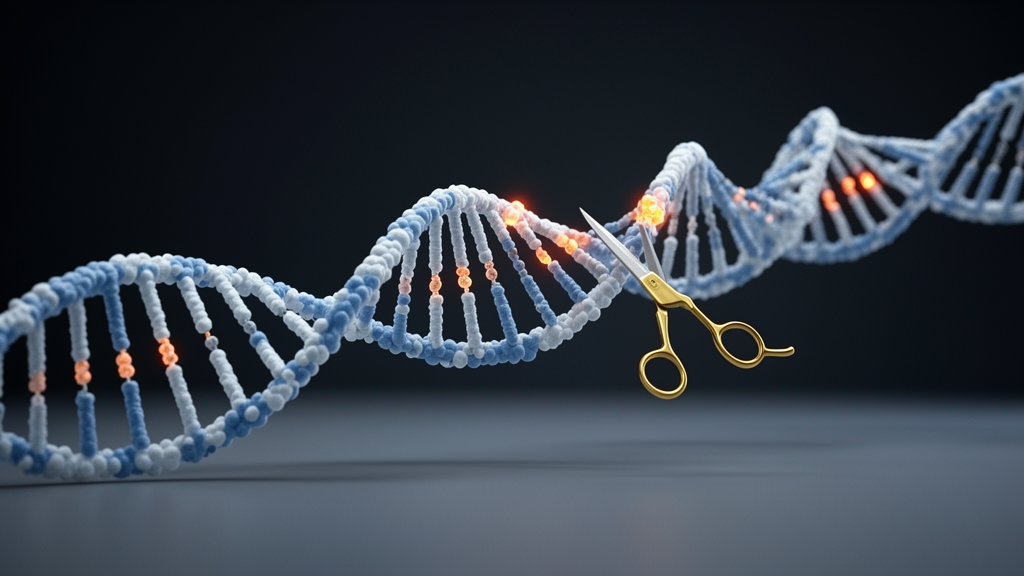
The first CRISPR-based medicine is already in patients, but the unintended edits it may leave behind in the genome remain the field’s most stubborn safety problem. Its central message is sobering: the safety framework built around the first approved CRISPR drug cannot simply be transplanted onto the wave of newer editing platforms now heading toward the clinic.
The clinical stakes crystallised in December 2023, when the US Food and Drug Administration approved Casgevy, the first CRISPR-based medicine. The therapy targets the BCL11A erythroid enhancer to reactivate foetal haemoglobin in sickle cell disease and transfusion-dependent beta-thalassaemia. Its regulatory approval established an extensive off-target characterisation framework that now functions as a reference standard for subsequent programmes. As additional CRISPR therapies advance through clinical development across haematological, metabolic, cardiovascular and ocular indications, the requirements for robust and standardised off-target surveillance will continue to expand.
The molecular basis of off-target cleavage begins with how Cas9 finds its targets. The protein transiently samples PAM-containing sites along DNA, and once it locates one, it compares the adjacent sequence with its guide RNA, starting from the PAM-proximal seed region. Mismatch tolerance is not evenly distributed: the roughly eight to twelve nucleotides immediately adjacent to the PAM are least permissive, and single substitutions there reliably abrogate cleavage. Positions farther from the PAM are more forgiving, and combinations of mismatches confined to that region can still permit efficient cutting. G:U wobble pairs are tolerated more readily than other mismatches because of their geometric similarity to canonical Watson-Crick pairs, and RNA or DNA bulges can be accommodated in some structural configurations.
Chromatin adds another layer of complexity. Tightly compacted heterochromatin restricts Cas9 binding and cleavage at many potential sites, meaning an identical guide RNA can display substantially different off-target profiles depending on the epigenomic state of the target cell. Histone modifications, DNA methylation patterns and transcription factor occupancy all modulate Cas9 binding kinetics at candidate off-target sites. This dependency has direct consequences for preclinical safety testing: off-target events characterised in transformed cell lines may not faithfully reflect the profile seen in primary patient-derived cells, where the tissue-specific chromatin landscape may differ substantially.
Beyond small insertions and deletions, a growing body of evidence documents large structural variations arising from CRISPR-Cas9 nuclease activity, including kilobase- to megabase-scale deletions, complex chromosomal rearrangements and translocations between on-target and off-target break sites. Standard short-read sequencing, which underlies most current detection workflows, is poorly suited to identifying such events, which require long-read approaches or targeted structural variant assays. The genotoxic potential of these large events, particularly if they disrupt tumour suppressor loci or create oncogenic fusions, is disproportionate relative to their frequency. One study found that base editors and prime editors generate large DNA deletions at roughly 20-fold lower frequency than conventional Cas9 nucleases, a practical consideration when choosing an editing modality where minimising genotoxicity is a priority.
Computational prediction serves as the first-pass filter in safety assessment, but the review stresses that two functionally distinct categories of tools are often conflated. Exhaustive genomic search tools such as Cas-OFFinder enumerate all candidate sites matching a guide sequence within specified mismatch or bulge tolerances; their output is a ranked list of candidates, not a prediction of cleavage efficiency. Predictive scoring models, from early linear regression approaches through gradient-boosted models like Azimuth to deep learning architectures such as DeepCRISPR, which incorporates epigenomic features, assign cleavage probabilities using learned feature sets. Systematic profiling studies find that roughly 97 percent of detectable off-target cleavage occurs at sites with fewer than five mismatches from the guide, which is why mismatch tolerance thresholds of three or four mismatches capture most experimentally detected events.
Yet no current deep learning model has demonstrated robust cross-platform generalisation, meaning reliable performance on off-target data generated by assay types or cell contexts substantially different from those in the training set. Training datasets assembled from heterogeneous experimental assays, cell types and guide libraries contain inconsistencies that propagate into predictions. Models trained on human cell line data perform poorly when applied to primary patient-derived cells, non-model organisms or plant species. Class imbalance in training data makes accurate prediction at the low-activity end of the distribution unreliable, and most tools were developed for SpCas9 and do not readily extend to Cas12a, Cas13 or newer orthologues. A false-negative prediction, the failure to flag an active off-target site, represents the most consequential error type in a clinical safety assessment.
Experimental detection provides the empirical complement. Biased methods such as deep amplicon sequencing can push detection thresholds below 0.1 percent with sufficient read depth, and droplet digital PCR offers absolute quantification at nominated sites with sensitivity in the range of 0.01 to 0.1 percent. Unbiased genome-wide methods paint a fuller picture: GUIDE-seq integrates short oligonucleotide tags into break sites in living cells and detects events down to roughly 0.1 percent, though it depends on transfection efficiency; CIRCLE-seq and Digenome-seq work on purified DNA in vitro and may overestimate sites cleaved in a cellular context; DISCOVER-seq exploits recruitment of the DNA repair protein MRE11 to breaks and works without introducing an exogenous tag, making it more applicable to primary cells. CAST-seq was designed specifically to detect chromosomal translocations arising from simultaneous breaks at on-target and off-target sites, filling a gap left by assays focused on isolated indel detection.
On the mitigation side, engineers have produced a series of high-fidelity Cas9 variants, including SpCas9-HF1, eSpCas9, HypaCas9 and SuperFi-Cas9, that reduce non-specific DNA contacts, though all may show reduced on-target activity at certain sequences. Guide RNA design offers an accessible lever: truncated 17- to 18-nucleotide guides reduce off-target activity with acceptable on-target efficiency, and chemical backbone modifications improve nuclease resistance and alter duplex kinetics. Base editors and prime editors avoid double-strand breaks altogether, but they introduce their own off-target categories, including bystander editing within the activity window and transcriptome-wide RNA editing by tethered deaminases. Cas13 systems, which target RNA, exhibit collateral cleavage activity that depends strongly on enzyme expression level, target transcript abundance and delivery format rather than being a fixed property of the platform.
Delivery adds a tissue-level dimension that the review argues has received insufficient attention. Standard lipid nanoparticle formulations show strong liver tropism, and broad-tropism viral vectors can reach the heart, skeletal muscle and dorsal root ganglia, where nuclease expression makes on-target editing an off-target event by intent. Biodistribution studies in animal models have detected viral vector genomes in gonadal tissue after systemic administration, raising the question of inadvertent germline modification, and transient delivery formats reduce but do not eliminate that risk. The review closes by calling for standardised detection workflows, expanded structural variation surveillance and safety characterisation extended to the full diversity of editing platforms now approaching clinical use, warning that the framework established for ex vivo haematopoietic editing will not transfer intact to in vivo, non-haematopoietic or non-DSB editing contexts.
Subject of Research: Off-target effects in CRISPR-based genome editing and their implications for gene therapy safety
Article Title: Navigating off-target effects in CRISPR-based genome editing for safer gene therapies
Article References: Bhardwaj, A. (2026). Navigating off-target effects in CRISPR-based genome editing for safer gene therapies. Discover Genetics and Evolution, 72(1), Article 4. https://doi.org/10.1007/s00294-026-01339-y
Image Credits: AI Generated
DOI: 10.1007/s00294-026-01339-y
Keywords: CRISPR, off-target effects, gene therapy, Cas9, base editing, prime editing, genome editing safety, structural variation, Casgevy, guide RNA, lipid nanoparticles, epigenome editing
News Source: Juliet Wilcox. (October 28, 2026). CRISPR gene therapies face a reckoning with off-target genome edits. Scienmag.