Enzymes are fragile workhorses. They catalyze reactions across the chemical, pharmaceutical, food, and energy industries, but free enzymes tend to lose activity when temperatures rise, when pH drifts, or when someone tries to fish them out of a reaction mixture for another round. Their material, described in the journal Discover Polymers, kept full catalytic activity below 80 °C and across pH 6 to 8, and retained more than 70 percent of its activity after 20 reuse cycles in a homogeneous medium and 10 cycles in a heterogeneous one.
The design is deliberately hierarchical, operating at two length scales simultaneously. They confirmed the coating worked by measuring hydrodynamic diameter and surface charge: bare magnetic nanoparticles averaged about 477 nanometers in diameter, while the alginate-wrapped versions swelled to roughly 740 nanometers, consistent with a polymer layer forming around each core. The zeta potential, a measure of surface charge, flipped from +12.8 millivolts for the bare particles to −17.1 millivolts after encapsulation, a shift the authors attribute to negatively charged carboxylate groups on alginate appearing at the particle surface. That negative charge also improves colloidal stability, keeping particles from clumping together in suspension.
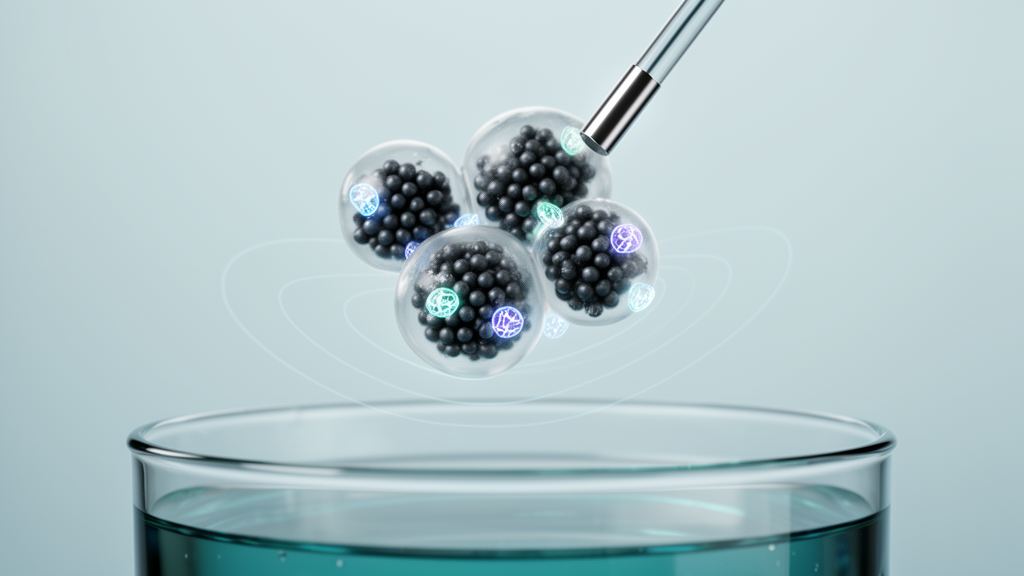
The result is a dual-scale architecture: a magnetic core wrapped in nano-alginate, embedded with the enzyme inside a second, larger alginate microsphere. The researchers call this a nano-in-micro composite, and the point of the nesting is separation. Direct contact between enzymes and nanoparticle surfaces can partially denature proteins or block active sites, so the inner alginate layer acts as a physical buffer between the two.
Immobilization yields ranged from 89.6 to 96.9 percent across all systems, with the highest yield going to the nano-microstructured material. More striking was the activity measurement. The nano-microstructured, lyophilized biocatalyst reached more than 4000 units per gram, compared with 1437 units per gram for the free enzyme reported in the group’s earlier work and a dismal 0.7 units per gram for enzyme immobilized in an alginate matrix with magnetic particles at the microscale alone.
The authors attribute that leap in activity to more than just enzyme loading. The dual alginate layers, they argue, create a controlled diffusional barrier that minimizes destabilizing contact between enzyme and magnetic surface while keeping the active site accessible to substrate. The hierarchical structure also increases effective surface area and, in the lyophilized form, forms a more compact matrix that resists enzyme diffusion out of the support. Magnetic nanoparticles add mechanical rigidity, reducing molecular mobility of the trapped enzyme and helping it resist partial denaturation during reactions. The team is careful to frame this as a probable mechanism rather than a proven one, but the performance data are consistent with it.
Thermal and pH testing reinforced the picture. All the Yarrowia lipolytica lipase systems showed maximum activity between 30 and 40 °C, but their fates diverged above that. Alginate-only systems dropped below 40 percent relative activity at 70 °C, while systems containing magnetic particles held 60 to 80 percent up to 80 °C. The nano-microstructured lyophilized formulation was the standout, staying above 80 percent relative activity across 30 to 70 °C. On the pH side, all samples peaked between pH 7 and 8. Under acidic conditions from pH 3 to 5, alginate-only systems fell to 30 to 50 percent activity, whereas the nano-microstructured lyophilized system stayed above 60 percent. In alkaline conditions, the micro and nano-micro systems retained 80 to 90 percent activity while the alginate-only control dropped to around 70 percent.
Reusability is where the architecture really earns its keep. In repeated lipase reaction cycles, the nano-microstructured system maintained over 70 percent relative activity after 20 cycles. By contrast, enzyme encapsulated in alginate alone collapsed sharply after the fourth cycle, which the authors suggest may reflect rupture of the alginate walls that hinders catalyst recovery. Systems with bare magnetic nanoparticles mixed in held moderate activity to roughly the tenth cycle.
The resulting lyophilized biocatalyst achieved an immobilization yield of 97.3 percent with an amylolytic activity of 3649 units per gram. Its optimum activity spanned 30 to 80 °C and pH 6 to 8, and it held more than 70 percent relative activity even under harsher conditions at 80 °C and across pH 3 to 5. In 90-minute stability tests, the immobilized enzyme retained 100 percent of its activity between 30 and 70 °C and across pH 6 to 8, dropping to 75 percent at 80 °C, 60 percent at 90 °C, and 35 percent at 100 °C. At pH 3 it preserved at least 35 percent of its activity after 90 minutes.
Even under these harsher conditions, the biocatalyst maintained over 70 percent relative activity after 10 reuse cycles, compared with roughly 70 percent after 20 cycles in the homogeneous starch hydrolysis assay. The authors note that heterogeneous systems typically impose more severe conditions that accelerate enzyme inactivation, making the sustained performance across cycles particularly notable.
What the study ultimately demonstrates is that polymer organization, not exotic chemistry, can govern the stability, recyclability, and efficiency of a biocatalyst. The authors position the dual-layer composite as a structured catalytic microreactor in which polymer-controlled interfaces modulate mass transport and shield the enzyme from its own magnetic support. Compared with literature reports of alginate-immobilized enzymes that managed five to nine reuse cycles or lost activity above 60 to 70 °C, the hierarchical design extends both the thermal window and the operational lifetime. The datasets behind the study are available from the corresponding author on reasonable request, and the work was published as an open-access article on 22 September 2026.
Subject of Research: Hierarchical alginate-based magnetic nanoparticle-in-microparticle composites that protect and recycle immobilized enzymes
Article Title: Polymer-engineered hierarchical magnetic nanoparticle-in-microparticle composites as protective catalytic microenvironments for recyclable biocatalysis
Article References: dos Santos Horta, M. K., da Cunha Pariz, T. F., dos Santos, T. C., da Silva Santos, E. C., Finotelli, P. V., Amaral, P. F. F., De Paula Cabral Silva, L., da Silveira Lomba Sant´Ana Coutinho, A. C., & Martins, M. G. (2026). Polymer-engineered hierarchical magnetic nanoparticle-in-microparticle composites as protective catalytic microenvironments for recyclable biocatalysis. Discover Polymers, 3(1), Article 27. https://doi.org/10.1007/s44347-026-00069-1
Image Credits: AI Generated
DOI: 10.1007/s44347-026-00069-1
Keywords: alginate, magnetic nanoparticles, enzyme immobilization, biocatalysis, lipase, amylase, reusable catalysts, nano-in-micro composites, thermal stability, pH stability, Yarrowia lipolytica, Attenuzyme
News Source: Neil Sanderson. (October 28, 2026). Alginate-wrapped magnetic nanoparticles shield enzymes for 20-cycle reuse. Scienmag.