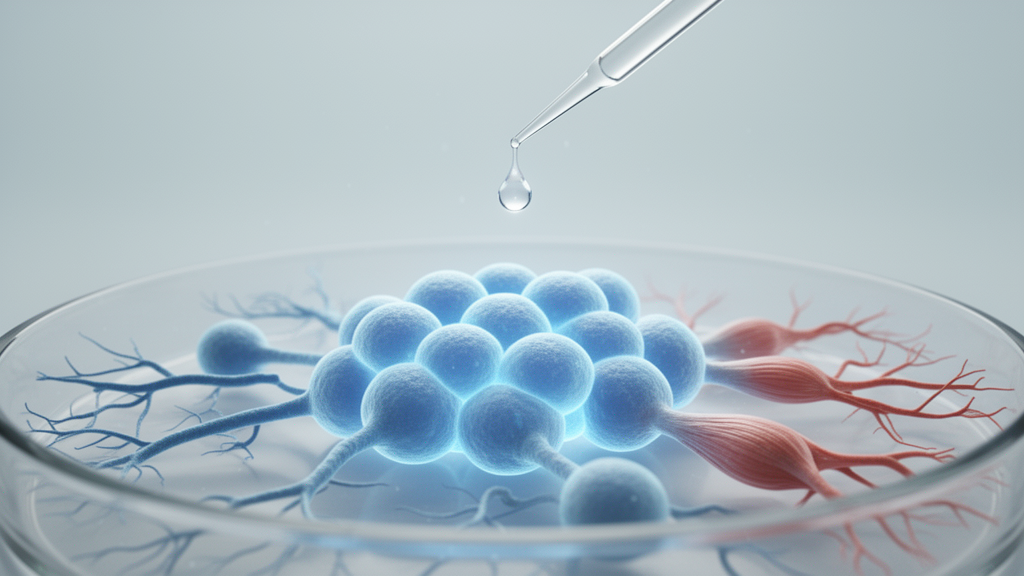
Researchers have developed a reprogramming strategy that produces human induced pluripotent stem cells (iPSCs) with markedly improved ability to differentiate into mesodermal and endodermal lineages, including pancreatic endocrine beta-like cells. The method, described in a Report published in Cell Regeneration on 21 October 2026, adds a transient ten-day treatment with a culture condition called 4CL during the reprogramming of human peripheral blood mononuclear cells (PBMCs). The resulting cells, which the team calls 4CL-primed iPSCs, retain the core features of conventionally generated iPSCs while showing consistently higher yields of lineage-specific cells in directed differentiation assays.
iPSCs are generated from somatic cells by reprogramming and share with embryonic stem cells an unlimited capacity for in vitro proliferation and the potential to differentiate into cell types from all three germ layers. Because they can be derived from a patient’s own cells, they are considered promising resources for regenerative medicine, disease modeling, and drug discovery. Yet a persistent obstacle has limited their utility: iPSC lines vary widely in differentiation capacity, and a subset of clones carries defects that undermine their reliability. Previous work documented undifferentiated cells persisting during neural differentiation, with transplantation into immunodeficient mice producing teratomas, and similar differentiation defects have been observed during hematopoietic differentiation. At the molecular level, aberrant transcriptional and epigenetic patterns, primarily abnormal DNA methylation, have been detected in such lines and are regarded as reprogramming errors.
These quality problems carry practical consequences. Extensive validation is needed before clinical application to minimize the effects of such interfering factors, which substantially increases the cost of translating iPSC-based therapies. While early studies attributed line-to-line heterogeneity to genetic background, subsequent research showed that the reprogramming method itself influences the quality and stability of the resulting cells. That observation opened the door to modifying the reprogramming process in ways that improve the final product rather than simply screening clones after the fact.
One influential precedent is the transient-naive-treatment, or TNT, reprogramming strategy, which inserts a transient naive-state step into conventional reprogramming. The TNT step mimics the global DNA demethylation that occurs during early embryonic development, a stage involving an epigenetic reset, and it enhanced the differentiation capacity of hiPSCs derived from diverse cell types while correcting epigenetic memory and aberrations. The concept behind both TNT and the new work is that transient exposure to an earlier pluripotent state during reprogramming can drive more complete epigenetic resetting and yield higher-quality iPSCs. Over the past decade, distinct pluripotent states, including naive, primed, formative, and totipotent-like states, have been captured and cultured, each with distinct epigenetic profiles, and transitions between these states are accompanied by epigenetic remodeling.
The 4CL culture condition, the basis of the new strategy, has previously been shown to promote a totipotent-like, 8-cell embryo-like state from primed pluripotent stem cells, representing an even earlier developmental stage than the naive state. After twelve days of 4CL treatment of primed pluripotent stem cells, a few cells exhibit characteristics of totipotent-like, 8-cell-like cells. The team hypothesized that incorporating a transient 4CL treatment during reprogramming itself could promote more thorough epigenetic resetting than conventional methods. They therefore designed a protocol in which PBMCs, electroporated with four episomal reprogramming plasmids and expanded briefly in hematopoietic culture medium, were switched on day six either to standard reprogramming medium for five days or to 4CL medium for ten days before being moved to standard pluripotency medium for colony outgrowth. The complete reprogramming process takes approximately twenty-five to thirty days, and colony counts of roughly ten to fifteen colonies per million PBMCs were comparable between the 4CL-primed and conventional approaches.
The characterization began with the fundamentals. The researchers generated and screened four independent iPSC lines for each group and observed consistent trends across all lines, then selected two representative lines with robust growth for in-depth validation. Both conventional and 4CL-primed lines showed identical morphology and expressed the core pluripotency genes OCT4, NANOG, and SOX2 by qRT-PCR, with some line-to-line variation, and immunofluorescence confirmed robust OCT4 and NANOG protein expression in both groups. Karyotype analysis showed that both lines maintained a normal karyotype even after more than thirty passages, indicating genetic stability during long-term culture. Pluripotency was further confirmed functionally: embryoid body formation assays produced normal embryoid bodies of comparable size in both groups, qRT-PCR of nine-day embryoid bodies revealed robust differentiation toward all three germ layers, and teratoma formation in immunodeficient mice showed derivatives of all three germ layers on histological examination.
The differences emerged in directed differentiation. When the cells were pushed toward mesoderm, immunofluorescence showed that 4CL-primed iPSCs generated a significantly higher proportion of T-positive cells, and flow cytometry with intracellular staining for the transcription factor T confirmed the result. qRT-PCR showed significantly higher expression of the mesodermal genes EOMES, MIXL1, and T, along with markedly lower expression of the pluripotency genes OCT4, NANOG, and SOX2, in the 4CL-primed group. Definitive endoderm differentiation told a similar story. Conventional iPSCs retained a substantial number of OCT4-positive cells after differentiation, while 4CL-primed cells expressed the endodermal marker FOXA2 more efficiently, produced a marked increase in CXCR4-positive/SOX17-positive double-positive cells by flow cytometry, and showed higher FOXA2 and SOX17 expression with lower OCT4 and SOX2 by qRT-PCR. Ectoderm differentiation, by contrast, showed no significant difference between the groups in the percentage of PAX6-positive cells by either quantitative immunofluorescence or flow cytometry, although the images suggested more homogeneous PAX6 expression in the 4CL-primed derivative cultures.
The most demanding test was pancreatic lineage differentiation, a multi-stage protocol proceeding from definitive endoderm through pancreatic progenitor, pancreatic endoderm, and mature beta-like cell stages. At the pancreatic progenitor stage, 4CL-primed iPSCs produced more PDX1-positive cells with a more homogeneous distribution, and qRT-PCR confirmed significant upregulation of PDX1. Differentiated cells co-expressed PDX1 and NKX6-1, and quantitative analysis confirmed that the percentage of PDX1-positive and NKX6-1-positive cells was significantly higher in the 4CL-primed group, with qRT-PCR showing significant changes in pancreatic endodermal gene expression including PDX1, NKX6-1, NGN3, PTF1A, P48, and CK19. At the final stage, immunofluorescence showed that 4CL-primed iPSCs produced more cells co-expressing C-peptide, a functional beta-cell marker, and NKX6-1. qRT-PCR revealed significantly higher expression of key beta-cell transcription factors including INS, GCG, NGN3, NKX6-1, PDX1, PAX4, GLUT2, ISL1, NEUROD1, CK19, and AMY2A, and lower expression of the delta-cell transcription factor SST, compared with conventional iPSCs. Across every stage of the same protocol, the 4CL-primed cells generated a higher number of target-positive cells.
The authors are careful about what these results do and do not establish. Although 4CL-primed cells showed increased expression of pancreatic and beta-cell markers including C-peptide and NKX6-1, marker expression alone does not establish functional identity or maturity. Functional validation, particularly glucose-stimulated insulin secretion assays and quantitative measurement of insulin and C-peptide release, will be essential to assess whether the beta-like cells actually work like beta cells. The current characterization relied on immunofluorescence, flow cytometry, and qRT-PCR, which do not capture the global transcriptomic landscape; RNA sequencing is identified as a critical next step. The mechanistic explanation also remains a hypothesis: the team proposes that the transient 4CL treatment facilitates more complete epigenetic resetting, including more thorough DNA demethylation and erasure of residual somatic epigenetic memory, consistent with the association between 4CL and an early pluripotency state resembling the 8-cell embryo stage, a period of global epigenetic remodeling. But whether the improvement truly reflects erasure of aberrant epigenetic memory such as abnormal DNA methylation requires genome-wide epigenetic profiling, for example whole-genome bisulfite sequencing and ATAC-seq, which the authors list as important future work.
Within those limits, the study delivers a practical advance. The 4CL-primed strategy produces iPSCs that match conventional lines in reprogramming efficiency, morphology, proliferation, pluripotency marker expression, and karyotypic stability, yet differentiate more efficiently and homogeneously into mesodermal and endodermal lineages, with pancreatic differentiation as the flagship application. As additional early pluripotency states, such as extended pluripotent stem cells with bidirectional developmental potential and totipotent-like 8-cell-like cells, continue to be identified, the authors note that testing whether incorporating those conditions into reprogramming protocols can further improve iPSC quality remains an open question. For now, the work offers researchers studying mesodermal and endodermal differentiation, particularly pancreatic lineage differentiation, a cell source that appears to convert more completely and uniformly into the cells they need.
Subject of Research: A modified reprogramming strategy for generating human induced pluripotent stem cells with improved mesodermal and endodermal differentiation capacity
Article Title: A novel strategy to generate human iPSCs with enhanced mesodermal and endodermal differentiation capacity
Article References: Zhang, M., Zheng, R., Wang, Y., Wen, J., Xu, J., Xiao, D., Cheng, Y., Wang, L., Cao, W., Gao, Y., & Cai, C. (2026). A novel strategy to generate human iPSCs with enhanced mesodermal and endodermal differentiation capacity. Cell Regeneration, 15(1), Article 32. https://doi.org/10.1186/s13619-026-00306-9
Image Credits: AI Generated
DOI: 10.1186/s13619-026-00306-9
Keywords: induced pluripotent stem cells, reprogramming, 4CL-primed strategy, epigenetic resetting, mesoderm differentiation, endoderm differentiation, pancreatic beta-like cells, regenerative medicine, pluripotency, TNT reprogramming, cell therapy, diabetes research
News Source: Drew Townsend. (October 27, 2026). Transient early-pluripotency treatment yields human iPSCs with stronger differentiation. Scienmag.