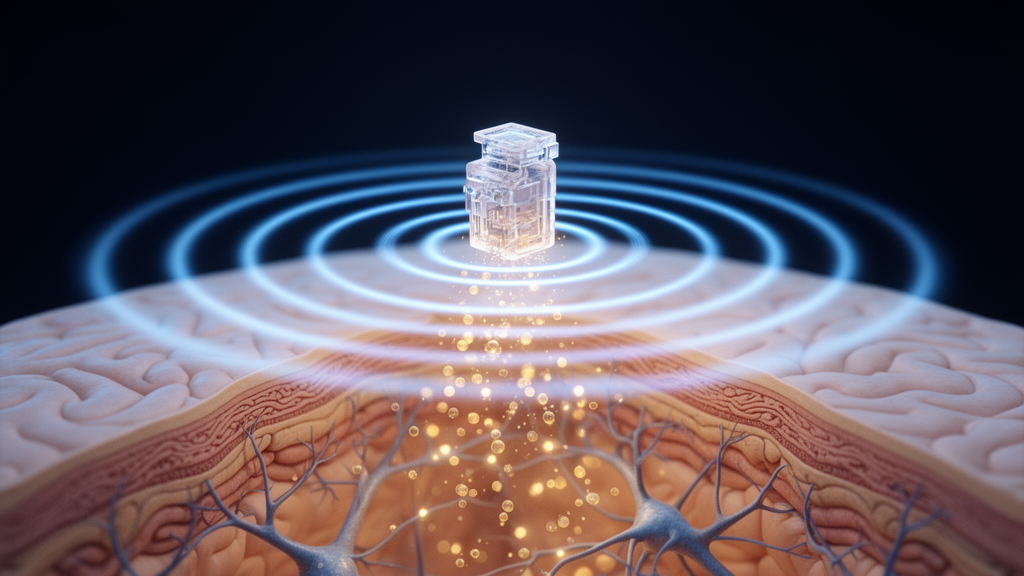
An implantable device developed at the Massachusetts Institute of Technology combines a miniature ultrasound array with a drug-delivery cannula to push therapeutic molecules farther into brain tissue than passive diffusion alone can achieve. In a study published in the journal Device, the researchers showed that their ultrasound device allowed molecules to spread further after being released, both in tissue models and in a mouse study. The work targets one of the most stubborn problems in neuro-oncology: getting drugs to the cells that surgery leaves behind.
The device, named LUCID for Long-term Ultrasound-enhanced Convective Injection Device, is a flexible implant as thin as a sheet of cardstock. A drug-delivery cannula is 3D-printed directly onto an array of 24 miniature ultrasound transducers. These transducers generate ultrasound waves right at the tip of the needle, helping drug molecules diffuse farther into tissue after they are released. The implant’s reservoir carries about 100 microliters of fluid, infusion is supplied by a passive osmotic pump, and ultrasound can be controlled wirelessly through Bluetooth. A small battery that can be recharged wirelessly powers the electronics.
“We have 24 transducers in one ultrasound array, which can help a given drug bypass the blood-brain barrier and enhance the drug infusion. The device also gives doctors options in terms of the size, the length, and the number of infusions,” says Canan Dagdeviren, an associate professor of media arts and sciences at MIT and the senior author of the study. After implantation, a wireless controller can be used to program the exact ultrasound dosages to be delivered, enhancing the reach of the delivered therapy.
The clinical motivation is glioblastoma, an aggressive brain tumor with a little more than 10,000 cases diagnosed in the United States per year. On average, patients survive 12 to 15 months after diagnosis. Patients typically undergo surgery to remove as much of the tumor as possible, followed by radiation and chemotherapy. Yet it is difficult for surgeons to remove all of the cancer cells, and the tumor often recurs. The MIT team hopes their device, which could be implanted in the brain during surgery and then gradually release drugs that help kill the remaining tumor cells, could help address that recurrence.
Chemotherapy drugs are usually given either as pills or an intravenous infusion, but in recent years, scientists have developed drug-delivery wafers and hydrogels that can be implanted directly in the skull. That approach can help to eliminate the side effects of chemotherapy and ensure that a higher concentration of the drug reaches the brain. Those devices, however, work by passive diffusion of drugs, which limits how far molecules travel and offers little control over the timing of release. The MIT researchers wanted a system that would allow greater control of drug-release timing while incorporating ultrasound arrays to enhance the distribution of drug molecules.
The physics behind the enhancement is well established. Previous research has shown that ultrasound helps drug molecules disperse more widely by creating convective flows that carry them longer distances. The mechanical oscillations generated by ultrasound waves also temporarily increase the permeability of the blood-brain barrier, helping drug molecules get into the brain. LUCID builds directly on Dagdeviren’s earlier work: she had previously designed a tiny cannula, about as thin as a human hair, that could be implanted in the brain to deliver drugs, and she also built an implant called ImPULS, which uses tiny ultrasound transducers to deliver deep brain stimulation. The new study combined those two technologies into a single implant.
“Getting a drug into the brain is only part of the challenge. It also needs to spread through the surrounding tissue. We brought a delivery channel and a tiny ultrasound array together in one implant to help molecules reach a larger area, even during slow infusion,” says Jason Hou, a lead author of the study who received his PhD from MIT in 2026. Sarah Ornellas, an MIT graduate student, is the other lead author.
The team first evaluated the system in a tissue phantom, a gel-like material engineered to mimic human tissue. In that model, ultrasound-aided delivery spread drug molecules much farther than delivery without ultrasound. “By enhancing that distribution locally and programmably with ultrasound, you can reduce systemic toxicity in nontarget organs, while the therapy that you’re using has a better chance of reaching whatever tumor cells are within the affected area,” Ornellas says. The researchers then moved to an animal test, using the system in mice to deliver an MRI contrast agent. When the ultrasound array was activated, the contrast agent spread further through the brain than when ultrasound was not used.
If developed for use in patients, the drug cannula and ultrasound array would be placed inside the skull, while the part of the device containing the battery and other electronics could sit outside the skull, the researchers say. Beyond small-molecule drugs, the team says the technology could also be used to deliver immunotherapies or nucleic acids, including gene therapies, and could potentially be applied in organs other than the brain. “We started with the brain as a follow-up to our ImPULS technology, but eventually this can be used for other soft tissue treatments for different types of drugs, different types of interventions in deep body tissue,” Dagdeviren says. “We are showing that we can make any kind of payload be distributed in a better way.”
For now, the evidence for LUCID rests on laboratory tissue models and a mouse study rather than human trials, and the researchers describe the device as something they hope could help prevent glioblastoma recurrence rather than a proven treatment. Other authors of the paper include Michal Nowicki, a research associate at Massachusetts General Hospital; Jerry Li, a recent graduate of Harvard University; Heloise Leblanc, a graduate student at Boston University; Betul Serra Tulu, an MIT undergraduate; David Sadat, a research specialist at MIT; Marco Mineo, an instructor in neurosurgery at Harvard Medical School; Steve Ramirez, an associate professor of psychological and brain sciences; and E. Antonio Chiocca, a professor of neurosurgery at Harvard Medical School and Massachusetts General Hospital. The research was funded by the MIT Media Lab Consortium and the National Institutes of Health.
Subject of Research: An implantable ultrasound-enhanced drug delivery device for the brain, tested in tissue models and mice
Article Title: Implantable device from MIT researchers uses ultrasound to improve drug delivery to the brain
Article References: Implantable device from MIT researchers uses ultrasound to improve drug delivery to the brain. Original publication (Bibliographic details unavailable.)
Image Credits: AI Generated
DOI: Not provided
Keywords: glioblastoma, drug delivery, ultrasound, blood-brain barrier, implantable device, brain tumor, MIT, osmotic pump, convection-enhanced delivery, Device journal, mouse study, neurotechnology
News Source: Nathaniel Bowman. (October 27, 2026). Ultrasound-Boosted Implant Aims to Push Drugs Deeper Into the Brain. Scienmag.