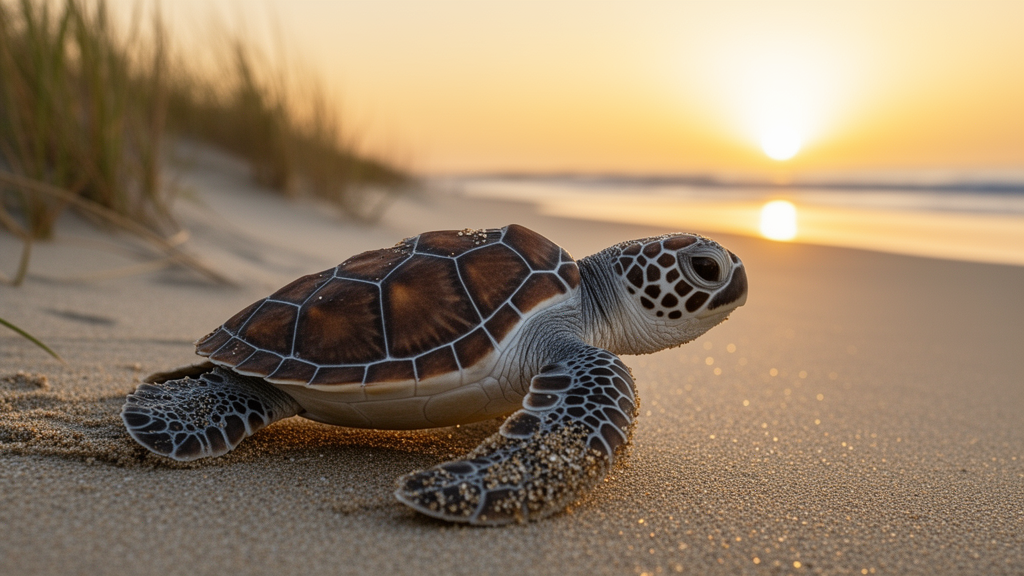
Scute anomalies on the shells of turtles have long been read as signs of developmental stress, but a new study of captive-bred loggerhead turtle hatchlings suggests a more nuanced picture. Researchers led by Ken Sakaoka, Makoto Yoshii and Hitoshi Okamoto report in BMC Ecology and Evolution that the number and arrangement of carapacial scutes in loggerhead (Caretta caretta) hatchlings reflect both inherited parental influences and the thermal conditions experienced during incubation.
The team worked with a long-term dataset of captive-bred hatchlings of known parental lineage, a design that allowed them to separate genetic from environmental contributions. Paternity was assigned using eight microsatellite loci, and incubation duration served as a proxy for the thermal exposure each clutch experienced in the nest.
Using this framework, the researchers evaluated the effects of maternal identity, paternal identity, incubation duration and bilateral asymmetry on variation in scute counts. Comparisons among half-siblings revealed parental influences on marginal, costal and nuchal scute counts, indicating that the number of plates along different regions of the carapace is not determined by incubation conditions alone.
Successive clutches produced by full siblings provided the complementary environmental signal. When the same parents produced clutches that differed in incubation duration, the frequency of scute anomalies shifted, showing that thermal conditions during development alter how often these traits appear even within a single family line.
Generalized linear mixed models brought the two threads together. Both parental identity and incubation duration significantly predicted scute variation, and the pattern of expression was threshold-like: rather than varying smoothly, scute counts appeared to switch between states once underlying influences crossed some combination of genetic and developmental thresholds.
One further result ruled out a simple explanation. Scute anomalies were not associated with hatchling body size, suggesting that scute count is not merely a function of overall growth. The anomalies instead behave as distinct traits in their own right, shaped by probabilistic inheritance interacting with incubation temperature.
The authors argue that this evidence supports a threshold model in which scute anomalies represent polymorphic traits rather than purely pathological defects. Under this view, the traditional classification of unusual scute patterns as abnormalities should be complemented by treating them as naturally occurring variants whose expression depends on both genotype and environment.
The framing has practical consequences for sea turtle conservation. Because rising incubation temperatures under climate change are likely to influence trait expression through interaction with underlying genetic and developmental variation, the authors note that recognizing scute variation as a natural polymorphism is relevant to how hatchling phenotypes are monitored and interpreted. The study was published open access on 26 October 2026 as a peer-reviewed research article, with an early-release version subject to further edits before the final Version of Record.
Subject of Research: Genetic and environmental influences on carapacial scute variation in captive-bred loggerhead turtle hatchlings
Article Title: Scute variation in loggerhead turtle hatchlings: genetic and environmental influences
Article References: Sakaoka, K., Yoshii, M., & Okamoto, H. (2026). Scute variation in loggerhead turtle hatchlings: genetic and environmental influences. BMC Ecology and Evolution. https://doi.org/10.1186/s12862-026-02606-9
Image Credits: AI Generated
DOI: 10.1186/s12862-026-02606-9
Keywords: loggerhead turtle, scute anomalies, Caretta caretta, incubation duration, threshold model, microsatellite paternity, half-siblings, thermal exposure, polymorphism, sea turtle conservation, climate change, hatchling phenotype
News Source: Juliet Wilcox. (October 27, 2026). Loggerhead turtle scute patterns shaped by genes and nest temperature. Scienmag.