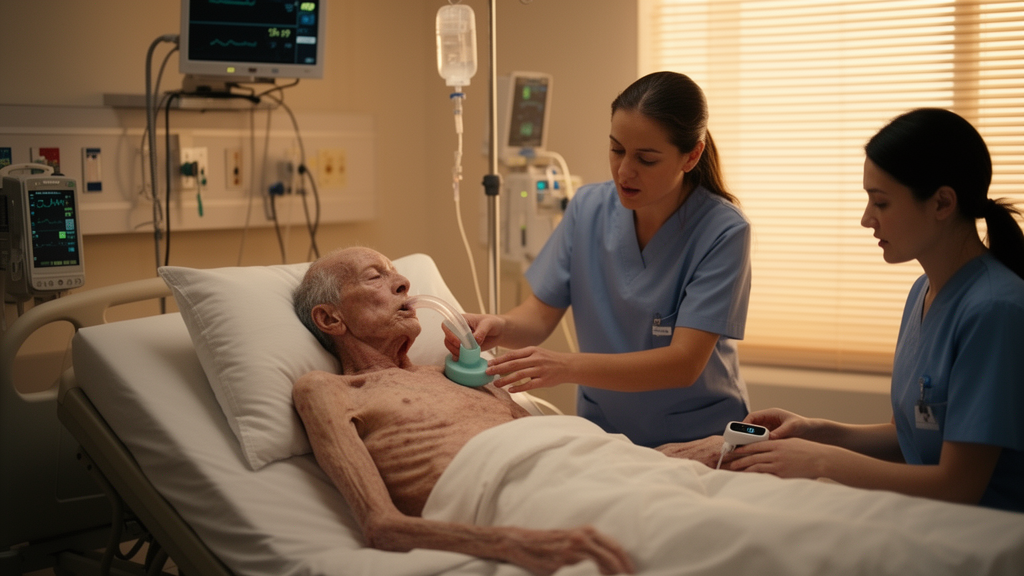
Patients with esophageal squamous cell carcinoma who enter surgery with a low body mass index face a markedly elevated risk of pulmonary complications during their hospital stay, according to a single-center retrospective cohort study published in the European Journal of Medical Research. The finding is notable because the relationship between body mass index and lung complications after esophagectomy was not a simple straight line: risk rose steeply at the low end of the body mass index scale, while estimates at higher values carried wide uncertainty.
The study, conducted at Shanxi Province Cancer Hospital, included 364 patients with esophageal squamous cell carcinoma who had received neoadjuvant therapy and then underwent curative-intent esophagectomy. Pulmonary complications occurred in 134 of the 364 patients, or 36.8 percent, underscoring how common these events remain after esophageal surgery.
Patients who developed pulmonary complications had lower average body mass index than those who did not, 22.43 versus 23.27 kilograms per square meter, a difference that was statistically significant. They also experienced anastomotic leaks far more often, with leaks recorded in 35.8 percent of the complication group compared with 19.6 percent of patients without pulmonary complications.
When the researchers modeled body mass index as a simple linear predictor in a multivariable logistic regression adjusted for demographic and clinical covariates, neoadjuvant regimen, and surgical route and approach, the association fell short of statistical significance, with an odds ratio of 0.93 per unit of body mass index and a p-value of 0.085. That conventional analysis would have suggested no meaningful relationship at all.
The picture changed when the team used restricted cubic splines, a statistical technique that allows the risk curve to bend rather than forcing a straight-line assumption. Spline modeling revealed a significant overall association and significant nonlinearity, with p-values of 0.006 for both the overall test and the test of nonlinearity. The excess risk was concentrated at low body mass index: a patient with a body mass index of 18.5 had roughly 2.9 times the odds of pulmonary complications compared with a patient at 22.8, with an odds ratio of 2.879 and a 95 percent confidence interval of 1.504 to 5.511.
At the higher end of the body mass index range, the estimates were far less precise. Comparing a body mass index of 28 with 22.8 yielded an odds ratio of 1.387 with a confidence interval spanning 0.751 to 2.559, meaning the data could not rule out either an elevated risk or no difference at higher body weights. The authors note that any possible increase in risk at higher body mass index values requires validation in larger cohorts.
A complementary analysis using modified Poisson regression with robust variance estimation, again based on the spline model, produced a directionally consistent pattern. In that analysis, a body mass index of 18.5 compared with 22.8 was associated with an adjusted risk ratio of 1.689, with a 95 percent confidence interval of 1.260 to 2.262, translating to roughly a 69 percent higher risk of in-hospital pulmonary complications at the low body mass index value.
The nonlinear association persisted when the researchers additionally adjusted for anastomotic leak in sensitivity analyses, with an overall p-value of 0.004 and a nonlinearity p-value of 0.006. This suggests the low-body-mass signal is not simply a byproduct of leak-related complications, although leaks were themselves strongly associated with pulmonary events in the unadjusted comparison.
The study’s context matters. Neoadjuvant therapy can worsen nutritional status and muscle reserve before surgery, and the authors argue that in this era body mass index should be interpreted as a nonuniform risk marker rather than a uniform one. They describe their results as hypothesis-generating evidence for perioperative optimization at the post-neoadjuvant and preoperative time points, and for nutritional and prehabilitation strategies during neoadjuvant treatment aimed at mitigating pulmonary risk.
As a single-center retrospective cohort study, the analysis cannot establish causation, and the authors caution that greater uncertainty surrounds the risk estimates at the extremes of the body mass index distribution. Nevertheless, the work suggests that a low body mass index after neoadjuvant therapy may help identify patients who warrant closer attention to pulmonary risk before and after esophagectomy.
Subject of Research: The nonlinear association between body mass index and in-hospital pulmonary complications after neoadjuvant-treated esophagectomy for esophageal squamous cell carcinoma
Article Title: Nonlinear association between body mass index and in-hospital pulmonary complications after esophagectomy following neoadjuvant therapy for esophageal squamous cell carcinoma
Article References: Ma, Y., Zhang, M., Sang, Y., Ge, Q., Yang, B., Lian, J., & Lu, T. (2026). Nonlinear association between body mass index and in-hospital pulmonary complications after esophagectomy following neoadjuvant therapy for esophageal squamous cell carcinoma. European Journal of Medical Research. https://doi.org/10.1186/s40001-026-04894-9
Image Credits: AI Generated
DOI: 10.1186/s40001-026-04894-9
Keywords: esophageal squamous cell carcinoma, esophagectomy, neoadjuvant therapy, body mass index, pulmonary complications, restricted cubic splines, anastomotic leak, retrospective cohort study, nutritional status, prehabilitation, surgical outcomes, Nonlinear
News Source: Ophelia Keating. (October 27, 2026). Low Body Mass Index Flags Higher Pulmonary Risk After Neoadjuvant Esophagectomy. Scienmag.