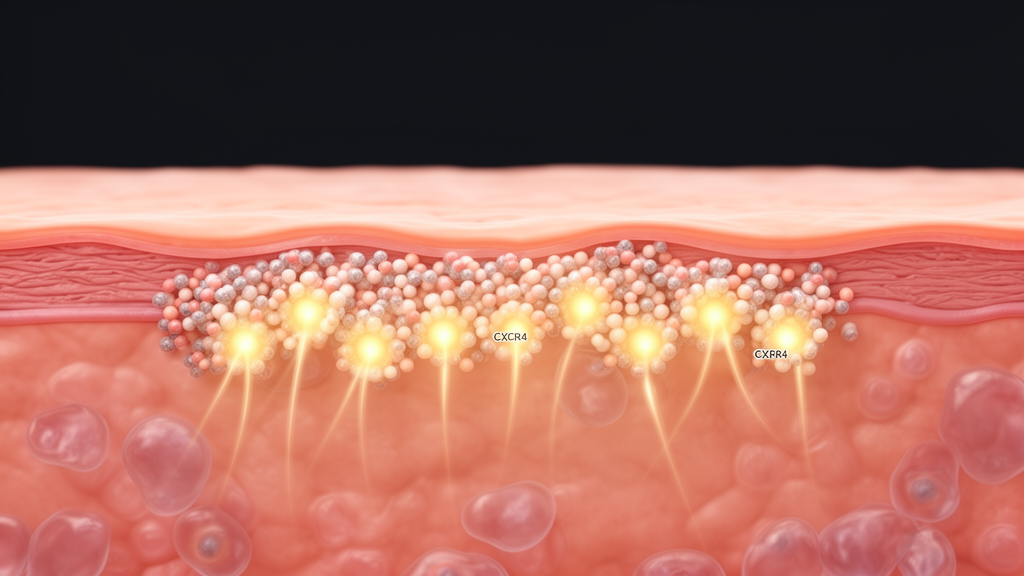
Researchers have mapped where the chemokine receptor CXCR4 sits within psoriatic skin, combining single-cell RNA sequencing with spatial transcriptomics to trace both the cellular distribution of the receptor and the putative communication lines it may support. The work, published in Archives of Dermatological Research, integrates public datasets with experimental validation in a psoriasis-like mouse model, and paints a picture of CXCR4 as a receptor concentrated in immune cells within the dermis of affected skin.
The team, led by Ru-nan Fang and Jian-hong Li, drew on publicly available single-cell RNA sequencing and spatial transcriptomics datasets from psoriatic and healthy control skin samples deposited in the Gene Expression Omnibus database. After sample-level quality control and Harmony-based integration of the datasets, the researchers performed cell clustering, cell-type annotation, and CellChat-based ligand-receptor inference, with a particular focus on the CXCL signaling pathway.
The single-cell analysis identified 15 major cell types in human skin. Notably, a sample-level comparison of cell composition showed no significant differences in the proportions of major cell types between the control and psoriasis groups after Benjamini-Hochberg correction for multiple testing. This means the observed CXCR4 pattern reflects changes in expression within cell populations rather than a measurable shift in the overall cellular makeup of the samples analyzed.
Within those cell populations, CXCR4 transcripts were detected mainly in immune cells, including T cells, dendritic cells, and macrophages, with limited signal also appearing in keratinocytes. The receptor’s ligand, CXCL12, told a complementary story: its transcript signals were associated mainly with fibroblast clusters, although the chemokine was also detected in other cell populations.
Using CellChat-based inference, the researchers identified the CXCL12-CXCR4 pair as one of the candidate ligand-receptor pairs with a relatively high inferred contribution to the CXCL signaling pathway in the psoriasis group. The spatial arrangement of these signals suggested a putative communication pattern in which fibroblast-associated CXCL12 forms inferred ligand-receptor links with multiple immune-cell populations expressing CXCR4.
Spatial transcriptomics added a tissue-level dimension to the single-cell findings. CXCR4 transcript signals were mainly enriched in the dermal region of psoriatic skin, placing the receptor’s activity in the layer beneath the epidermis where inflammatory immune infiltrates accumulate in the disease.
To validate these computational findings experimentally, the team turned to an imiquimod-induced psoriasis-like mouse model. Immunohistochemistry and reverse transcription-quantitative polymerase chain reaction were used to assess tissue-level CXCR4 staining signals and CXCR4 mRNA expression, respectively. In the mouse skin, CXCR4-positive staining areas were increased in both the epidermal and dermal compartments, and this was accompanied by increased CXCR4 mRNA expression.
The researchers also performed double immunofluorescence staining for CXCL12 and Vimentin to evaluate CXCL12 fluorescence signals and their spatial overlap with stromal-related regions. The tissue-level CXCL12 fluorescence signal was increased in the psoriasis-like mouse skin. However, the Manders overlap coefficient for CXCL12 and Vimentin signals was not increased, meaning the expected spatial colocalization between the chemokine and the stromal marker was not confirmed at the protein level in the model tissue.
The authors frame the study as an integrative characterization of CXCR4’s cellular distribution, spatial localization, and associated putative intercellular communication patterns in psoriasis. They suggest that the CXCL12-CXCR4-associated putative stromal-immune communication pattern may be related to the psoriatic inflammatory microenvironment, while emphasizing that the precise cellular sources and functional significance of this signaling axis require further validation.
Several caveats accompany the findings. The ligand-receptor links are computational inferences from transcriptomic data rather than demonstrated functional interactions, and the human analyses relied on public datasets rather than newly collected patient samples. The mouse work used an imiquimod-induced model that mimics key features of psoriasis but is not the human disease itself. Within those limits, the study offers a detailed spatial and cellular reference for CXCR4 signaling in psoriatic skin and a candidate stromal-immune communication axis for future functional studies to test.
Subject of Research: CXCR4 expression and putative cell-cell communication in psoriasis characterized by single-cell RNA sequencing and spatial transcriptomics
Article Title: Single-cell RNA sequencing and spatial transcriptomics characterize CXCR4 expression and associated putative cell–cell communication in psoriasis
Article References: Fang, R.-N., Zhou, Y., Ge, D., Pan, Y.-R., & Li, J.-H. (2026). Single-cell RNA sequencing and spatial transcriptomics characterize CXCR4 expression and associated putative cell–cell communication in psoriasis. Archives of Dermatological Research, 318(1), Article 529. https://doi.org/10.1007/s00403-026-05009-4
Image Credits: AI Generated
DOI: 10.1007/s00403-026-05009-4
Keywords: psoriasis, CXCR4, CXCL12, single-cell RNA sequencing, spatial transcriptomics, chemokine signaling, immune cells, fibroblasts, imiquimod mouse model, dermatology, CellChat, cell-cell communication
News Source: Juliet Wilcox. (October 27, 2026). CXCR4 emerges as a dermal immune signal hub in psoriasis, single-cell and spatial study finds. Scienmag.