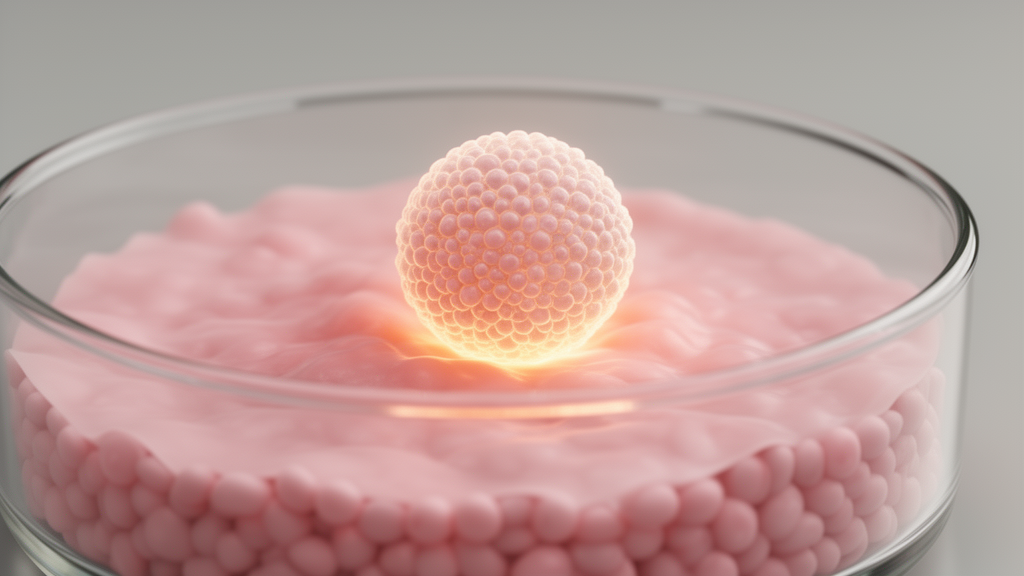
Human embryo implantation begins with dynamic, tightly coordinated interactions between the embryonic and endometrial compartments, yet the earliest trophoblast–endometrial interface dynamics remain poorly resolved in vivo. A team led by Yan Bi, Zhifen Tu, Xinbao Zhang, Jindian Hu and Che Chen, working with senior authors Shaorong Gao and Yixuan Wang, has now built a three-dimensional co-culture system that recreates key features of this interface in the laboratory. Reporting in Nature Cell Biology, the researchers combined human blastoids — stem-cell-derived embryo models — and natural blastocysts with endometrial assembloids to follow implantation-like progression over time.
The system’s central strength is its compatibility with time-series single-cell transcriptomics, which allowed the team to profile how both compartments change as they interact, alongside functional perturbation experiments to test which signals matter. The work is presented as a technical report, meaning its main contribution is a tractable experimental framework rather than findings from human pregnancies themselves.
A key result is the identification of co-culture-induced trophoblast subsets marked by the co-expression of SDC1 and MMP7. Importantly, the researchers report that these subsets were reproducibly detected across independent implantation-like systems, suggesting the observation is not an artefact of a single model configuration.
The induced trophoblast subsets emerged specifically within a decidualized stromal co-culture context. Intercellular communication analysis linked the subsets to stromal-derived CSF3 signalling, and targeted perturbation experiments supported this connection, with the CSF3–CSF3R pathway implicated in supporting induced trophoblast adaptation and blastoid expansion during the implantation-like interaction.
In parallel, the endometrial side of the co-culture was not a passive partner. This mutual adjustment — embryonic cells adapting towards an invasive, remodelling phenotype while endometrial cells deepen their decidual and secretory programmes — is what the authors describe as reciprocal embryo–endometrial adaptation at the onset of implantation.
The study’s scope and limitations deserve emphasis. Because the experiments rely on blastoids and assembloids in a dish, the findings describe implantation-like processes in a model system, not events observed in the human uterus. The authors themselves note that the earliest trophoblast–endometrial interface is poorly resolved in vivo, which is precisely why such models are needed; conversely, it means the co-culture-induced states, including the SDC1-positive, MMP7-positive trophoblast subsets, remain to be matched against human in vivo data. The abstract describes the work as providing a framework for dissecting these interactions rather than establishing clinical outcomes.
Within those limits, the framework offers several practical advantages. It accommodates both stem-cell-derived blastoids and natural blastocysts, permitting comparison between model and natural embryos under identical conditions. Its compatibility with single-cell time courses captures the dynamics of the interface rather than a single snapshot, and the functional perturbation capability — demonstrated with the CSF3 signalling axis — allows candidate maternal signals to be tested directly rather than merely correlated.
For researchers studying early pregnancy, the system provides a controlled setting in which questions that are inaccessible in vivo can be addressed: which maternal stromal signals prompt trophoblast remodelling programmes, how glandular secretions change during early interface formation, and how these processes depend on the decidualized state of the endometrium. The identification of CSF3 as a stromal-derived signal linked to trophoblast adaptation gives such dissection a concrete starting point.
Subject of Research: A three-dimensional co-culture system modelling reciprocal embryo–endometrial adaptation during human implantation-like interaction
Article Title: A three-dimensional human co-culture system reveals reciprocal embryo–endometrial adaptation at implantation onset
Article References: Bi, Y., Tu, Z., Zhang, X., Hu, J., Chen, C., Xu, Y., Zheng, Y., Song, Y., Chen, Y., Lin, T., Wang, H., Che, X., Li, J., Huang, G., Gao, S., & Wang, Y. (2026). A three-dimensional human co-culture system reveals reciprocal embryo–endometrial adaptation at implantation onset. Nature Cell Biology. https://doi.org/10.1038/s41556-026-02106-4
Image Credits: AI Generated
DOI: 10.1038/s41556-026-02106-4
Keywords: embryo implantation, blastoids, endometrial assembloids, trophoblast, decidualization, single-cell transcriptomics, CSF3 signalling, extracellular matrix remodelling, organoid co-culture, human early development, three-dimensional, human
News Source: Drew Townsend. (October 27, 2026). Lab-grown co-culture reveals how embryo and endometrium adapt at implantation onset. Scienmag.