This study integrated long-term remote sensing data, specifically the Normalised Difference Vegetation Index (NDVI), with seasonal ornithological surveys and climate metrics to assess the impact of anthropogenic pressures and climate change on this vital freshwater ecosystem. Karataş Lake, which was established as a reservoir in 1982 and subsequently designated a Wildlife Development Area in 2006, serves as an important feeding and breeding ground for migratory and resident bird species in the Lakes Region. The research utilized a temporal span of 2017 to 2024 for satellite imagery and climate data, complemented by intensive field surveys conducted during 2021 and 2022, providing a robust dataset to monitor ecological shifts over time.
The study area itself, situated in the Karamanlı District of Burdur Province, is geographically characterized by its strategic location and ecological importance, covering an area of 2.2 km² with an average depth of 2 meters. Historically, the lake has been fed by the Sarıdere river, which flows through water channels passing through Hüyükköy. However, the ecosystem faces severe degradation. Recent observations indicate that the lake’s water volume has decreased and its ecosystem functions have been significantly impaired due to low rainfall, the drying up of natural water sources, and the intensification of agricultural activities in the surrounding region. These factors have led to wetland contraction and habitat fragmentation, posing a direct threat to the biological diversity and the ecosystem services provided by the lake, which are crucial for regional water management and agricultural growth.
To quantify the environmental changes, researchers employed the Normalised Difference Vegetation Index (NDVI), a powerful remote sensing tool derived from Sentinel-2 multispectral imagery spanning 2017 to 2024. NDVI data are essential for monitoring the vegetation health and habitat quality of wetlands, as they reveal seasonal and annual changes in plant productivity. The integration of these NDVI analyses with climate data, sourced from the TerraClimate database for temperature and precipitation, provided a scientific foundation for understanding the ecological status of Karataş Lake under the dual pressures of agricultural expansion and climate change. The study specifically aimed to examine how agricultural pressure, drought, and environmental variability affect the lake’s ecosystem, thereby contributing to the development of sustainable management strategies.
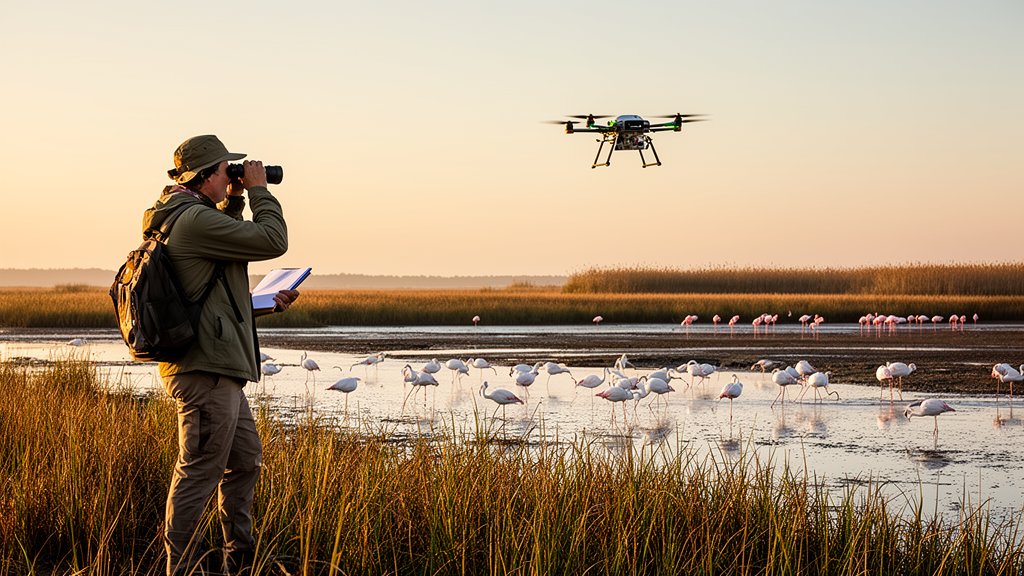
The ornithological surveys, which were conducted using the point count method at a single observation station within the lake, captured a total of 46 bird species across four seasonal sampling events: spring, summer, autumn, and winter. This dataset represents presence-only occurrence records, documenting species identification, individual counts, observation dates, and precise geographic coordinates. Among the recorded species, notable examples include the Northern Lapwing (*Vanellus vanellus*), classified as Near Threatened (NT) by the IUCN Red List, and the Common Pochard (*Aythya ferina*), which is classified as Vulnerable (VU). The analysis utilized the Jackknife method to estimate species richness, allowing for a comparative assessment of biodiversity across the different seasons and environmental conditions.
The findings revealed stark seasonal variations in both avian diversity and environmental indicators. During the summer season, the highest levels of species richness and abundance were recorded, with 37 bird species and a total of 3785 individual birds observed. This peak coincided with high average temperatures, reaching 32.55°C, and a high average NDVI of 0.1418. Conversely, in autumn, although the NDVI reached its highest recorded level at 0.1482, the number of bird species observed plummeted to only nine. These results suggest that while vegetation health (NDVI) is a key indicator of habitat quality, it is not the sole determinant of avian diversity, as other environmental factors, such as precipitation, play a crucial role in determining habitat suitability.
Exploratory statistical comparisons between the seasonal data indicated that bird species richness, abundance, and Jackknife richness estimates tended to vary in parallel with temperature, and to a lesser extent, with NDVI. However, rainfall exhibited an opposite seasonal pattern relative to these biodiversity metrics. It is important to note that the analysis was based on only four seasonal observations, and therefore, no formal statistical significance testing was applied; the observed patterns should be interpreted as descriptive indications rather than statistically confirmed causal relationships. Multivariate analysis techniques, such as Principal Component Analysis (PCA), were employed to evaluate the relationships between seasonal changes in NDVI, climate data, bird species richness, and individual numbers, providing a comprehensive interpretation of the dynamics between habitat quality and environmental pressures.
The degradation of Karataş Lake is linked to several critical environmental issues. Remote sensing observations from 2017 to 2024 clearly demonstrated agricultural expansion and wetland contraction. Furthermore, the lake’s surface area has significantly decreased, largely attributed to irrigation demands. The water loss and habitat shrinkage observed in this study are directly associated with the threat posed by human activities. Wetlands are globally recognized as critically important for the sustainability of migration routes, offering essential feeding, shelter, and resting opportunities. The degradation or loss of these wetlands along migration pathways negatively impacts the energy balance of bird populations, which consequently reduces migration success and threatens the long-term survival of these species.
The study highlights the necessity of integrating diverse indicators for effective conservation. The findings suggest that to restore the ecological function of Lake Karataş, sustainable agricultural practices, planned water resource use, and wetland management must be promoted. The use of remote sensing techniques, coupled with bird diversity indicators, provides a scientific basis for future restoration efforts. Therefore, the successful management of Karataş Lake requires continuous monitoring using remote-sensing techniques and the implementation of integrated land management practices at both local and national levels to ensure the sustainability of wildlife in the region.
Subject of Research: Assessment of avian diversity and wetland health in Lake Karataş, Türkiye, using NDVI and climate data.
Article Title: A seasonal bird occurrence dataset from Karataş Lake (Burdur, Turkey) with associated NDVI and climate data, 2021 to 2022
Article References: Özdemir, Y. (2026). A seasonal bird occurrence dataset from Karataş Lake (Burdur, Turkey) with associated NDVI and climate data, 2021 to 2022. Biodiversity Data Journal, 14, Article e200154. https://doi.org/10.3897/bdj.14.e200154
Image Credits: AI Generated
Keywords: Wetland Ecology, Ornithology, Remote Sensing, NDVI, Climate Change, Biodiversity, Lake Karataş, Sustainable Management, seasonal, bird, occurrence, dataset
News Source: Gavin Prescott. (October 27, 2026). Remote Sensing and Bird Surveys Reveal Seasonal Shifts and Threats to Karataş Lake Ecosystem. Scienmag.