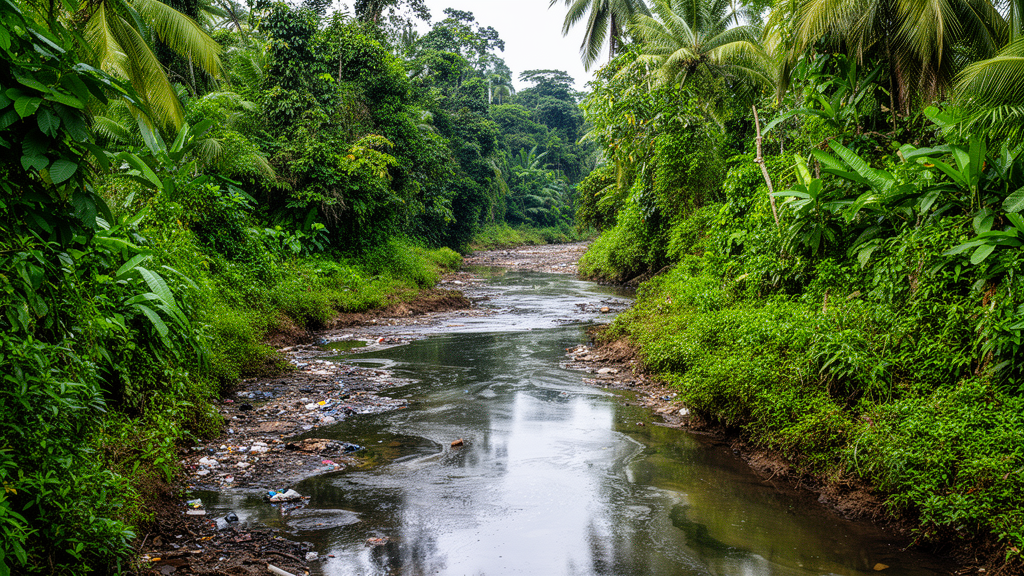
An urban stream winding through Manaus, the largest city in the Brazilian Amazon, carries some of the highest per- and polyfluoroalkyl substance (PFAS) concentrations ever reported for South America, according to a new study in Results in Engineering. The first assessment of these persistent synthetic chemicals in an Amazonian waterway found total PFAS concentrations ranging from 76.5 to 366.9 nanograms per liter in the Educandos stream, with a median of 189.2 nanograms per liter. That median exceeds roughly 84 percent of more than 40,000 PFAS measurements compiled from rivers, lakes and estuaries across 56 countries, placing a tropical urban stream without any known fluorochemical manufacturing or firefighting-foam sites in the same concentration range as heavily industrialized catchments in the Northern Hemisphere.
The research team, led by Erickson Oliveira dos Santos of what the journal lists as the study’s affiliation network, sampled surface water daily over five consecutive days in May 2025, at the end of the wet season, at four points along the roughly 15-kilometer Educandos stream plus a background site at its spring in forested headwaters. The stream crosses 16 neighborhoods home to about 450,000 people and borders Industrial District 1, the city’s primary industrial zone with more than 400 companies. Manaus, a city of about 2.3 million people, has among the lowest sewage coverage of Brazil’s largest cities: recent estimates indicate only about 20 percent of the urban population has sewage collection and roughly 12 percent of households are connected to the sewer network, so most domestic sewage is discharged untreated into the city’s streams, alongside effluents from company treatment plants in the industrial district.
Using a modified version of the US EPA Method 1633 with solid-phase extraction and ultra-performance liquid chromatography coupled to quadrupole time-of-flight mass spectrometry, the researchers quantified 24 target PFAS compounds. Only five were detected: the short-chain perfluorocarboxylic acids PFBA, PFPeA, PFHxA and PFHpA, and the fluorotelomer sulfonate 6:2 FTS. PFPeA, PFHxA and 6:2 FTS appeared in every sample, PFBA in 94 percent, and PFHpA in 33 percent. Strikingly, the regulated legacy compounds PFOA, PFOS, PFNA, PFHxS and PFDA were not detected in any sample. The authors attribute the dominance of short-chain compounds partly to their chemistry: C4–C6 perfluorocarboxylic acids are more water-soluble and mobile, less retained by sediments and organic matter than their long-chain counterparts, which preferentially sorb to particles and accumulate in biota.
The compositional fingerprint was co-dominated by PFPeA, which made up 48 percent of total PFAS, and 6:2 FTS, which accounted for 44 percent, together about 92 percent of the total. The authors interpret this as pointing to fluorotelomer-based chemistry rather than legacy electrochemical fluorination products. 6:2 FTS has replaced PFOS in applications such as chromium plating mist suppressants and aqueous film-forming foams, and appears as a residual in fluorotelomer-based surface treatments for textiles and paper. PFPeA, meanwhile, is mainly formed by degradation of 6:2 fluorotelomer precursors: aerobic biotransformation of 6:2 fluorotelomer alcohol in soil and activated sludge yields PFPeA as the main terminal product, and 6:2 FTS itself transforms slowly into PFHxA and PFPeA in sludge and leachate microcosms. The co-occurrence of the two compounds is consistent with inputs of fluorotelomer-based products undergoing partial transformation during transport.
Spatial patterns added a crucial clue. No PFAS were detected at the background spring, concentrations rose downstream, and the highest values occurred at Point 3, the Studio 5 bridge, where mean 6:2 FTS reached 194.1 nanograms per liter, more than double the levels at Points 2 and 4. Statistical testing confirmed the difference between Point 3 and the upstream industrial bridge site. In contrast, PFPeA concentrations stayed relatively constant along the stream, suggesting diffuse sources. Multivariate analyses, including Spearman correlations, principal component analysis and hierarchical clustering, showed that PFAS inputs are not explained solely by the wastewater signature: correlations between individual PFAS and wastewater-related ions such as chloride, sodium and ammonium were mostly not significant, and the mean chloride-to-sodium mass ratio of 1.1 sat slightly above the range typical of domestic sewage. The authors conclude that untreated sewage contributes, but that 6:2 FTS likely has an additional, localized source near Point 3, possibly industrial, which targeted sampling of outfalls and effluents must confirm.
The concentrations carry regulatory weight. Brazil has no PFAS limits in its national drinking-water standard or surface-water classification, but the study benchmarks the data against international rules. Summed perfluorocarboxylic acids exceeded the European Union drinking-water limit of 100 nanograms per liter for the sum of 20 PFAS in 12 of the 18 samples, driven mainly by PFPeA, though no sample crossed the 500-nanogram PFAS-total ceiling. All 18 samples exceeded Canada’s drinking-water objective of 30 nanograms per liter for the sum of 25 PFAS, a list that includes all five detected compounds. Using relative potency factors, the researchers calculated PFOA-equivalent concentrations of 1.5 to 5.8 nanograms per liter, with a mean of 3.5; three samples exceeded the European Union’s new surface-water environmental quality standard of 4.4 nanograms per liter PFOA-equivalent. None of the compounds regulated under the US 2024 drinking-water rule, including PFOA and PFOS, were detected, illustrating how legacy-focused regulations miss short-chain-dominated contamination.
The global context sharpens the finding. The worldwide compilation the authors used, spanning 40,457 measurements from 7,618 locations in 56 countries, is heavily biased toward the Northern Hemisphere, which holds about 88 percent of all data, and the United States alone contributes about 69 percent. Of 4,898 Southern Hemisphere measurements, 97 percent come from Australia, and Latin America was represented by only 27 coastal Brazilian samples, all below 3.4 nanograms per liter. No data existed for the Amazon basin or any other inland tropical South American river system. Seventeen of the 18 Educandos samples exceeded the 100-nanogram-per-liter mark, compared with about 21 percent of samples globally, although the stream’s concentrations remain one to three orders of magnitude below the compilation’s most extreme values, which are tied to firefighting-foam-impacted sites and fluorochemical manufacturing.
For sanitation engineering, the numbers translate into demanding treatment targets. Meeting the EU drinking-water value would require removing only about 8 percent of summed perfluorocarboxylic acids at the mean concentration, but 48 percent at the maximum. Meeting Canada’s 30-nanogram objective would require 85 to 92 percent removal of total PFAS. Conventional drinking-water processes such as coagulation, filtration, oxidation and disinfection are mostly ineffective for PFAS, and short-chain carboxylates like PFPeA, which makes up roughly half the stream’s PFAS burden, are among the hardest to retain by adsorption: granular activated carbon removal can fall to about 20 percent after 15,000 bed volumes in pilot columns. Nanofiltration removed PFAS by 99 percent on average in reported studies, and reverse osmosis achieved significant removal of all PFAS including PFBA in full-scale systems. The authors argue that because centralizing sewage would concentrate rather than eliminate the PFAS load, source control, including pre-treatment of industrial 6:2 FTS effluents upstream of Point 3 and substitution of fluorotelomer-based products, is the most cost-effective measure, alongside expanding sewer collection.
The study’s limitations are clearly stated. The targeted method quantified 24 analytes and misses ultrashort-chain compounds such as trifluoroacetic acid, fluorinated ionic liquids and unknown precursors, so total PFAS burdens are likely underestimated. Only four sites were sampled along the stream, each represented by four or five daily samples under a single stable hydrological condition, so the design captures within-site variability rather than seasonal change, and denser sampling across wet and dry seasons is needed to confirm gradients and estimate loads. Sediments and biota were not analyzed, and the non-detection of long-chain PFAS in water does not exclude their presence there. The authors recommend PFPeA and 6:2 FTS as indicator compounds, Point 3 as a priority monitoring station, and extension of monitoring to other Manaus streams and environmental matrices. As the first PFAS data from the Amazon basin, the study fills a major geographical gap and underscores that PFAS contamination is not confined to the industrialized Global North.
Subject of Research: First measurement of PFAS contamination in the Educandos urban stream in Manaus, Brazil, in the Amazon basin
Article Title: First assessment of per- and polyfluoroalkyl substances (PFAS) in an Amazonian urban stream (Manaus, Brazil): occurrence, sources and implications for sanitation engineering
Article References: Santos, E. O. D., Costa, C. C. D., & Gonzáles, P. L. S. (2026). First assessment of per- and polyfluoroalkyl substances (PFAS) in an Amazonian urban stream (Manaus, Brazil): occurrence, sources and implications for sanitation engineering. Results in Engineering, 32, Article 113614. https://doi.org/10.1016/j.rineng.2026.113614
Image Credits: AI Generated
DOI: 10.1016/j.rineng.2026.113614
Keywords: PFAS, Manaus, Amazon, Educandos stream, water pollution, 6:2 FTS, PFPeA, short-chain PFAS, wastewater, sanitation engineering, drinking water, Brazil
News Source: Denise Maddox. (October 27, 2026). Amazon Urban Stream Carries Some of South America’s Highest PFAS Levels. Scienmag.