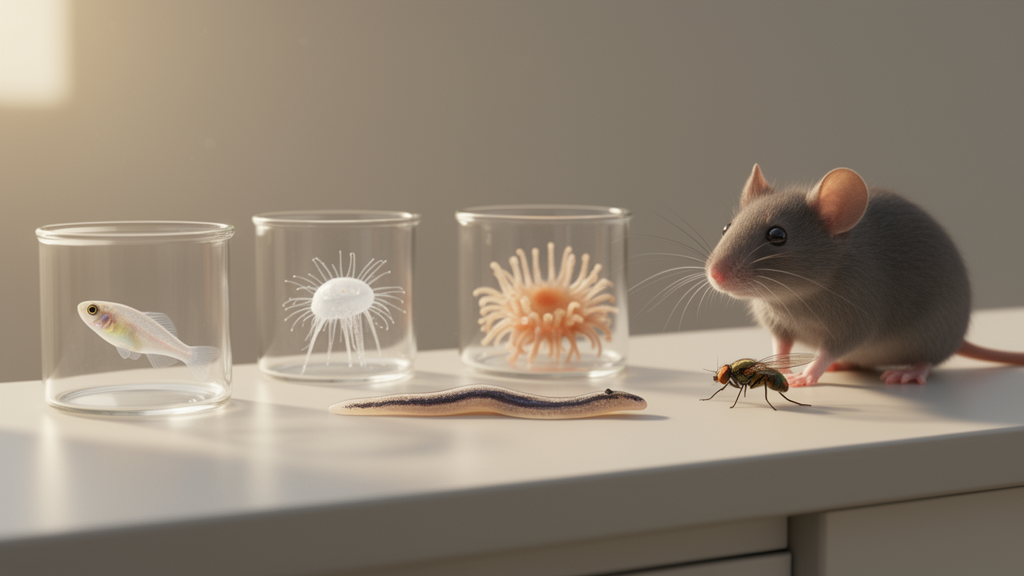
For most of the past century, biology has concentrated its resources on a remarkably small cast of characters: mice, fruit flies, nematode worms, yeast, thale cress and a handful of other laboratory stalwarts. These species represent an astonishingly small fraction of a percent of the planet’s biological diversity, yet they have anchored some of the most consequential discoveries in the history of science. A new editorial published in BMC Biology argues that this intense focus has now produced significant biases, blind spots and gaps in knowledge, and that continued reliance on the standard model organisms may soon become a limiting factor in the quest to understand the fundamental processes that support life on Earth.
The editorial, written by Eve Gazave, Vladimír Hampl, Jason E. Podrabsky, Deanne Whitworth and colleagues and published as the introduction to a journal Collection on non-traditional model organisms, makes the case that the field is entering a decisive transition. The choice of organism, the authors note, has always shaped experimental outcomes. Some species are simply better suited to particular questions because of their evolutionary history and specific features of their biology. That insight is not new, but its practical consequences are being transformed by technology.
The intellectual foundation for this argument dates back nearly a century. Hans Krebs, who received the Nobel Prize in 1953, understood the point firsthand: his studies using pigeon breast muscle contributed to the discovery of the citric acid cycle. Krebs later discussed what he termed the August Krogh principle, quoting Krogh’s 1929 formulation that for a large number of problems there will be some animal of choice, or a few such animals, on which it can be most conveniently studied. The Krogh principle underlies powerful approaches in comparative and evolutionary biology that leverage evolutionary history and novelty to understand the basic mechanisms that allow organisms to adapt and thrive in the face of diverse environmental and biological challenges.
Paradoxically, the historical reliance on a few model organisms was itself an application of the Krogh principle. Those species were chosen for their biological properties: they were easy to rear in the laboratory, and researchers could manipulate them experimentally and genetically with relative ease. The editorial argues that many of the technological barriers that once favored this concentration have now been overcome. As a result, researchers are entering an age in which the choice of study organism can be based not on technological feasibility but on the biology of the organism and the question at hand. The authors go further, suggesting that it may be time to move beyond the concept of a model organism altogether, since ideally such organisms should represent the full spectrum of natural diversity, including species of particular importance such as humans.
The mismatch between the classic model panel and the true breadth of life is stark. Traditional models such as mice, Drosophila, Caenorhabditis, yeast and Arabidopsis no longer reflect current understanding of eukaryotic diversity, which includes more than a dozen major lineages comparable in rank to animals and plants. The editorial illustrates this with a schematic of the eukaryotic tree of life showing that 23 commonly used model organisms fail to adequately cover that diversity. New deep lineages continue to be discovered, and their cell biology can differ significantly from that of familiar laboratory species. The same problem holds within individual groups such as animals. To truly understand fundamental aspects of biology, the authors contend, the field must expand its focus to a much greater diversity of organisms.
What has changed is the toolkit. The diversification of model organisms is being fostered above all by high-throughput omics technologies. Advanced sequencing methods such as Hi-C and long-read sequencing, combined with a substantial reduction in sequencing costs, have made it possible to generate high-quality, chromosome-scale genomes for virtually any species, a prerequisite for many if not all biological questions. These advances have enabled the emergence of huge genome sequencing consortia, most prominently the Earth BioGenome Project, which aims to sequence all eukaryotic biodiversity to reveal what the editorial calls the blueprint of life.
Those resources are already feeding into applied research agendas. New model systems developed for investigating the impact of climate change at the genetic and epigenetic levels are emerging, and the editorial predicts they will allow researchers to refine predictions about one of the major challenges facing humanity. At the cellular scale, a separate initiative, the Biodiversity Cell Atlas, aims to create comprehensive single-cell molecular atlases across the eukaryotic tree of life using single-cell RNA sequencing. Many biological fields are expected to benefit from this initiative, directly or indirectly. The authors also point to a potential societal payoff: a reservoir of biotechnological innovation, including the discovery of new biomolecules emerging from non-conventional model systems.
Technology is not limited to sequencing. Recent advances in imaging are enabling the emergence of new models that were previously neglected because of their small size. Super-resolution microscopy, expansion microscopy and cryo-electron tomography now reveal the nanoscale organization of cellular structures, transforming fields such as cell biology and biomedical research. Organisms once excluded from the laboratory precisely because researchers could not see inside them are becoming accessible at unprecedented resolution, opening questions about cellular architecture across the tree of life that were previously unanswerable.
The final piece of the puzzle is functional manipulation. Gene and genome editing can now be implemented in a plethora of less conventional model systems, offering what the editorial describes as unprecedented opportunities to address the biological world at the mechanistic level. Where researchers once had to confine mechanistic questions to species with established genetic toolkits, editing technologies allow cause-and-effect experiments in organisms chosen for their biology rather than their laboratory pedigree. Bridging these approaches and their associated communities, the authors argue, holds the promise of developing any living species as a unique model organism, a transformative advancement with expected benefits for health, agriculture, biotechnologies, environmental and evolutionary biology.
The BMC Biology Collection that accompanies the editorial already reflects these growing opportunities at the eukaryotic scale, demonstrating the value of looking beyond established systems to uncover advances in biomedical research as well as environmental and evolutionary biology. The editorial is open access, published on 26 October 2026 as Volume 24, article number 224 of the journal. Its central message is straightforward: the golden age of the classic laboratory models produced extraordinary returns, but the barriers that once justified concentrating on a handful of species have largely fallen. In the era of cheap chromosome-scale genomes, single-cell atlases, nanoscale imaging and editable genomes, the most convenient animal of choice for any given problem can finally be the one whose biology makes it the right choice, not merely the one that is easiest to keep alive in a laboratory cage or flask.
Subject of Research: The expanding role of non-traditional model organisms in biological research
Article Title: The brilliant future of non-traditional model organisms in biology
Article References: Gazave, E., Hampl, V., E. Podrabsky, J., & Whitworth, D. (2026). The brilliant future of non-traditional model organisms in biology. BMC Biology, 24(1), Article 224. https://doi.org/10.1186/s12915-026-02770-w
Image Credits: AI Generated
DOI: 10.1186/s12915-026-02770-w
Keywords: model organisms, Krogh principle, eukaryotic diversity, genomics, Earth BioGenome Project, Biodiversity Cell Atlas, single-cell RNA sequencing, gene editing, expansion microscopy, cryo-electron tomography, comparative biology, BMC Biology
News Source: Juliet Wilcox. (October 26, 2026). Beyond the classics: why biology’s future lies in non-traditional model organisms. Scienmag.