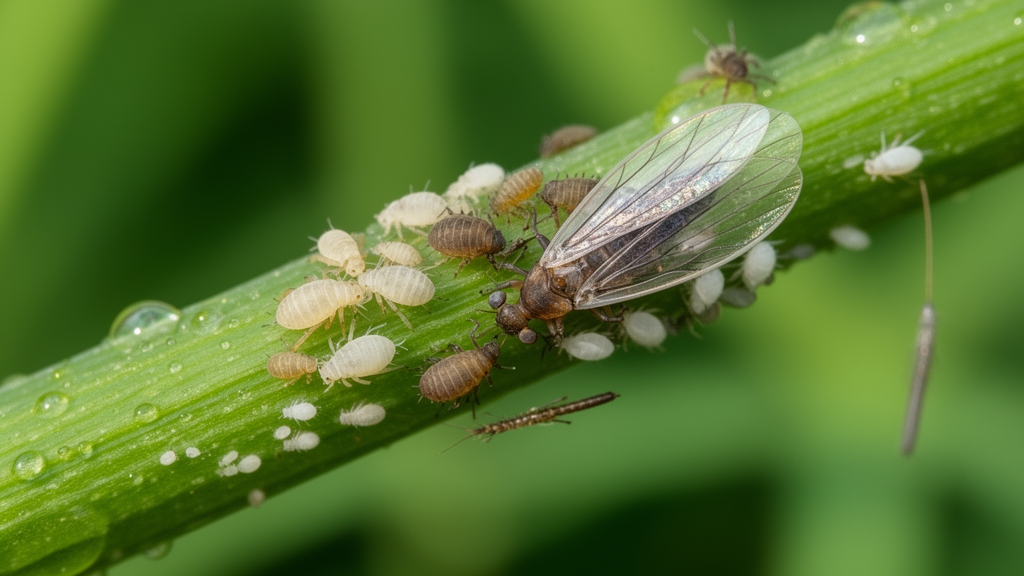
In the vast insect order Paraneoptera, which includes true bugs, aphids, scale insects, whiteflies, thrips, lice, booklice, cicadas and their relatives, most species pass through a simple direct development from a mobile first larva to a winged or wingless adult, typically spanning five or six immature instars. Wing buds, called protoptera, appear in the third through fifth or sixth instars, which are traditionally named nymphs in contrast to the first larval instars that lack them. All postembryonic stages in this archaic pattern are actively mobile and feeding, a condition inherited from the common ancestor of all Paraneoptera and shared with most other so-called hemimetabolous insects. Yet scattered throughout this order, in related but non-sister lineages, evolution has produced some of the most curious and even enigmatic developmental aberrations known in the entire class Insecta, ranging from seventeen-year life cycles to immobile pupa-like stages and females that reproduce while still morphologically larvae.
Among booklice, the order Copeognatha retains the ancestral six larval instars, though rare species reduce this number to five, four or even three, a change associated with neoteny and wing polymorphism. One particularly striking aberration occurs in the European species Prionoglaris stygia, which changes its initial type of mouthparts to a different type during preimaginal development. The small parasitic group containing chewing lice and sucking lice, which originated from booklice, shows a simplified ontogenesis with only three immature instars and a total lack of protoptera and wings. These reductions likely connect with the loss of both the true imaginal stage and the true first larval instar through a so-called embryonal molt.
The larger groups of Paraneoptera, including psyllids, cicadas, true bugs and the relict order Coleorrhyncha, generally preserve the archaic hemimetabolous development, which may be monovoltine or polyvoltine depending on species and climate. Minute aberrations appear in unusual prolongations of the larval stage or in reductions of the number of larval instars. The periodical cicadas of the genus Magicicada display thirteen- or seventeen-year life cycles in different species, with the adult stage lasting only four to six weeks. Some brachypterous species of the planthopper tribe Almanini reduce their larval instars from the usual five to four. In true bugs, sporadic species from families including Veliidae, Mesoveliidae, Nepidae, Nabidae, Anthocoridae, Cimicidae, Microphysidae, Miridae, Tingidae, Reduviidae and Tessaratomidae show four larval instars instead of the vast majority’s five, while six instars are known only in several species of Miridae and Piesmatidae. The parasitic true bug family Polyctenidae, characterized by viviparity and paedogenesis, shows only three larval instars, all bearing protoptera, which probably indicates the loss of the two first larval instars.
The most dramatic departures from the ancestral pattern occur in thrips, whiteflies and scale insects, which have ontogenesis with one or several immobile instars. In thrips, the most primitive ontogenesis includes two mobile larval instars, two quiescent starving nymphs with partly reduced mouthparts, and a mobile adult with normally developed legs, antennae, wings and mouthparts. In whiteflies, the larva loses mobility after the first molt, and the next three larval instars have only vestigial legs and are absolutely immobile. All immature stages lack protoptera, and the final larval stage, called a pseudopuparium, can survive a long period of starvation before molting into a mobile adult. This ontogenesis is in fact similar to the metamorphosis of holometabolous insects and is considered the most aberrant not only among Paraneoptera but of Insecta as a whole.
In scale insects, two preadult instars of the male are quiescent, arostrate and with non-segmented appendages, stages that are in fact analogous to pupal instars of Holometabola. Adult males of all scale insects are arostrate but usually have normally developed legs and wings. In the female life cycle of all scale insects, the normal imaginal stage is absent, and a larva of the third or fourth stage, a neotenic female, copulates with the adult male and reproduces progeny. In some archaic scale insects of the family Margarodidae sensu lato, the second and third female instars are apodous but actively suck sap from the host plant, whereas the neotenic female is mobile, has legs, but lacks mouthparts. Most other archaic scale insects and many advanced ones have simple direct ontogenesis of females with all stages mobile, while advanced groups such as armoured scales lose their legs during the first or last molt of females without alternation of movable and immovable instars.
Two competing hypotheses have long framed the evolution of scale insect ontogenesis. Borchsenius in 1956 presumed that the original ontogenesis of Coccinea was similar to that of whiteflies, with apodal stages present in both female and male development, but this presumption lacked detailed argumentation. Danzig in 1980 argued the opposite, that the ancestor of all scale insects had simple direct ontogenesis similar to psyllids, cicadas and true bugs, with complicated development appearing in males only while females retained the direct cycle but lost the winged adult through neoteny. Recently, modern investigations have provided important new data. Kluge in 2010 studied several scale insect species from different families and discovered a paradoxical transformation of legs and antennae during molts, in which most internal soft tissues of every appendage, including the majority of muscles, degenerate before the molt and then emerge anew. The proximal segment of each appendage newly grows in an unusual inverted position and everts only during ecdysis, so the larva cannot move during the molt. Gavrilov-Zimin in 2018 comprehensively analyzed life cycles of all studied archaic scale insects combined with comparative morphological analysis. Both studies evidenced that the complicated ontogenesis with alternation of mobile and immobile stages and with an arostrate adult of both sexes was initial in scale insect evolution, making Borchsenius’s idea seem more reliable.
The appearance of complicated metamorphosis, including holometabolism, was probably connected with the development of larval instars in narrow shelters under high pressure from unspecialized predators, which decreased the number of openly living insects in late Paleozoic and Mesozoic biotopes. The extinct Archescytinoidea, an ancestral group for aphids, scale insects and all other Homoptera, lived in the Permian period and were trophically connected with gymnosperm trees. Females laid eggs in unripe strobili of gymnosperms, and larvae dwelt there until the ripe strobilus dehisced, a mode of life that exactly permitted protection of immature stages from predators. The sedentary life in strobili and then in cracks of tree bark probably led to increasingly significant differences between larval instars and adults. As a result, scale insect larvae reduced and lost legs, and such apodous instars started to occupy most of the life cycle. In conditions of immobility, the apodous body was probably more protected from entomopathogenic fungi, being evenly covered with wax. In contrast, the unprotected adult became a short-lived instar with reduced mouthparts, and the significant morphological contrast between the immobile apodous larva and the highly mobile adult led to the appearance of quiescent nymphal stages and so to complicated metamorphosis.
In some groups of scale insects, the female lives and reproduces inside the cuticle of the final larval instar. This remarkable ontogenesis is known in some archaic scale insects of the subfamilies Callipappinae and Margarodinae and in some advanced scale insects, including about sixty genera of Diaspididae and occasional species of Beesoniidae and Eriococcidae. In genera of the tribe Cryptokermesini, the second larvae of both sexes secrete a resinous protective test that enlarges during subsequent development, and the third larva and neotenic female remain inside this test and inside the exuviae of the previous instar. Such instars are often considered pupillarial, but this is incorrect because the true puparium is the cover of a pupa, whereas scale insect females never have pupal instars. Gavrilov-Zimin introduced the new term exuviatrium for the larval exuvium used by the next larva-like instar, including the neotenic female, as a shelter. Correspondingly, species with this peculiarity may be named exuviatrial. It seems rather obvious that this mode of ontogenesis originated several times in the evolution of scale insects, since the exuviatrial archaic forms probably originated from the archaic ontogenesis of Coelostomidiini ancestors, while the exuviatrial advanced scale insects clearly originated from the advanced pattern of Monophlebinae and Pseudococcidae, in which adult females are sap-sucking.
Mating of winged scale insect males with apterous larva-like females and parthenogenetic reproduction of larva-like females are usually considered examples of neoteny and paedogenesis, an approach based on the comparison of female and male ontogenesis. The female has only three or four instars, all always larva-like, whereas the male has five instars, one or two of which are quiescent nymphs with protoptera, and one is the alate adult. Some species from different scale insect families show obligate or facultative presence of larva-like males, and in cases of facultative appearance, apterous males are present in the population together with normal alate males. It was clearly demonstrated in some species that apterous males have fewer instars than alate males, three or even two immature instars instead of four. However, Borchsenius disputed neoteny in scale insects and explained the evolution of coccid ontogenesis through larvalization of both females and apterous males, supposing that the evolutionary reduction of the general number of instars was connected with the loss of quiescent instars rather than the loss of the imaginal instar itself. This idea is contradicted by cytogenetic facts: all cytogenetically studied scale insect males have spermatogonial meiosis in the third instar, whereas the fourth instar and adult male have fully developed sperm bundles in their testes, and oogenesis also occurs in the third instar of the female, so this instar may clearly be considered a reproduced neotenic third larva. The real imaginal larvalization with the absence of nymphs may be observed in aphids, the sister group to scale insects, where apterous larva-like females and males usually have the same number of instars as alate females of the same population, so true larvalization is not connected with the reduction of the number of instars but with their modification only.
The ontogenesis of aphids, usually consisting of six instars including the egg, four larval instars and the adult, is complicated in most cases by cyclic parthenogenesis with a regular alternation of bisexual and parthenogenetic generations, with or without a regular alternation of host plants. In the archaic aphid superfamily Phylloxeroidea, both parthenogenetic and bisexual generations lay eggs, whereas in the advanced superfamily Aphidoidea, parthenogenetic females produce offspring by placental viviparity or ovoviviparity. In so-called holocyclic aphids, the life cycle includes a bisexual generation that copulates and produces eggs, a generation of wingless fundatrices that hatch from the eggs and produce the next generation by parthenogenesis, several or many wingless parthenogenetic generations of virginoparae, a generation of alate females that may migrate to another host plant, and a generation of alate sexuparae that migrate back to the primary host plant and parthenogenetically produce the bisexual generation. In the development of the parthenogenetic egg, only one maturation division of meiosis takes place without reduction of the diploid number of chromosomes, though crossing over of homologous chromosomes probably occurs in early prophase. In sexuparae females, the oocytes destined to produce males form a bivalent with two X chromosomes joined end-to-end, and then one X chromosome degenerates while the other divides equationally with the autosomes. During male meiosis, one of the secondary spermatocytes receives an X chromosome and more cytoplasm than the other spermatocyte, which degenerates, a unique feature of the Aphidoid genetic system. Some aphid species, especially in tropical climates, demonstrate simplified anholocyclic life cycles with only parthenogenetic generations, often fifteen to twenty per year and sometimes up to forty. Conversely, in some aphid species from the families Greenideidae and Aphididae, the annual cycle may be reduced in some parts of the species range to only two generations. The ancestral ontogenesis and life cycle of aphids was based on obligatory bisexual reproduction as in most other Paraneoptera, and the appearance of intricate aphid cycles with obligate alternation of bisexuality and parthenogenesis was connected with the original adaptation of the group to the temperate climate of the Holarctic, where an absolute majority of aphid species, including all archaic groups, are still found. The evolutionary appearance of aphid cyclic parthenogenesis, based on this unique genetic system, is considered an apomorphic character of the suborder Aphidinea, and this genetic system excludes the reduction of the modern aphid life cycle to only one bisexual generation. The overall picture of ontogenesis in Paraneoptera thus shows peculiar evolutionary parallelisms, with the independent appearance of similar aberrations in related but not sister phylogenetic lineages, and the questions connected with clear interpretation of homology or non-homology of the instars in the ontogenesis of most Paraneoptera remain presently rather controversial and very poorly studied.
Subject of Research: Aberrant ontogeneses and life cycles in Paraneoptera
Article Title: Aberrant ontogeneses and life cycles in Paraneoptera
Article References: Gavrilov-Zimin, I. A. (2021). Aberrant ontogeneses and life cycles in Paraneoptera. Comparative Cytogenetics, 15(3), 253-277. https://doi.org/10.3897/compcytogen.v15.i3.70362
Image Credits: AI Generated
DOI: 10.3897/compcytogen.v15.i3.70362
Keywords: Aberrant, ontogeneses, life, cycles, Paraneoptera, scientific research
News Source: Gavin Prescott. (October 26, 2026). Aberrant ontogeneses and life cycles in Paraneoptera. Scienmag.