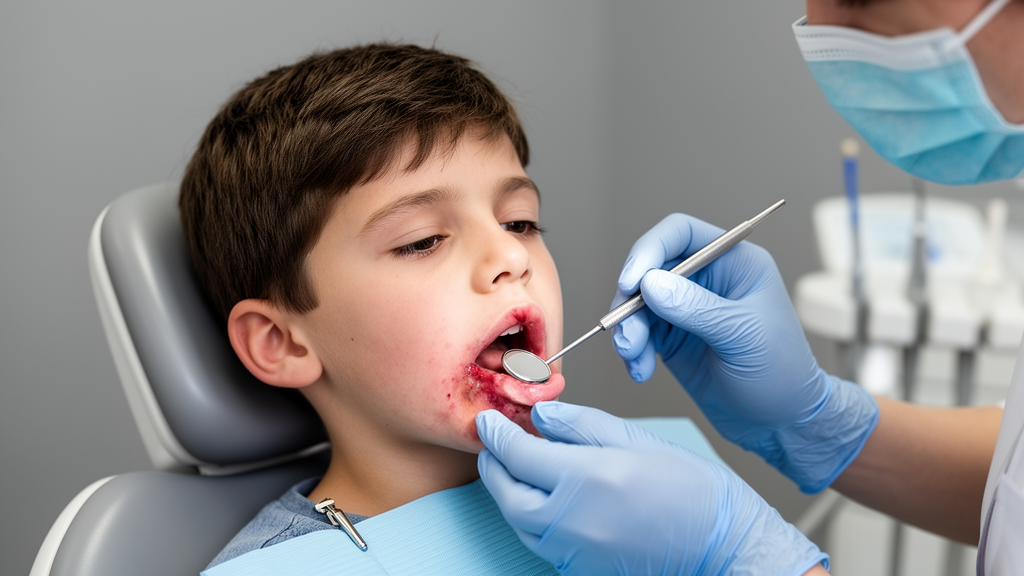
An 11-year-old boy in China developed erythema multiforme after a punctate oral ulcer was worsened by chemical irritation and then complicated by a secondary Staphylococcus aureus infection, according to a case report from clinicians at Dalian Women and Children’s Medical Center (Group). The case, accepted for publication in Frontiers in Pediatrics, describes how overnight application of buccal metronidazole likely added chemical injury to the original lesion, setting off a cascade that spread from the mouth to the extremities and required a carefully sequenced wound-care protocol to resolve.
Erythema multiforme is an acute mucocutaneous disorder that is usually triggered by infections. Chemical injury with secondary bacterial infection is a rare trigger in children, which makes this case notable for clinicians who may not immediately suspect the condition when a child presents with atypical oral lesions. In this patient, the diagnosis was delayed long enough that initial wound care based on a burn model proved ineffective, and the lesions continued to progress.
Laboratory testing revealed a marked decrease in CD4+ T cells, measured at 185 cells per microliter, along with a reduced CD4/CD8 ratio of 0.66. These immunological findings accompanied the clinical picture of severe lip and oral involvement. The authors report that lesions spread from the oral cavity outward to the extremities, with the mucosal surfaces of the lips and mouth bearing the brunt of the injury.
The turning point came after the team confirmed the diagnosis of erythema multiforme and abandoned the burn-based approach. They implemented a structured, multistep nursing protocol built around sequential topical agents. The sequence began with ethacridine lactate, an antiseptic, followed by mupirocin, a topical antibiotic directed at the staphylococcal infection. Compound triamcinolone acetonide, a corticosteroid preparation, was then applied, and the regimen concluded with recombinant human epidermal growth factor to support tissue repair.
Alongside the topical sequence, the care team delivered continuous low-flow oxygen to the affected areas. This combination of measures was associated with marked improvement of the lesions. The lip ulcers healed, oral function returned, and the patient was discharged in good condition, according to the report.
The authors emphasize that the structured wound-care strategy was used in this single case, and the report documents the care and outcome of one child rather than the results of a controlled trial. As a case report, it cannot establish that the protocol would produce similar outcomes in other patients, and the contribution of each individual component of the regimen cannot be separated from the whole. Nonetheless, the detailed description of the sequential approach offers a practical reference for nursing teams managing severe mucocutaneous disease in children.
The case also highlights the diagnostic challenge posed by chemical injury as an EM trigger. Most cases of erythema multiforme in children follow infectious causes, and the appearance of a punctate oral ulcer that worsens after topical medication exposure may not immediately suggest the disorder. In this patient, the combination of chemical irritation from overnight buccal metronidazole and subsequent S. aureus infection preceded the EM diagnosis, illustrating how an atypical trigger can obscure recognition of a familiar condition.
The immunological findings add another layer to the clinical picture. The reduced CD4+ T cell count and depressed CD4/CD8 ratio were documented in this patient, though the report does not establish a causal relationship between these laboratory values and the severity or course of the disease. The authors present them as part of the laboratory characterization of the case.
For clinicians, the report underscores the need for early recognition of erythema multiforme in children with atypical oral lesions, particularly when lesions progress despite conventional wound care. The authors argue that identifying EM promptly allows a shift away from approaches designed for other wound types and toward the structured, multistep nursing strategy that coincided with healing in this case. The patient’s recovery, with restored oral function and complete healing of the lip ulcers before discharge, provides the outcome that anchors the report’s conclusions.
The article, authored by Nannan Li, Zhe Zhang, Yujie Lu, Huanling Wu, Yu Zhang, Zhong Li and Fenghui Cong, draws on expertise spanning hematology-oncology, pharmacy and nursing at the Dalian center. The authors note that all claims in the article are solely their own and do not necessarily represent those of their affiliated organizations or the publisher.
Subject of Research: Erythema multiforme in a child triggered by oral chemical injury and secondary bacterial infection, managed with a structured wound-care protocol
Article Title: Care and outcome of a child with erythema multiforme complicated by secondary bacterial infection: a case report
Article References: Li, N., Zhang, Z., Lu, Y., Wu, H., Zhang, Y., Li, Z., & Cong, F. (2026). Care and outcome of a child with erythema multiforme complicated by secondary bacterial infection: a case report. Frontiers in Pediatrics, 14, Article 1916599. https://doi.org/10.3389/fped.2026.1916599
Image Credits: AI Generated
DOI: 10.3389/fped.2026.1916599
Keywords: erythema multiforme, children, oral chemical injury, Staphylococcus aureus, case report, wound care, nursing protocol, CD4 T cells, metronidazole, pediatrics, mucocutaneous disorder, Care
News Source: Kristina Jarvis. (October 26, 2026). Chemical Mouth Injury and Bacterial Infection Triggered Erythema Multiforme in an 11-Year-Old Boy. Scienmag.