A routine cardiac monitor that stroke patients already wear in the days after admission could quietly solve one of neurology’s most persistent screening gaps. In a large French cohort study, researchers at Saint-Étienne University Hospital showed that electrocardiogram-based algorithms, run on standard Holter recordings paired with wrist oximetry, can flag sleep-disordered breathing in post-stroke patients with clinically useful accuracy. The finding matters because breathing disturbances during sleep are extraordinarily common after stroke, yet most patients never receive a formal sleep study during their hospital stay.
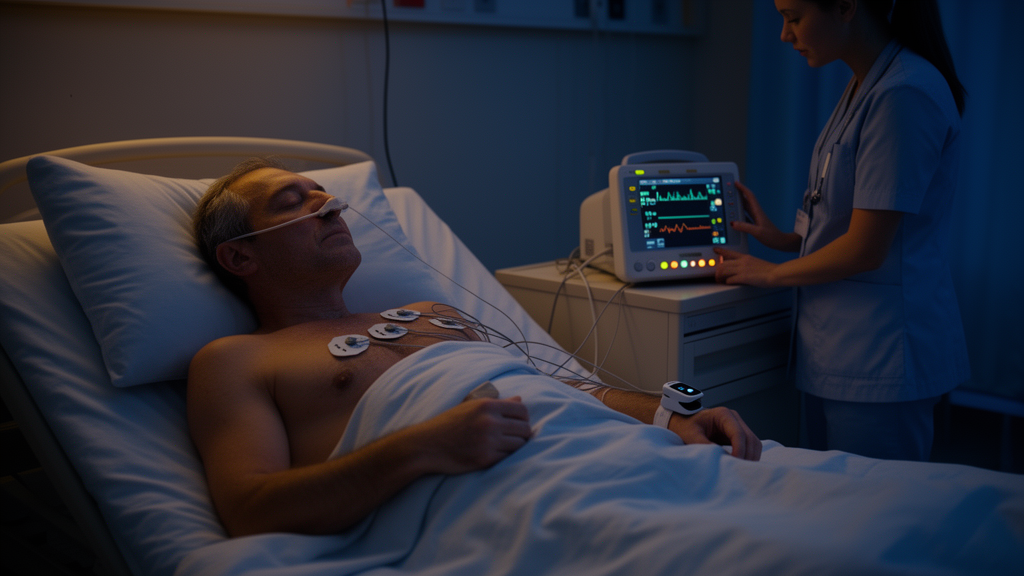
The study, published in Frontiers in Neuroscience, analysed 1,929 consecutive patients hospitalised for ischaemic stroke, haemorrhagic stroke, or transient ischaemic attack between January 2010 and December 2021. The cohort comprised 1,440 ischaemic strokes, 440 haemorrhagic strokes and 49 transient ischaemic attacks, with 61 percent men and a mean age of 65.9 years. All wore a Holter device that simultaneously recorded a two-to-three lead electrocardiogram at 200 Hz, thoracic impedance, and oxygen saturation from a Bluetooth wrist oximeter sampling once per second. Because all three signals were captured on a single time-referenced file, the derived indices aligned in time without any post-hoc synchronisation. Recordings began within 24 to 72 hours of admission and continued for 18 to 48 hours.
The scale of the underlying problem was striking. Using the oxygen desaturation index, or ODI, the number of drops in blood oxygen of at least 3 percent per hour, as the reference standard, suspected sleep-disordered breathing of any severity appeared in 74.6 percent of patients. Moderate-to-severe disease, defined as an ODI of 15 or more events per hour, affected 38.9 percent, and severe disease, at 30 or more events per hour, affected 17.1 percent. Men carried a somewhat heavier burden than women, with 41.1 percent showing an ODI at or above 15 per hour compared with 35.5 percent of women. These estimates sit within, though partly below, the ranges reported in large meta-analyses of post-stroke populations, a difference the authors attribute at least in part to the exclusion of arrhythmia patients from the analysable cohort.
Three electrocardiogram-derived indices were put to the test, each extracting breathing information from a different physiological signature. The Thoracic Impedance Disturbance Index, or TIDI, measures respiratory effort by passing a constant 1 mA alternating current at 50 kHz through the chest and tracking voltage changes, with cubic spline filtering removing cardiogenic artefacts. ECG-derived respiration, or EDR, reconstructs the breathing pattern from beat-to-beat changes in QRS complex area, since thoracic movement subtly alters the electrical morphology of each heartbeat; events lasting at least 10 seconds with at least 50 percent amplitude reduction were scored automatically. The Very Low Frequency Increment, or VLFI, instead reads autonomic oscillations in heart rate variability between 0.003 and 0.04 Hz, which rise during apnoeic episodes.
The two mechanical indices showed sharply complementary diagnostic profiles. At the moderate-to-severe threshold of ODI 15 or more per hour, TIDI achieved 93.3 percent sensitivity and a 90.8 percent negative predictive value, making it a powerful rule-out tool: a negative TIDI makes moderate or severe breathing disturbance unlikely. EDR, by contrast, delivered 80.2 percent specificity and 74.2 percent accuracy at the same threshold, and at the severe threshold of ODI 30 or more per hour it reached 92.4 percent specificity and 85.2 percent accuracy, positioning it as a rule-in tool. Bland-Altman analysis, however, showed wide limits of agreement for both indices, spanning roughly 26 events per hour in either direction for EDR, so neither can serve as a quantitative estimator of apnoea severity; their value is categorical, not numerical.
Combining the two indices sharpened the rule-in performance further. When both TIDI and EDR were independently positive, specificity rose to 85.2 percent at the moderate threshold and 95.4 percent at the severe threshold, with accuracy of 76.4 and 86.9 percent respectively, and positive predictive values of 72.9 and 67.3 percent. The cost was sensitivity, which fell to 62.5 percent and 45.5 percent, meaning a concordant positive result strongly suggests disease, but requiring concordance would miss a substantial share of true cases. The authors therefore frame the combined rule as an exploratory, post-hoc strategy for prioritising patients for confirmatory polysomnography, not as a standalone diagnostic.
The third index failed outright in this population. VLFI managed only 36.9 to 38.0 percent sensitivity and 52.0 to 58.0 percent accuracy across thresholds, a stark contrast to its original validation in middle-aged adults, where it had shown 87 percent sensitivity. The likely explanation lies in autonomic ageing: VLFI depends on intact heart rate variability responses to apnoeic events, and in this cohort its values followed an inverted-U relationship with age, peaking in the sixth to seventh decade before declining. With a mean cohort age of 65.9 years and heavy cardiovascular comorbidity, including hypertension in 72.4 percent of patients, the autonomic substrate that VLFI relies on appears compromised. The authors conclude it is unsuitable for elderly stroke populations.
Why does early detection matter? Sleep-disordered breathing after stroke is linked to intermittent hypoxaemia, sympathetic activation, endothelial dysfunction, prothrombotic states, and arrhythmias, and it is associated with impaired functional recovery and increased mortality. Moderate-to-severe obstructive sleep apnoea roughly doubles stroke risk over three to ten years in the general population, and previous trials suggest timing matters: early treatment of sleep apnoea after stroke has been associated with better neurological and functional outcomes, and continuous positive airway pressure use during inpatient rehabilitation has been linked to improved recovery. Screening from the acute phase onward is further justified by evidence that breathing disturbances are already frequent on the first night after cerebral infarction.
The study’s limitations are candid and consequential. ODI from wrist oximetry, not full polysomnography, served as the reference standard, and oximetry cannot distinguish obstructive from central apnoeas, the latter including Cheyne-Stokes respiration that may account for up to a quarter to a third of apnoeic events in acute stroke and often resolves spontaneously during recovery. Pulse oximetry is also vulnerable to motion artefact and hypoperfusion, both plausible in acutely ill stroke patients. Most importantly, patients in atrial fibrillation, with pacemaker rhythm, or with more than 10 percent ectopic beats, 705 of the initial 3,595 records, were excluded a priori because reliable EDR computation requires stable sinus rhythm. These arrhythmia patients may be among those at highest risk of sleep-disordered breathing, so both the prevalence estimates and the diagnostic performance may not generalise to them. A further 820 patients, 29.8 percent of those reaching that screening stage, were excluded for inadequate signal quality and may have included more severely affected patients, and sleep periods for EDR analysis were identified manually by a single analyst without actigraphy.
Even with those caveats, the practical appeal is hard to overstate. Holter monitoring for arrhythmia detection is already routine in most stroke units within the first days of admission, so the incremental burden amounts to adding a wrist oximeter and running software. A sequential workflow emerges naturally from the data: TIDI first as a high-sensitivity filter, EDR confirmation in positive cases, and formal polysomnography or type 2 polygraphy where results disagree or treatment is contemplated. The authors stress that prospective validation against polysomnography, extension of screening to arrhythmia patients with tools that do not depend on regular QRS morphology, and clinical outcome studies are still needed before implementation. But the core message stands: the equipment to begin identifying hidden breathing disorders is already strapped to the chests of thousands of stroke patients, simply waiting to be read differently.
Subject of Research: ECG Holter-based screening for sleep-disordered breathing in post-stroke patients
Article Title: ECG Holter-based screening for sleep-disordered breathing in post-stroke patients: a large monocentric cohort study
Article References: Monier, M., Pichot, V., Berger, M., Trombert, B., Garnier, P., Camdessanché, J.-P., & Roche, F. (2026). ECG Holter-based screening for sleep-disordered breathing in post-stroke patients: a large monocentric cohort study. Frontiers in Neuroscience, 20, Article 1973784. https://doi.org/10.3389/fnins.2026.1973784
Image Credits: AI Generated
DOI: 10.3389/fnins.2026.1973784
Keywords: stroke, sleep-disordered breathing, ECG Holter, screening, oxygen desaturation index, thoracic impedance, ECG-derived respiration, heart rate variability, polysomnography, sleep apnoea, diagnostic accuracy, cerebrovascular disease
News Source: Cassandra Pierce. (October 26, 2026). Routine Heart Monitors Reveal Hidden Sleep Breathing Problems in Stroke Patients. Scienmag.