A new laboratory study suggests that an activating mutation in the NRAS gene, or simple overexpression of the wild-type gene, can make ovarian cancer cells unusually vulnerable to the MEK inhibitor trametinib. The finding, published open access in the Journal of Cancer Research and Clinical Oncology, points to a possible route for extending MEK-targeted strategies beyond low-grade serous carcinoma, the setting from which this study deliberately excluded itself, although the evidence comes entirely from engineered cell models rather than patients.
Ovarian cancer remains difficult to diagnose early and frequently recurs, and recurring tumors are often resistant to the platinum-based chemotherapy that forms the backbone of first-line treatment. The RAS/RAF/MEK/ERK signaling pathway, which can be distorted by mutations in RAS-family proteins, influences tumor progression and chemoresistance. Trametinib targets this pathway by blocking MEK. The research team, led by Hugo T. H. Chen and Mingo M. H. Yung with senior authors including David W. Chan and Karen K. L. Chan, set out to test whether NRAS activity determines how non-low-grade serous ovarian cancer cells respond to this drug.
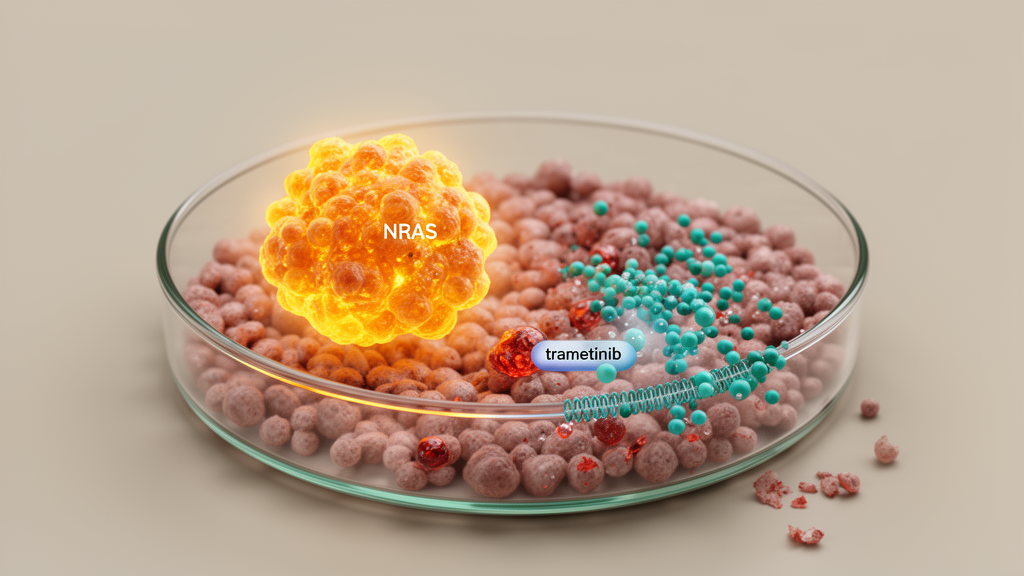
Methodologically, the group used retroviral transduction to force three established ovarian cancer cell lines — TOV112D, OVCA433 and ES2 — to express either wild-type NRAS or the gain-of-function NRASQ61K variant. These engineered models were then run through functional assays measuring proliferation, migration and invasion, with and without trametinib and with and without cisplatin, allowing direct comparison of cell behavior before and after treatment. Because the cell lines were manipulated to express NRAS at elevated levels or to carry the Q61K mutation, the models test a specific engineered condition rather than the natural mutation landscape of ovarian tumors.
The results showed that NRAS expression promoted proliferation as well as the migratory and invasive capacities of the ovarian cancer cells. Cells carrying the NRASQ61K mutation were more migratory and invasive still, and they displayed heightened susceptibility to MEK inhibition by trametinib. In a second, clinically relevant twist, trametinib also enhanced the cytotoxicity of cisplatin in the mutated models, indicating that MEK blockade may sensitize NRASQ61K cells to standard chemotherapy rather than merely acting as a standalone agent.
The authors conclude that the NRASQ61K mutation confers susceptibility to trametinib in selected engineered ovarian cancer models outside the low-grade serous carcinoma setting. The study type matters for interpretation: these are cell-line experiments with induced NRAS expression or mutation, so the findings establish a mechanistic vulnerability and a testable biomarker hypothesis, not demonstrated efficacy in patients. Whether NRAS upregulation or Q61K-type mutations can identify trametinib-responsive tumors in the clinic will require validation in patient-derived models and clinical trials. Nevertheless, the work adds a concrete piece to the puzzle of chemoresistant ovarian cancer, linking a specific RAS-family alteration to both aggressive cell behavior and a druggable dependence on the MEK/ERK pathway.
Subject of Research: NRAS-driven susceptibility to the MEK inhibitor trametinib in non-LGSC ovarian cancer cell models
Article Title: NRAS upregulation or gain-of-function mutation confers susceptibility to the MEK inhibitor trametinib in ovarian cancer models outside the LGSC setting
Article References: Chen, H. T. H., Yung, M. M. H., Siu, M. K. Y., Tang, C., Hui, L. M. H., Zhong, K. X., Lu, H., Liu, K., Ngan, H. Y. S., Tsui, S. K. W., Chan, D. W., & Chan, K. K. L. (2026). NRAS upregulation or gain-of-function mutation confers susceptibility to the MEK inhibitor trametinib in ovarian cancer models outside the LGSC setting. Journal of Cancer Research and Clinical Oncology. https://doi.org/10.1007/s00432-026-06645-z
Image Credits: AI Generated
DOI: 10.1007/s00432-026-06645-z
Keywords: ovarian cancer, NRAS, trametinib, MEK inhibitor, RAS/RAF/MEK/ERK pathway, Q61K mutation, cisplatin, cell line models, low-grade serous carcinoma, targeted therapy, gain-of-function, chemoresistance
News Source: Nathaniel Bowman. (October 26, 2026). NRAS mutation renders ovarian cancer cells vulnerable to MEK inhibitor trametinib. Scienmag.