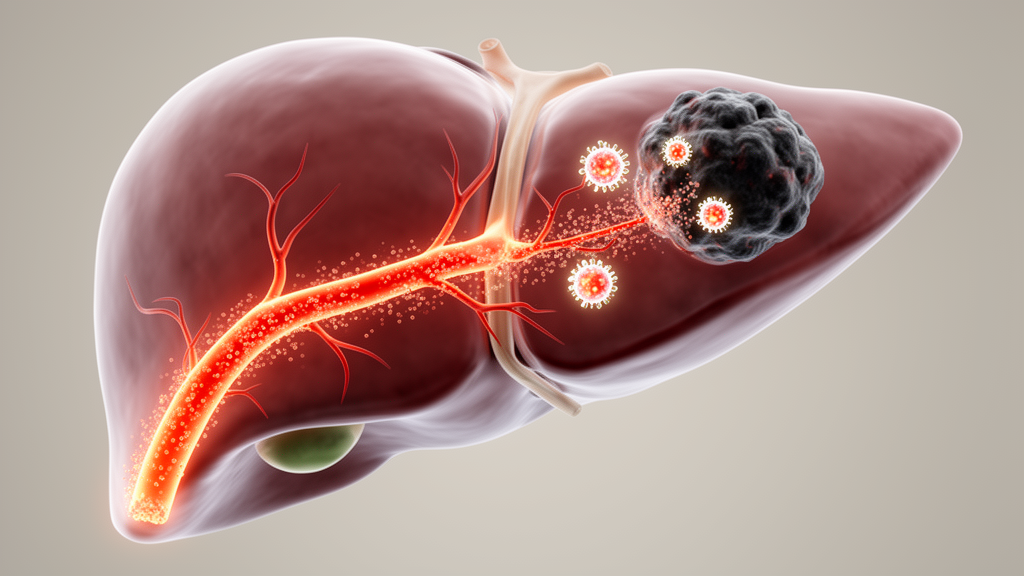
A systematic review and meta-analysis of fourteen retrospective cohort studies suggests that adding hepatic arterial infusion chemotherapy (HAIC) to transarterial chemoembolization (TACE), alongside targeted therapy and immune checkpoint inhibitors, may improve survival and tumor-response outcomes in patients with unresectable hepatocellular carcinoma. The analysis, conducted by researchers at The First Affiliated Hospital of Henan University of Science and Technology in Luoyang, China, compared TACE-HAIC combination regimens against both TACE-based and HAIC-based comparator strategies.
The research team searched eight databases, including CNKI, the Cochrane Library, Embase, PubMed, SinoMed, VIP, Wanfang, and Web of Science, from inception through August 19, 2026. Overall survival served as the sole primary efficacy outcome, while progression-free survival, objective response rate, disease control rate, and complete response were designated as secondary outcomes. The investigators used comparator-specific random-effects meta-analyses, assessed risk of bias for survival outcomes with the ROBINS-I tool, and evaluated certainty of evidence using the GRADE framework.
Fourteen retrospective cohort studies met the inclusion criteria. The TACE-based analysis pooled nine comparisons involving 1,510 participants, while the HAIC-based analysis pooled five comparisons involving 572 participants. All included studies were retrospective in design, a limitation that shapes how the pooled findings can be interpreted.
Against a comparator of TACE plus targeted therapy and immune checkpoint inhibitors, the addition of HAIC was associated with a lower hazard of death, with a hazard ratio of 0.59 and a 95 percent confidence interval of 0.47 to 0.75. The same comparison showed a lower hazard of progression or death, with a hazard ratio of 0.65 and a 95 percent confidence interval of 0.55 to 0.78. Tumor-response measures also favored the TACE-HAIC combination: the objective response rate ratio was 1.34 (95 percent CI: 1.19 to 1.52), the disease control rate ratio was 1.14 (95 percent CI: 1.07 to 1.21), and the complete response rate ratio was 2.17 (95 percent CI: 1.46 to 3.21).
When the comparator was an HAIC-based regimen rather than a TACE-based one, TACE-HAIC was again associated with a lower hazard of death (HR=0.56, 95 percent CI: 0.43 to 0.72) and a lower hazard of progression or death (HR=0.64, 95 percent CI: 0.48 to 0.86). The objective response rate was higher with TACE-HAIC in this comparison as well (RR=1.24, 95 percent CI: 1.03 to 1.50). However, disease control rate and complete response showed no clear between-group differences against the HAIC-based comparator.
Safety findings were less definitive. Overall grade 3 or higher treatment-related adverse events were imprecisely estimated in both comparisons. In the TACE-based analysis, the risk ratio was 1.16 with a 95 percent confidence interval of 0.81 to 1.67, and in the HAIC-based analysis it was 1.27 with a 95 percent confidence interval of 0.92 to 1.74. Because both confidence intervals crossed the threshold of no effect, the available evidence was insufficient to determine whether TACE-HAIC increases the overall risk of serious treatment-related adverse events.
The authors concluded that TACE-HAIC plus targeted therapy and immune checkpoint inhibitors was associated with improved survival and tumor-response outcomes compared with a TACE-based regimen. Against an HAIC-based regimen, the associations favored TACE-HAIC for overall survival, progression-free survival, and objective response rate in the main analyses, although the progression-free survival and objective response rate findings were less robust in sensitivity analyses. This weakening under sensitivity testing signals that some of the pooled estimates may be sensitive to the choice of included studies or analytical decisions.
The certainty of the evidence was rated as low to very low across outcomes, reflecting the retrospective design of all included studies and the inherent risk of confounding in cohort comparisons of treatment strategies. The authors stated that prospective validation is required before firm clinical conclusions can be drawn. The study addresses an ongoing question in the field: whether combining two liver-directed approaches, TACE and HAIC, adds benefit on top of targeted therapy and immune checkpoint inhibitors in unresectable hepatocellular carcinoma.
For clinicians and researchers, the meta-analysis provides a quantified synthesis of the currently available retrospective evidence rather than proof from randomized trials. The findings identify TACE-HAIC combination therapy as a strategy associated with favorable survival and response signals in both comparator settings, while leaving the safety question open and underscoring the need for higher-certainty, prospectively designed studies to confirm or refute these associations in patients with unresectable hepatocellular carcinoma.
Subject of Research: Meta-analysis of TACE-HAIC combined with targeted therapy and immune checkpoint inhibitors for unresectable hepatocellular carcinoma
Article Title: TACE-HAIC plus targeted therapy and immune checkpoint inhibitors for unresectable hepatocellular carcinoma: a systematic review and meta-analysis of TACE- and HAIC-based comparisons
Article References: Li, P., Li, H., Mei, B., Feng, S., & Niu, H. (2026). TACE-HAIC plus targeted therapy and immune checkpoint inhibitors for unresectable hepatocellular carcinoma: a systematic review and meta-analysis of TACE- and HAIC-based comparisons. Frontiers in Oncology, 16, Article 1942009. https://doi.org/10.3389/fonc.2026.1942009
Image Credits: AI Generated
DOI: 10.3389/fonc.2026.1942009
Keywords: hepatocellular carcinoma, TACE, HAIC, targeted therapy, immune checkpoint inhibitors, meta-analysis, systematic review, overall survival, progression-free survival, tumor response, unresectable liver cancer, GRADE certainty
News Source: Nathaniel Bowman. (October 25, 2026). Combining Liver Artery Therapies With Immunotherapy Shows Survival Gains in Advanced Liver Cancer Review. Scienmag.