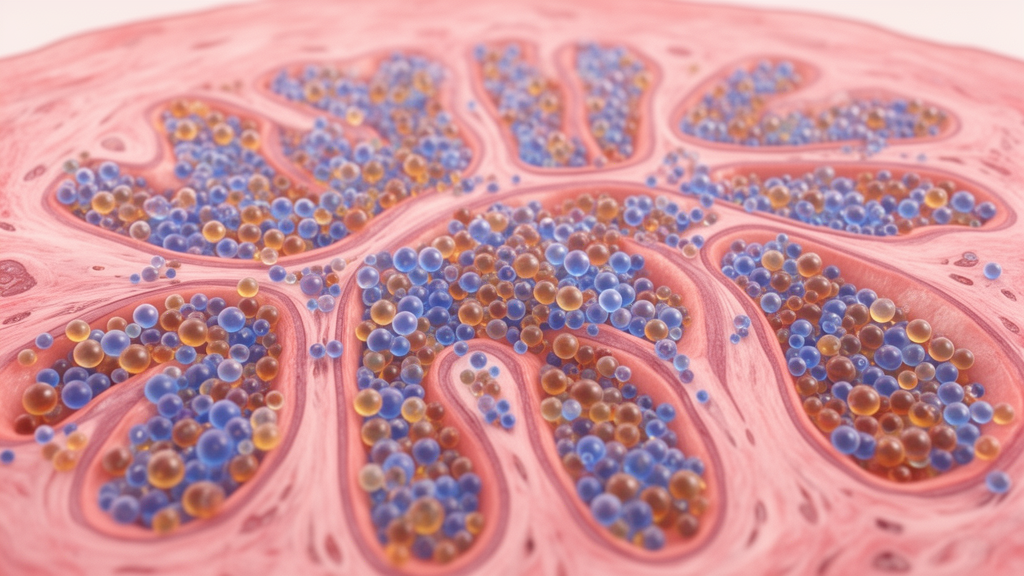
Colorectal cancers diagnosed before age 50 contained similar overall numbers of immune cells to those diagnosed later, but the cells were organized differently within the tissue, according to a brief report comparing early-onset and late-onset colorectal cancer. Imaging mass cytometry revealed distinct local patterns involving regulatory T cells, CD8+ T cells, helper T cells and granzyme B-positive, CD15-positive neutrophil-like cells. These differences were observed in a patient-sample study of 142,992 cells from 18 regions of interest and do not establish that the immune patterns caused either form of cancer.
Investigators analyzed 18 tissue regions from seven patients with early-onset colorectal cancer, or EOCRC, and ten patients with late-onset colorectal cancer, or LOCRC. The imaging mass cytometry data were processed with the Steinbock computational pipeline to examine both the composition and spatial organization of immune populations at single-cell resolution. Overall immune-cell abundance did not differ significantly between the two groups.
The findings therefore identify differences in cellular neighborhoods and interactions rather than a general increase or decrease in immune-cell abundance. Several spatial features distinguished the early-onset samples. EOCRC regions showed increased avoidance of GZMB+ neutrophil-like cells marked by CD15 by regulatory T cells, or Tregs.
They also showed increased interaction between CD8+ T cells and T-helper cells identified as CD3+ and CD4+. Tregs were significantly enriched within immune-enriched neighborhoods in EOCRC, with a reported 1.6-fold difference from LOCRC (p = 0.018). Patch-based analysis likewise measured 1.6-fold greater Treg enrichment in early-onset tumors (p = 0.03).
Both populations were reported at 0.5-fold, with p < 0.0001 for CD8+ T cells and p = 0.00054 for helper T cells. The investigators also observed a trend toward increased intraepithelial lymphocytes expressing CD8α in EOCRC, although the supplied results do not identify that trend as statistically significant. Immunohistochemistry in four independent EOCRC and four LOCRC tumors supported the principal abundance finding: Treg levels were 1.6-fold higher in the early-onset group (p < 0.0001).
The report is limited to a small number of patients and selected tissue regions, and it is an accepted brief report whose version may still undergo further edits. Its results support a measurable difference in the spatial organization of immune cells between early- and late-onset colorectal cancer, but they do not identify the biological cause of that difference. The analysis also does not demonstrate a clinical test, treatment benefit or patient outcome; rather, it provides a detailed cellular description of how the two groups differed in the tissue samples examined.
Subject of Research: Spatial organization of immune cells in early- versus late-onset colorectal cancer
Article Title: Spatial profiling reveals distinct immune microenvironments in early- vs late-onset colorectal cancer
Article References: Jani, N., Zhang, Z., Mallory, P., Yuichiro, H., Flynn, C., Pore, M., Nakanishi, M., & Rosenberg, D. W. (2026). Spatial profiling reveals distinct immune microenvironments in early- vs late-onset colorectal cancer. Cancer Immunology, Immunotherapy. https://doi.org/10.1007/s00262-026-04593-8
Image Credits: AI Generated
DOI: 10.1007/s00262-026-04593-8
Keywords: colorectal cancer, early-onset cancer, tumor immunology, immune microenvironment, imaging mass cytometry, regulatory T cells, CD8+ T cells, spatial profiling, single-cell analysis, Spatial, profiling, reveals
News Source: Nathaniel Bowman. (October 22, 2026). Early-onset colorectal cancer shows distinct immune-cell spatial patterns. Scienmag.