• HOME
  • NEWS
  • EXPLORE
    • CAREER
      • Companies
      • Jobs
    • EVENTS
    • iGEM
      • News
      • Team
    • PHOTOS
    • VIDEO
    • WIKI
  • BLOG
  • COMMUNITY
    • FACEBOOK
    • INSTAGRAM
    • TWITTER
Thursday, October 22, 2026
BIOENGINEER.ORG
No Result
View All Result
  • Login
  • HOME
  • NEWS
  • EXPLORE
    • CAREER
      • Companies
      • Jobs
        • Lecturer
        • PhD Studentship
        • Postdoc
        • Research Assistant
    • EVENTS
    • iGEM
      • News
      • Team
    • PHOTOS
    • VIDEO
    • WIKI
  • BLOG
  • COMMUNITY
    • FACEBOOK
    • INSTAGRAM
    • TWITTER
No Result
View All Result
Bioengineer.org
No Result
View All Result
Home NEWS Science News Cancer

Early-onset colorectal cancer shows distinct immune-cell spatial patterns

by
October 22, 2026
in Cancer
Reading Time: 2 mins read
0
Early-onset colorectal cancer shows distinct immune-cell spatial patterns

Early-onset colorectal cancer shows distinct immune-cell spatial patterns

Share on FacebookShare on TwitterShare on LinkedinShare on RedditShare on Telegram

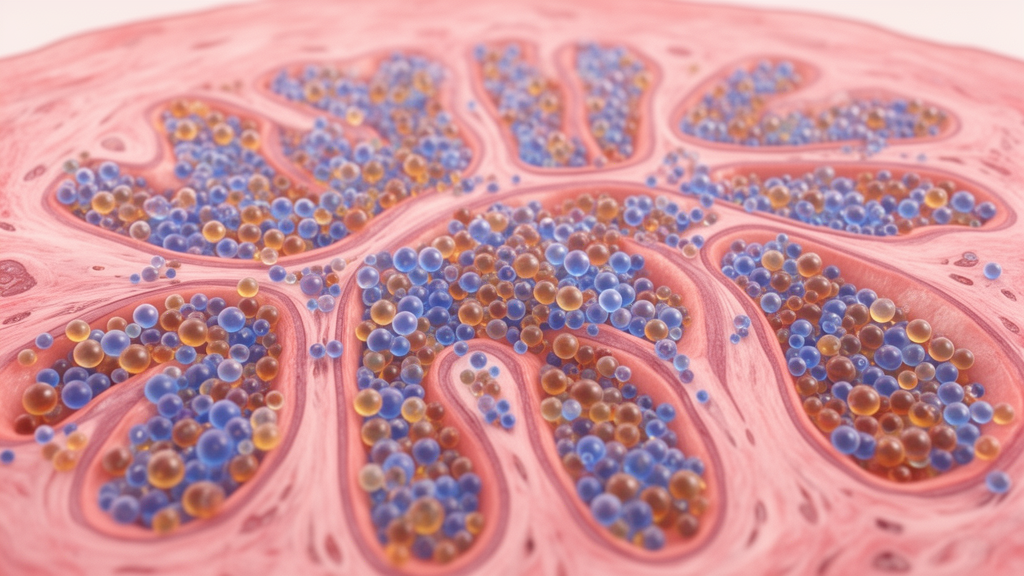
Colorectal cancers diagnosed before age 50 contained similar overall numbers of immune cells to those diagnosed later, but the cells were organized differently within the tissue, according to a brief report comparing early-onset and late-onset colorectal cancer. Imaging mass cytometry revealed distinct local patterns involving regulatory T cells, CD8+ T cells, helper T cells and granzyme B-positive, CD15-positive neutrophil-like cells. These differences were observed in a patient-sample study of 142,992 cells from 18 regions of interest and do not establish that the immune patterns caused either form of cancer.

Investigators analyzed 18 tissue regions from seven patients with early-onset colorectal cancer, or EOCRC, and ten patients with late-onset colorectal cancer, or LOCRC. The imaging mass cytometry data were processed with the Steinbock computational pipeline to examine both the composition and spatial organization of immune populations at single-cell resolution. Overall immune-cell abundance did not differ significantly between the two groups.

The findings therefore identify differences in cellular neighborhoods and interactions rather than a general increase or decrease in immune-cell abundance. Several spatial features distinguished the early-onset samples. EOCRC regions showed increased avoidance of GZMB+ neutrophil-like cells marked by CD15 by regulatory T cells, or Tregs.

They also showed increased interaction between CD8+ T cells and T-helper cells identified as CD3+ and CD4+. Tregs were significantly enriched within immune-enriched neighborhoods in EOCRC, with a reported 1.6-fold difference from LOCRC (p = 0.018). Patch-based analysis likewise measured 1.6-fold greater Treg enrichment in early-onset tumors (p = 0.03).

Both populations were reported at 0.5-fold, with p < 0.0001 for CD8+ T cells and p = 0.00054 for helper T cells. The investigators also observed a trend toward increased intraepithelial lymphocytes expressing CD8α in EOCRC, although the supplied results do not identify that trend as statistically significant. Immunohistochemistry in four independent EOCRC and four LOCRC tumors supported the principal abundance finding: Treg levels were 1.6-fold higher in the early-onset group (p < 0.0001).

The report is limited to a small number of patients and selected tissue regions, and it is an accepted brief report whose version may still undergo further edits. Its results support a measurable difference in the spatial organization of immune cells between early- and late-onset colorectal cancer, but they do not identify the biological cause of that difference. The analysis also does not demonstrate a clinical test, treatment benefit or patient outcome; rather, it provides a detailed cellular description of how the two groups differed in the tissue samples examined.

Subject of Research: Spatial organization of immune cells in early- versus late-onset colorectal cancer

Article Title: Spatial profiling reveals distinct immune microenvironments in early- vs late-onset colorectal cancer

Article References: Jani, N., Zhang, Z., Mallory, P., Yuichiro, H., Flynn, C., Pore, M., Nakanishi, M., & Rosenberg, D. W. (2026). Spatial profiling reveals distinct immune microenvironments in early- vs late-onset colorectal cancer. Cancer Immunology, Immunotherapy. https://doi.org/10.1007/s00262-026-04593-8

Image Credits: AI Generated

DOI: 10.1007/s00262-026-04593-8

Keywords: colorectal cancer, early-onset cancer, tumor immunology, immune microenvironment, imaging mass cytometry, regulatory T cells, CD8+ T cells, spatial profiling, single-cell analysis, Spatial, profiling, reveals

News Source: Nathaniel Bowman. (October 22, 2026). Early-onset colorectal cancer shows distinct immune-cell spatial patterns. Scienmag.


Tags: CD8+ T cellsColorectal cancerearly-onset cancerimaging mass cytometryimmune microenvironmentprofilingregulatory T cellsrevealssingle-cell analysisspatialspatial profilingtumor immunology
Share12Tweet7Share2ShareShareShare1

Related Posts

PSMA-PRED protocol plans biomarker search for lutetium-PSMA treatment response

PSMA-PRED protocol plans biomarker search for lutetium-PSMA treatment response

October 22, 2026
Remote follow-up after breast biopsy reduces anxiety, not pain

Remote follow-up after breast biopsy reduces anxiety, not pain

October 22, 2026

Multicenter Qualitative Study Finds Palliative-Oncology Team Differences May Shape End-of-Life Outcomes

October 22, 2026

Telephone counselling improves measured colostomy outcomes in three-month trial

October 22, 2026

POPULAR NEWS

  • DHA and arachidonic acid linked to modest attention gains in select preterm children

    DHA and arachidonic acid linked to modest attention gains in select preterm children

    29 shares
    Share 12 Tweet 7
  • Research report: Sea Ice Meltwater Alters Prokaryotic Community Structure and Interaction Networks in the Amundsen Sea, Antarctica

    29 shares
    Share 12 Tweet 7
  • Study links osteoporosis knowledge and preventive practices in Yerevan women

    29 shares
    Share 12 Tweet 7
  • Triploid large yellow croaker embryos show preserved development with localized molecular changes

    29 shares
    Share 12 Tweet 7

About

We bring you the latest biotechnology news from best research centers and universities around the world. Check our website.

Follow us

Recent News

DHA and arachidonic acid linked to modest attention gains in select preterm children

Research report: Sea Ice Meltwater Alters Prokaryotic Community Structure and Interaction Networks in the Amundsen Sea, Antarctica

Study links osteoporosis knowledge and preventive practices in Yerevan women

Subscribe to Blog via Email

Enter your email address to subscribe to this blog and receive notifications of new posts by email.

Join 85 other subscribers
  • Contact Us

Bioengineer.org © Copyright 2023 All Rights Reserved.

Welcome Back!

Login to your account below

Forgotten Password?

Retrieve your password

Please enter your username or email address to reset your password.

Log In
No Result
View All Result
  • Homepages
    • Home Page 1
    • Home Page 2
  • News
  • National
  • Business
  • Health
  • Lifestyle
  • Science

Bioengineer.org © Copyright 2023 All Rights Reserved.