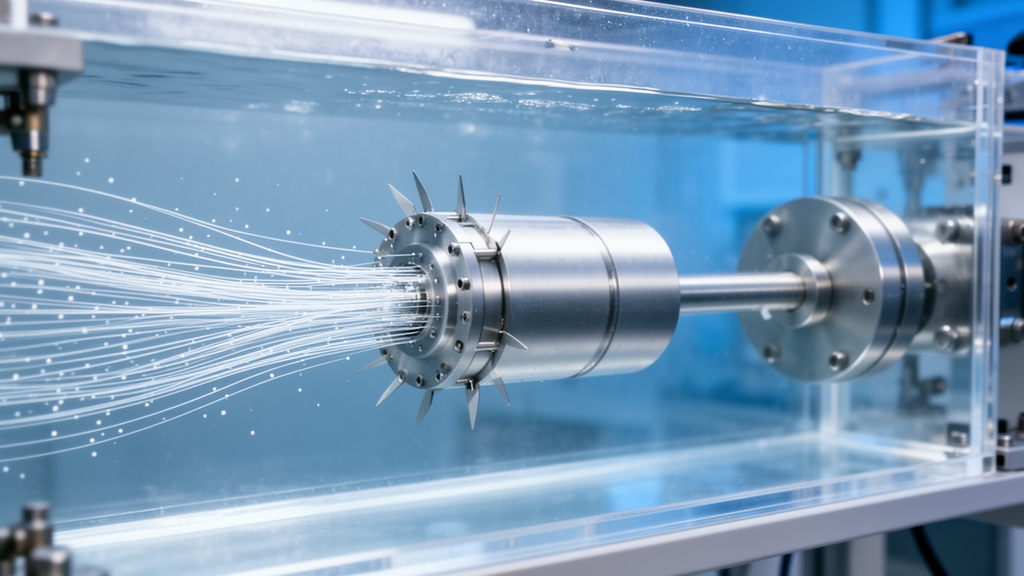
A reinforcement-learning controller developed for a wind-tunnel experiment reduced aerodynamic drag in the turbulent wake of a bluff body while also delivering net energy savings. The autonomous system, named REACT, used onboard sensors and servo-actuated surfaces and learned from sparse wind-tunnel measurements, bypassing empirical turbulence models. In the reported high-Reynolds-number environment, its state-dependent policy achieved two to four times greater performance than model-based baseline controllers.
REACT was deployed on an Ahmed-body model, a bluff body tested in the study’s wind tunnel. The experimental setup was designed to examine real-time control of turbulent wake dynamics rather than a simplified, steady-flow system. Across the reported tests, REACT discovered a policy that reduced drag and maximized energy efficiency by dynamically suppressing spatiotemporally coherent wake structures.
The researchers contrasted this dynamics-aware, state-dependent approach with standard reinforcement-learning policies that learned quasi-steady strategies oriented toward mean flow. Those baseline policies produced lower drag reduction and did not suppress the coherent instabilities identified in the turbulent-wake regime. The comparison therefore shows the measured advantage of REACT’s state-dependent control under the tested conditions, rather than a general guarantee for all turbulent-flow systems.
The controller was trained in a nondimensional state-reward space with amplitudes approximately invariant to Reynolds number, and it was conditioned on Reynolds number to provide temporal adaptation. Using this setup, the researchers report that an offline policy remained effective across Reynolds numbers from 86,400 to 518,400 without retraining. The work is an experimental demonstration in a high-Reynolds-number wind tunnel, using onboard sensing and servo-actuated surfaces to test autonomous reinforcement-learning control of a turbulent bluff-body wake.
Its reported outcomes include drag reduction, net energy savings, suppression of coherent instabilities and two-to-fourfold performance relative to model-based baselines. The authors describe the findings as a possible path toward data-driven, state-dependent control of turbulent flows, but the evidence comes from the wind-tunnel model rather than full-scale vehicles or other practical deployments. The article was shared as peer-reviewed, accepted research in Communications Engineering , with further edits possible before the final version of record.
Subject of Research: Experimental reinforcement learning for state-dependent control of turbulent bluff-body wakes
Article Title: Real-time reinforcement learning for turbulent state-dependent control in a bluff-body wake
Article References: Zhang, J., Xia, C., Jiang, X., Fumarola, I., & Rigas, G. (2026). Real-time reinforcement learning for turbulent state-dependent control in a bluff-body wake. Communications Engineering. https://doi.org/10.1038/s44172-026-00747-9
Image Credits: AI Generated
DOI: 10.1038/s44172-026-00747-9
Keywords: reinforcement learning, turbulent flow, wind tunnel, drag reduction, bluff-body wake, flow control, aerodynamics, Ahmed body, Reynolds number, machine learning, Real-time, reinforcement
News Source: Denise Maddox. (October 21, 2026). Reinforcement learning curbs drag in turbulent bluff-body wakes. Scienmag.