Plant cell-wall sensors form a shared control system linking normal growth with responses to pathogens, wounding and other stresses, according to a review synthesizing evidence from Arabidopsis, rice, maize, wheat, rose and other plant species. The focal proteins, known as wall-associated kinases or WAKs, span the plant plasma membrane: extracellular regions associate with pectin in the cell wall, while intracellular serine/threonine kinase domains transmit signals into the cell. By detecting changes in wall structure, WAKs help coordinate turgor-driven cell expansion as well as the activation of defense genes, reactive oxygen species and mitogen-activated protein kinase, or MAPK, cascades. The review identifies these receptors as potential molecular targets for improving crop disease resistance, but also emphasizes that major questions remain about ligand recognition, receptor distribution and genetic regulation.
The plant cell wall is not merely a static barrier. It is a dynamic matrix of carbohydrates and proteins that supports growth while providing physical and chemical defenses against infection. Primary walls contain cellulose and other carbohydrate polymers, while reinforced secondary walls in structures such as xylem can include additional xylan and lignin. During development, remodeling of these materials permits cells to expand, differentiate and form tissues. During pathogen attack, the same wall can be breached, chemically modified or degraded. Plant-produced antimicrobial proteins, phytoalexins and phytoanticipins can restrict potential intruders, but the review argues that wall integrity and wall-derived signals provide another layer of surveillance by linking physical damage to cellular defense. Compounds such as the fungitoxic 3-deoxy anthocyanin flavonoids produced by Sorghum bicolor at sites attacked by Colletotrichum species illustrate the localized chemical dimension of this response.
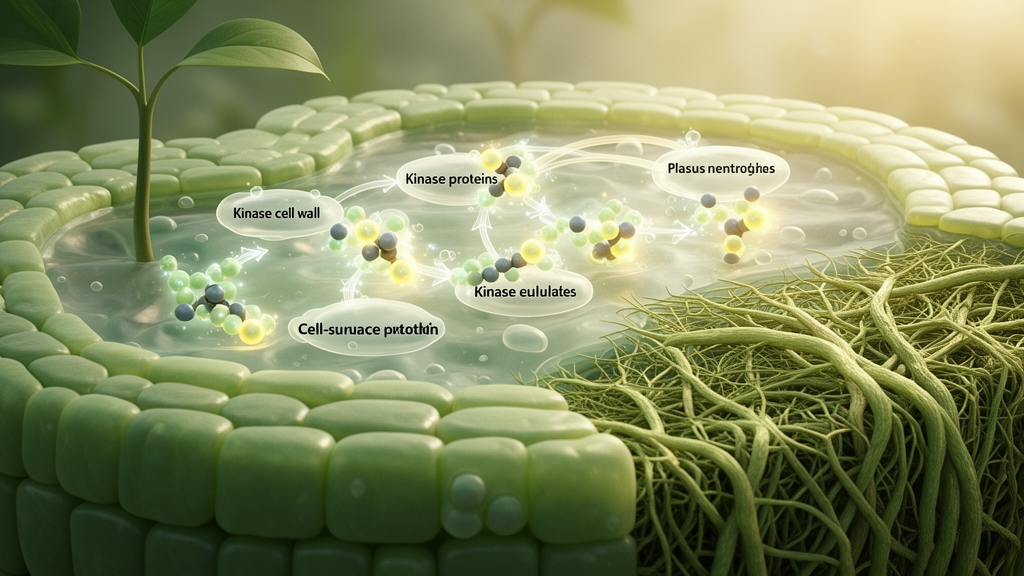
WAKs occupy a strategic position for wall surveillance because they are cross-linked to pectic material outside the cell and extend through the membrane into the cytoplasm. Their extracellular domains contain epidermal growth factor-like repeats, while their intracellular domains carry kinase activity. Pectin-removing enzymes release WAK proteins from wall material, and binding studies have shown that purified extracellular domains of WAK1 and WAK2 associate with pectic molecules. These include homo-galacturonans, oligogalacturonic acids and rhamnogalacturonans I and II, all of which contain galacturonic-acid backbones. WAKs generally bind more strongly to negatively charged, de-esterified pectins than to esterified forms, indicating that the charge and structure of wall pectin are important variables in receptor activation. The proteins also possess transmembrane and cytoplasmic kinase regions, allowing them to translate extracellular wall status into intracellular responses.
Experimental work in Arabidopsis links WAK2 signaling to sugar metabolism and turgor-driven root-cell expansion. A null mutation in WAK2 impairs root growth under low-sugar conditions, while wak2-1 roots show reduced vacuolar invertase activity and altered invertase RNA levels. Under one model, long-chain native pectin is de-esterified by pectin methylesterases and engages WAKs, leading to an MPK3 cascade, increased vacuolar invertase expression and the wall loosening required for elongation. Sucrose phosphate synthase and sugar-sink behavior have also been associated with the wak2-1 phenotype, although the exact mechanism by which WAKs affect turgor and sugar allocation remains unresolved. The evidence nevertheless places the receptors upstream of metabolic processes needed for cell enlargement rather than treating them simply as structural components of the wall.
The proposed defense route begins when pathogens, herbivores or mechanical injury alter the wall and release oligogalacturonide fragments, or OGs. These short pectin-derived molecules can act as damage-associated molecular patterns, abbreviated DAMPs. Their recognition by WAK extracellular domains is associated with activation of intracellular kinase domains and downstream signaling that includes calcium influx, MAPK cascades, reactive oxygen species production, callose deposition and transcriptional regulation of defense-related genes. The review distinguishes this stress response from the developmental pathway: long-chain native pectin is associated with growth-related MPK3 signaling, whereas pathogen-induced OGs are linked in the proposed model to MPK6 signaling, NADPH oxidase-dependent reactive oxygen species and defense outputs. This model presents wall damage as a signal that redirects cellular activity from growth toward defense and repair.
Downstream protein kinases help amplify and coordinate receptor-initiated events. MAPKs phosphorylate targets involved in transcriptional reprogramming, stress responses and defense-gene expression, while reactive oxygen species generated after pathogen recognition can contribute to disease resistance and serve as signaling molecules. Experimental studies have reported increased MPK3 activity after exposure to long pectin polymers and activation of MPK3 by OGs. Other receptor-like kinases, including SFR2 in Brassica oleracea and PR5K in Arabidopsis, have also been associated with wounding, bacterial infection or disease resistance. Plant resistance to pathogens depends substantially on early recognition, and the accumulated evidence supports a network in which WAKs feed information into MAPK, calcium and reactive-oxygen-associated pathways rather than acting as isolated receptors.
The genetic architecture of plant resistance provides another way to interpret WAK function. Major resistance genes can confer strong, race-specific qualitative resistance, although pathogen populations may overcome such genes. Quantitative resistance, by contrast, is usually polygenic, with each locus making a smaller contribution to overall disease limitation. Quantitative resistance loci may influence physical barriers, defense signaling, the circadian clock, detoxification of pathogen-produced phytotoxins and the production of antimicrobial compounds. Camalexin sensitivity has been associated with quantitative resistance in the Arabidopsis–Botrytis pathosystem, while salicylic acid, jasmonic acid and ethylene pathways interact in the regulation of susceptibility. WAK-associated genes are not interchangeable with classical major resistance genes, but they may contribute to quantitative resistance by enabling earlier perception of wall damage and more effective downstream responses. The rice Xa21 protein, a transmembrane kinase with extracellular leucine-rich repeats, illustrates another kinase-linked route to disease resistance.
Genetic experiments in Arabidopsis reveal why individual WAK functions can be difficult to separate. Five Arabidopsis WAK genes lie within a cluster of about 30 kilobases, complicating the production of double or triple mutants. A WAK2 null allele reduces root-cell expansion under low-sugar and salt conditions, whereas loss of several other WAK alleles produced no visible phenotype in the cited experiments. Antisense suppression of WAK proteins, by contrast, reduced protein levels and produced smaller cells, supporting a role in elongation. A hyperactive WAK2 allele designated cTAP generated reactive oxygen species, ectopic lesions, leaf curling, stunted growth and cell death. The phenotype required an active receptor, indicating that uncontrolled WAK signaling can shift wall surveillance toward a damaging stress response rather than simply amplifying growth or immunity. These findings also show that a null phenotype in one WAK gene does not necessarily rule out overlapping or compensatory functions among family members.
Evidence from diverse crops indicates that WAK and WAK-like genes can be associated with enhanced resistance to fungal and bacterial pathogens. Rice WAK proteins have been linked to basal defense against blast disease, while other reports associate WAK-family proteins with resistance in maize, Arabidopsis, cereals and rose. The wheat Yr36 locus encodes WKS1, a kinase carrying a START-related lipid-transfer domain, and confers broad-spectrum resistance to stripe rust under temperatures of 25–35 °C. Yr36 is not a classical WAK receptor, so it is not direct proof of WAK-mediated immunity; instead, it demonstrates how a broader family of kinase-mediated mechanisms can contribute to crop protection. Studies of chimeric receptors and the conserved architecture of plant immune receptors also support considering receptor differences as a basis for conventional breeding, marker-assisted selection and genome editing.
The review presents WAKs as multifunctional signaling hubs rather than separate regulators of growth and immunity, but it also makes clear that the evidence is not yet sufficient for immediate agricultural deployment. It remains unclear how WAKs distinguish among pectins with different galacturonic-acid structures, how they selectively respond to esterified and de-esterified forms, and how they are distributed within the wall. The genetic controls that determine WAK abundance, ligand specificity and downstream responses also remain poorly documented. Most evidence comes from individual genetic, biochemical or physiological studies using particular species, tissues, pathogens and stress conditions. The review generated and analyzed no new dataset and did not test a breeding intervention or a field-level disease outcome. Its practical significance is therefore prospective: better characterization of wall integrity sensors, damage-associated molecular patterns and their receptor relationships could reveal ways to strengthen plant immunity, while resolving binding specificity and signaling context will determine how reliably laboratory findings can be translated into crops with durable, broad-spectrum resistance.
Subject of Research: Review of wall-associated kinase signaling in plant development and pathogen defense
Article Title: Role of cell wall-associated kinases in plant development and defense responses
Article References: Asemoloye, M. D., & Olowe, O. M. (2026). Role of cell wall-associated kinases in plant development and defense responses. Molecular Biology Reports, 53(1), Article 1507. https://doi.org/10.1007/s11033-026-12695-w
Image Credits: AI Generated
DOI: 10.1007/s11033-026-12695-w
Keywords: plant immunity, cell wall integrity, wall-associated kinases, pectin signaling, plant development, damage-associated molecular patterns, MAPK cascades, crop disease resistance, reactive oxygen species, protein kinases, Role, cell
News Source: Drew Townsend. (October 21, 2026). Review maps plant cell-wall kinase links between growth and defense. Scienmag.