• HOME
  • NEWS
  • EXPLORE
    • CAREER
      • Companies
      • Jobs
    • EVENTS
    • iGEM
      • News
      • Team
    • PHOTOS
    • VIDEO
    • WIKI
  • BLOG
  • COMMUNITY
    • FACEBOOK
    • INSTAGRAM
    • TWITTER
Wednesday, October 21, 2026
BIOENGINEER.ORG
No Result
View All Result
  • Login
  • HOME
  • NEWS
  • EXPLORE
    • CAREER
      • Companies
      • Jobs
        • Lecturer
        • PhD Studentship
        • Postdoc
        • Research Assistant
    • EVENTS
    • iGEM
      • News
      • Team
    • PHOTOS
    • VIDEO
    • WIKI
  • BLOG
  • COMMUNITY
    • FACEBOOK
    • INSTAGRAM
    • TWITTER
No Result
View All Result
Bioengineer.org
No Result
View All Result
Home NEWS Science News Cancer

ACSS2 inhibition boosts cabozantinib activity in liver cancer models

by
October 21, 2026
in Cancer
Reading Time: 2 mins read
0
ACSS2 inhibition boosts cabozantinib activity in liver cancer models

ACSS2 inhibition boosts cabozantinib activity in liver cancer models

Share on FacebookShare on TwitterShare on LinkedinShare on RedditShare on Telegram

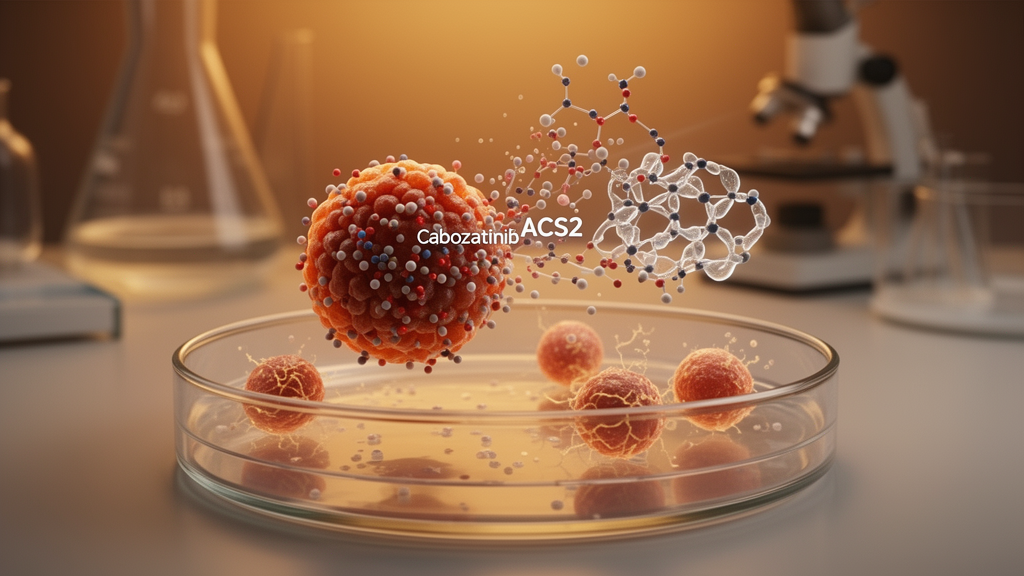
Cabozantinib increased autophagic flux in hepatocellular carcinoma cells, helping protect the cancer cells from the drug’s growth-inhibitory and pro-apoptotic effects, according to a laboratory study. Combining cabozantinib with either an inhibitor of ACSS2 or the autophagy inhibitor chloroquine enhanced antitumor activity in cell cultures and animal models. The findings identify a potential resistance mechanism and a candidate combination strategy, but they do not establish clinical benefit in people with hepatocellular carcinoma.

Researchers used RNA sequencing to analyze changes in gene expression after cabozantinib treatment in hepatocellular carcinoma cells. They also used a luciferase reporter assay to measure the transcriptional activity of transcription factor EB, or TFEB. Additional experiments examined the effects of cabozantinib alone or in combination with autophagy inhibitors, with findings assessed in vitro and in vivo. The study’s mechanistic and therapeutic experiments were conducted in preclinical models rather than in patients.

The mechanistic results indicated that cabozantinib increased the expression of acetyl-CoA synthetase 2, or ACSS2, and promoted its nuclear translocation. Nuclear ACSS2 was linked to activation of TFEB. TFEB then bound to promoter regions of lysosomal and autophagy-related genes, promoting lysosomal biogenesis and inducing autophagic flux. Thus, the experiments placed ACSS2 upstream of TFEB-dependent autophagy in the response of hepatocellular carcinoma cells to cabozantinib. The authors described this process as a protective response that counteracted the drug-induced inhibition of cell growth and apoptosis.

Impairing autophagy increased the cancer-cell killing associated with cabozantinib. Downregulating ACSS2 promoted cabozantinib-induced apoptosis, while treatment with an ACSS2 inhibitor enhanced the antitumor efficacy of cabozantinib in vitro and in vivo. Chloroquine produced a similar enhancement when used in combination with cabozantinib, supporting the conclusion that blocking autophagic flux can increase sensitivity to the treatment. These results were reported across both cell-based and animal experiments, although the supplied study abstract does not provide numerical response measures, statistical results, model details or other effect-size estimates.

The study proposes that cabozantinib can induce an ACSS2-TFEB-autophagy pathway that allows hepatocellular carcinoma cells to resist treatment, and that inhibiting ACSS2 or autophagy may counteract that response. The work offers a mechanistic basis for examining cabozantinib-based combinations in hepatocellular carcinoma. Its scope is preclinical: the reported evidence comes from cancer cells and animal models, not a clinical trial. Accordingly, the results show enhanced antitumor activity in experimental models and do not yet demonstrate that the combinations improve outcomes for patients with liver cancer.

Subject of Research: Preclinical enhancement of cabozantinib activity in hepatocellular carcinoma through ACSS2 and autophagy inhibition

Article Title: Inhibition of ACSS2 enhances cabozantinib sensitivity by blocking TFEB-induced autophagic flux in hepatocellular carcinoma

Article References: Feng, X., Lan, J., Du, J., Jiang, C., Qiu, G., Song, Y., Zhou, X., Zhang, Z., Xu, L., Hu, D., Liang, Y., Huang, J., Zeng, Y., & Yuan, K. (2026). Inhibition of ACSS2 enhances cabozantinib sensitivity by blocking TFEB-induced autophagic flux in hepatocellular carcinoma. British Journal of Cancer. https://doi.org/10.1038/s41416-026-03538-3

Image Credits: AI Generated

DOI: 10.1038/s41416-026-03538-3

Keywords: hepatocellular carcinoma, cabozantinib, ACSS2, TFEB, autophagic flux, drug resistance, chloroquine, lysosomal biogenesis, cancer cells, animal models, Inhibition, enhances

News Source: Nathaniel Bowman. (October 21, 2026). ACSS2 inhibition boosts cabozantinib activity in liver cancer models. Scienmag.

Tags: ACSS2animal modelsautophagic fluxCabozantinibcancer cellschloroquinedrug resistanceenhancesHepatocellular CarcinomaInhibitionlysosomal biogenesisTFEB
Share12Tweet7Share2ShareShareShare1

Related Posts

Systematic review maps tyrosine kinase inhibitor evidence in canine solid tumours

Systematic review maps tyrosine kinase inhibitor evidence in canine solid tumours

October 21, 2026
TCR-engineered T cells advance toward harder liver cancer targets

TCR-engineered T cells advance toward harder liver cancer targets

October 21, 2026

Commentary proposes etiological tumor classification for clinical research

October 21, 2026

Research report: Swallowing exercise adherence in patients with head and neck cancer based on the dual-process model: a qualitative study

October 21, 2026

POPULAR NEWS

  • Textile organic electrochemical transistors in biosensing and bioelectronics including materials architectures and emerging applications

    Textile organic electrochemical transistors in biosensing and bioelectronics including materials architectures and emerging applications

    29 shares
    Share 12 Tweet 7
  • Research report: Adjuvant EGFR-TKI therapy in completely resected non–small cell lung cancer with major uncommon EGFR mutations: a real-world study

    29 shares
    Share 12 Tweet 7
  • Soybean drought resilience requires field validation across African environments

    29 shares
    Share 12 Tweet 7
  • Reinforcement learning curbs drag in turbulent bluff-body wakes

    29 shares
    Share 12 Tweet 7

About

We bring you the latest biotechnology news from best research centers and universities around the world. Check our website.

Follow us

Recent News

Textile organic electrochemical transistors in biosensing and bioelectronics including materials architectures and emerging applications

Research report: Adjuvant EGFR-TKI therapy in completely resected non–small cell lung cancer with major uncommon EGFR mutations: a real-world study

Soybean drought resilience requires field validation across African environments

Subscribe to Blog via Email

Enter your email address to subscribe to this blog and receive notifications of new posts by email.

Join 85 other subscribers
  • Contact Us

Bioengineer.org © Copyright 2023 All Rights Reserved.

Welcome Back!

Login to your account below

Forgotten Password?

Retrieve your password

Please enter your username or email address to reset your password.

Log In
No Result
View All Result
  • Homepages
    • Home Page 1
    • Home Page 2
  • News
  • National
  • Business
  • Health
  • Lifestyle
  • Science

Bioengineer.org © Copyright 2023 All Rights Reserved.