A study combining analysis of human liver-tumor samples, experiments with hepatocellular carcinoma (HCC) cells and mouse models found that switch-associated protein 70 (SWAP70) promotes tumor-cell proliferation and tumor growth by increasing carnitine palmitoyltransferase 1A (CPT1A)-mediated fatty acid β-oxidation under glucose deficiency. SWAP70 expression was significantly elevated in HCC tissues, particularly in advanced tumors, and was associated with poor overall survival. The research identifies a metabolic pathway that may contribute to HCC development, but it does not establish a treatment for patients.
The researchers first evaluated SWAP70 expression and its relationship to clinical outcomes using bioinformatics analysis and immunohistochemistry on clinical tissue microarrays. SWAP70 is a multidomain protein that binds and bundles F-actin and has roles in multiple cellular functions. The tissue analysis showed that SWAP70 was upregulated in HCC, especially in advanced disease, and that high expression correlated with poorer overall survival. These observations associate SWAP70 with tumor severity and prognosis in the analyzed samples; they do not by themselves show that SWAP70 causes the clinical outcomes in patients.
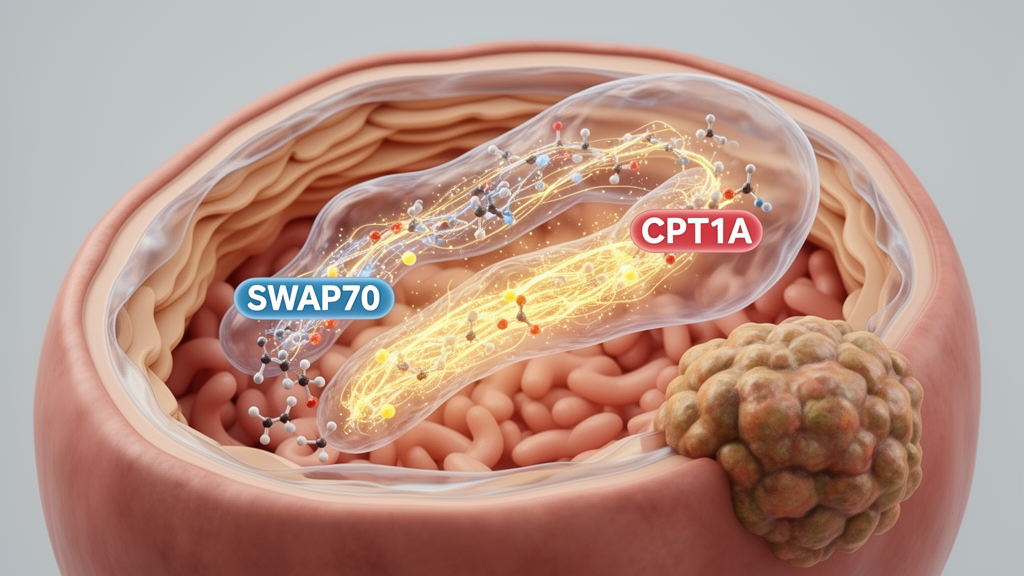
Functional studies then examined the effects of SWAP70 in HCC cells and animals. SWAP70 promoted proliferation in cultured cells and increased tumor growth in vivo. To investigate the mechanism behind these effects, the research team used multi-omics analysis. The analysis linked SWAP70 activity to increased mitochondrial fatty acid β-oxidation through upregulation of CPT1A, which the study identifies as a rate-limiting enzyme in this pathway. When CPT1A was silenced, the proliferative effect mediated by SWAP70 was abolished, supporting CPT1A’s role as a downstream component of the SWAP70-associated growth effect.
The study also identified a regulatory mechanism that connects glucose deficiency with SWAP70 expression. Under conditions of glucose deficiency, AMP-activated protein kinase (AMPK) was activated. This activation suppressed the expression of hepatocyte nuclear factor 4 alpha (HNF4A), which acts as a transcriptional repressor of SWAP70. With HNF4A-mediated repression reduced, SWAP70 expression increased, enhancing CPT1A-mediated fatty acid β-oxidation and supporting HCC-cell proliferation. The experimental sequence therefore links glucose deficiency to AMPK activation, lower HNF4A expression, higher SWAP70 expression and increased CPT1A-dependent fatty acid oxidation.
The investigators assessed the possible therapeutic relevance of the pathway in a mouse model of HCC induced with diethylnitrosamine and carbon tetrachloride. Silencing SWAP70 delayed tumor progression in this model. That result supports SWAP70 as a contributor to HCC development in the experimental system and suggests that suppressing it may warrant further investigation. The evidence presented is preclinical: the work includes tissue analysis, cell experiments and mouse models, and it does not demonstrate the safety or efficacy of SWAP70-directed treatment in people. The supplied article is an early accepted version that remains subject to further editing, so the findings should be regarded as an experimental description of the SWAP70–HNF4A–CPT1A pathway rather than a validated human therapeutic strategy.
Subject of Research: SWAP70 regulation of fatty acid metabolism and proliferation in hepatocellular carcinoma
Article Title: SWAP70 promotes hepatocellular carcinoma proliferation by enhancing CPT1A-mediated fatty acid β-oxidation under glucose deficiency
Article References: He, J., Wang, Y., & Zhang, D. (2026). SWAP70 promotes hepatocellular carcinoma proliferation by enhancing CPT1A-mediated fatty acid β-oxidation under glucose deficiency. Cellular and Molecular Life Sciences. https://doi.org/10.1007/s00018-026-06490-w
Image Credits: AI Generated
DOI: 10.1007/s00018-026-06490-w
Keywords: hepatocellular carcinoma, SWAP70, CPT1A, fatty acid β-oxidation, glucose deficiency, AMPK, HNF4A, tumor metabolism, liver cancer, mouse models, promotes, hepatocellular
News Source: Nathaniel Bowman. (October 20, 2026). SWAP70 promotes liver cancer growth through CPT1A-dependent fatty acid oxidation. Scienmag.