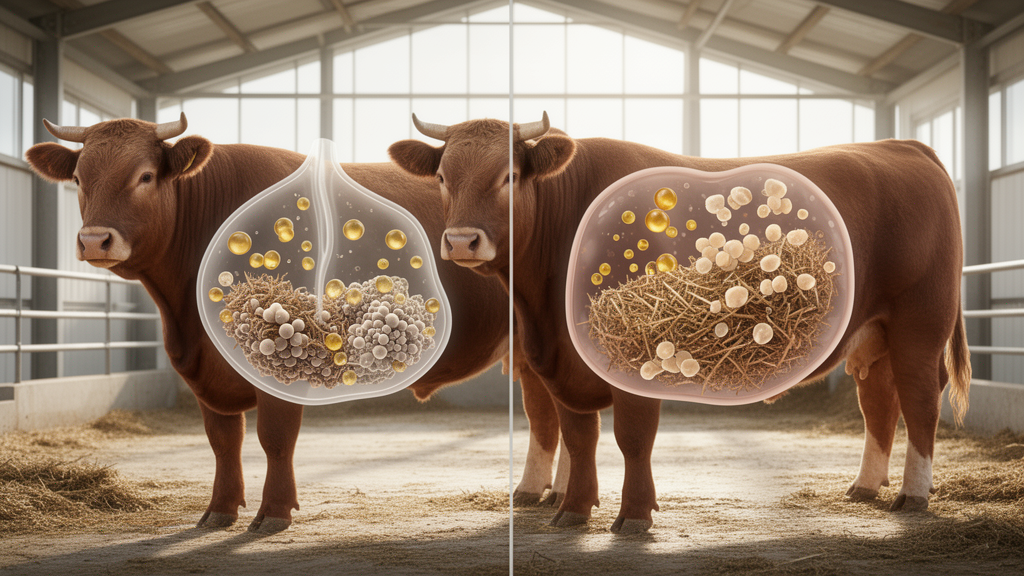
A comparative study of Japanese Wagyu and Nanyang cattle found breed-associated differences across the rumen microbiome, fermentation metabolites and muscle proteins related to lipid metabolism. Metagenomic analysis identified distinct carbohydrate-active enzyme profiles in the two breeds, while fermentation measurements showed higher ruminal acetate and butyrate concentrations in Wagyu cattle and higher propionate concentrations in Nanyang cattle. Proteomic analysis of longissimus dorsi muscle also found breed-associated differences in proteins involved in lipid synthesis, lipid storage and energy metabolism, providing an association between rumen microbial functions and host lipid metabolic profiles.
The researchers compared the rumen microbial community composition and functional profiles of the two cattle breeds. Their metagenomic analysis identified differential abundances of carbohydrate-active enzyme families associated with polysaccharide degradation. Wagyu cattle had greater abundances of glycoside hydrolase families GH5, associated with cellulose degradation, and GH92, associated with alpha-mannan degradation. Nanyang cattle showed enrichment of GH13, associated with starch degradation, and GH43, associated with arabinoxylan and arabinan degradation. The analysis also detected breed-associated differences in carbohydrate-degrading genera, including Prevotella, Fibrobacter and Butyrivibrio.
The microbial functional differences coincided with distinct fermentation profiles. Rumen fluid from Wagyu cattle contained higher concentrations of acetate and butyrate, whereas Nanyang cattle had higher propionate concentrations. These measured differences accompanied the metagenomic patterns but did not establish a causal sequence in which particular microbial enzymes or fermentation metabolites produced the observed host-protein differences. Instead, the study treated the rumen microbial community, fermentation metabolites and host proteome as linked layers that could be assessed together.
Proteomic analysis identified breed-associated differences in longissimus dorsi muscle proteins involved in lipid synthesis, lipid storage and energy metabolism. Five proteins were more abundant in Wagyu cattle: fatty acid binding protein 4, fatty acid synthase, perilipin 1, acetyl-CoA synthetase short-chain family member 2 and isocitrate dehydrogenase 1. Correlation analysis then examined relationships among microbial taxa, CAZyme families, fermentation metabolites and the host proteins related to lipid metabolism and intramuscular fat deposition. The authors reported associations across a microbiota–volatile fatty acid–proteome axis linking these measurements with intramuscular fat deposition.
Because the study compared two breeds, its findings show coordinated differences rather than proving that any single microbial taxon, enzyme family, fermentation product or muscle protein causes breed-associated changes in fat deposition. The reported results do not demonstrate that manipulating the rumen microbiome or one metabolite would reproduce a lipid profile in either breed. Nevertheless, the analysis offers a multi-layer account of breed-associated metabolic organization: carbohydrate-related microbial functions, measured ruminal fermentation patterns and host lipid-related proteins varied together in Japanese Wagyu and Nanyang cattle. This association-focused comparison provides a basis for further studies examining how rumen microbial functions may relate to lipid deposition in cattle, without establishing a causal mechanism.
Subject of Research: Associations between rumen microbial carbohydrate metabolism and host lipid metabolism in Wagyu and Nanyang cattle
Article Title: Rumen microbiome carbohydrate metabolism is associated with host lipid metabolic differences between Wagyu and Nanyang cattle
Article References: Xu, L., Zhang, H., Ma, Y., Lin, F., Liang, C., Hu, S., Zhang, P., Gu, J., & Shi, M. (2026). Rumen microbiome carbohydrate metabolism is associated with host lipid metabolic differences between Wagyu and Nanyang cattle. Applied Microbiology and Biotechnology. https://doi.org/10.1007/s00253-026-14075-7
Image Credits: AI Generated
DOI: 10.1007/s00253-026-14075-7
Keywords: rumen microbiome, Wagyu cattle, Nanyang cattle, carbohydrate-active enzymes, volatile fatty acids, intramuscular fat, muscle proteomics, metagenomics, host lipid metabolism, cattle breeds, Rumen, microbiome
News Source: Morgan Morrow. (October 20, 2026). Rumen microbial functions associated with lipid differences in two cattle breeds. Scienmag.