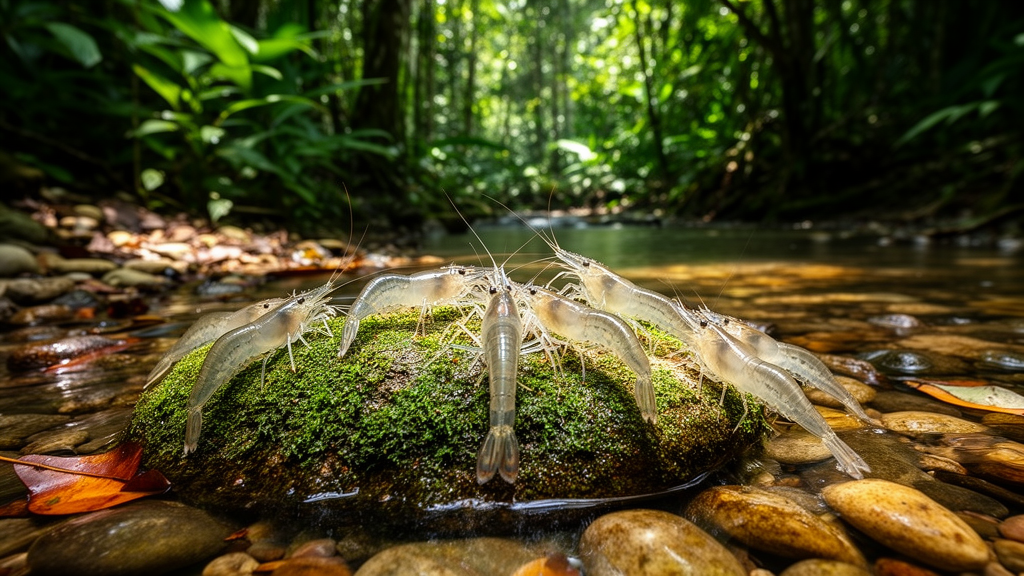
An integrative taxonomic study of freshwater shrimp in the genus Caridina has identified eight new species on Hainan Island, China, bringing the island’s recorded Caridina diversity from 11 to 19 species. The research combined detailed morphological examination with mitochondrial DNA analysis and field observations from streams in China and Vietnam. Seven of the new species are currently known only from their type localities in Hainan, while the eighth, Caridina caii, was separated from a population previously identified as C. clinata.
The findings show that closely similar shrimp can conceal substantial species diversity, while also highlighting the vulnerability of the island’s isolated freshwater habitats. The research focused on a nine-member complex centered on Caridina clinata, a small freshwater shrimp originally described in 1999 from Cuc Phuong National Park in northern Vietnam. Its close relative C. haivanensis was described a decade later from the Hai Van Mountain Pass in central Vietnam.
Phylogenetic analyses based on the mitochondrial cytochrome c oxidase subunit I gene, or COI, and the 16S ribosomal RNA gene resolved the complex into nine distinct, well-supported clades. C. clinata was recorded from both Vietnam and China, C. haivanensis remained restricted to Vietnam, and the seven newly described members of the complex were endemic to Hainan. Hainan is a continental island of 33,900 square kilometres in the South China Sea and the second-largest island in China.
Its high central terrain and lower surrounding areas produce a radial river system, including the Nandu, Changhua and Wanquan rivers, which together drain more than 3,000 square kilometres. The island’s varied geology, climate and habitats spanning marine, brackish and freshwater environments have contributed to high endemism. The newly described shrimp are locally distributed: Caridina fontinalis was found at a spring outlet near Haikou, while C. wenchangensis, C. qiongzhongensis, C. huangi, C. hepingensis, C. tunchengensis and C. brevilineata were each recovered from streams associated with particular towns in Wenchang, Qiongzhong, Tunchang and Qionghai.
Fieldwork was conducted from 2023 to 2025 at 14 sites, comprising 12 locations on Hainan and two in Vietnam representing material of C. clinata and C. haivanensis from their type regions. Researchers used fine-mesh dip nets and baited traps, recorded GPS coordinates and photographed habitats and live animals, and measured site conditions including substrate, water current, pH, dissolved oxygen and ammonia nitrogen. Specimens were preserved in ethanol and examined with a stereomicroscope.
For molecular analysis, DNA was extracted from abdominal muscle, the COI and 16S loci were amplified and sequenced, and the aligned sequences were trimmed to 490 and 473 base pairs, respectively. A concatenated maximum-likelihood analysis used the GTR+G+I model, with branch support evaluated through 1,000 bootstrap replicates. The eight new species were named Caridina wenchangensis, C. qiongzhongensis, C. huangi, C. hepingensis, C. fontinalis, C. tunchengensis, C. brevilineata and C. caii.
Their recognition rested on combined evidence rather than a single diagnostic character. Relevant traits included the length and tooth armature of the rostrum, proportions of the walking legs, form of the male reproductive appendages, structure of the telson, uropodal spines and egg dimensions. For example, C. fontinalis, described from cool water with stable flow, has a shorter rostrum and fewer teeth than C. lanceifrons, with which it occurs at the same sampling site.
C. brevilineata, whose name refers to short body stripes, differs from C. clinata in its leaf-shaped male first pleopod endopod, reduced rostral armature and the absence of a finger-like projection on the first maxilliped palp. The Wuzhishan population supplied the clearest instance of a revised identification. It had been assigned to C. clinata by Cai in 2014 because of its resemblance to C. lanceifrons, but new specimens from the locality and topotypic C. clinata from Vietnam showed that it was distinct in both morphology and genetics.
The Wuzhishan shrimp differed from C. clinata by 25.4–29.3% in COI sequence divergence and 10.8–12.1% in 16S divergence. It also possessed a pointed, subtriangular male first pleopod endopod rather than the rounded form found in C. clinata, a relatively broad second walking-leg carpus, fewer spines on the fifth leg and smaller eggs. The researchers named the species C. caii in honour of carcinologist Cai Y.
X., who discovered the species and made substantial contributions to carcinology. Genetic evidence also supported retaining the Ledong population of Hainan within C. clinata. Shrimp from Ledong differed from Vietnamese populations by only 0.6–1.2% in COI sequences and 0.7–1.6% in 16S, and the two populations occupied the same well-supported phylogenetic clade.
Although some morphological measurements varied, the male first pleopod and second pleopod appendages were closely alike. By contrast, C. wenchangensis was genetically closest to C. tunchengensis and C. clinata but remained a separate supported lineage. C. huangi and C. hepingensis, collected from unconnected streams in the same county, were likewise distinguishable in both morphology and genetic distance.
Members of the C. clinata complex occupy the middle and upper reaches of mountain streams. They shelter beneath leaf litter, among marginal vegetation or on muddy, sandy, gravelly and rocky substrates, generally in slow- to moderately flowing water. The complex produces relatively few large eggs, a reproductive pattern associated with direct larval development into benthic juveniles and an exclusively freshwater life cycle.
Field observations recorded dense populations in several streams, including the Ledong, Wuzhishan, Qiongzhong, Heping and Tuncheng localities, but lower densities at the Wenchang, Haikou and Qionghai sites. The study sampled only a limited set of streams, so the geographic range and population trends of the newly described taxa remain incompletely characterized. The survey also documented pressures on the habitats of these isolated shrimp.
Rubber and areca-nut plantations surround many streams, and intensive irrigation has reduced flow in some locations. Temporary in-stream diversions installed during droughts have left sections of streams completely desiccated, while pipelines have been used to extract water for domestic use. Hydropower and irrigation infrastructure further fragments river corridors, and agricultural chemicals threaten water quality.
Their specific effects on native shrimp remain undocumented, although predation, resource competition and disease transmission are recognized pathways through which invasive species can reduce native biodiversity. Following the International Union for Conservation of Nature’s Red List Categories and Criteria, the researchers classified all eight newly described species as Data Deficient because they are known only from their type localities and broader distribution data are unavailable. C. clinata retained the Data Deficient assessment assigned in an earlier evaluation.
These classifications identify major gaps in knowledge rather than low or high extinction risk. The study supports regular monitoring of wild populations and public-awareness efforts emphasizing the ecological importance of freshwater shrimp, while its broader sampling and genetic records provide a baseline for future surveys of Hainan’s stream biodiversity and for reassessing the conservation status of the newly recognized species.
Subject of Research: Taxonomic and phylogenetic study of the Caridina clinata species complex in Hainan and Vietnam
Article Title: Integrative taxonomy reveals the Caridina clinata Cai, Nguyen & Ng, 1999 species complex ( Crustacea , Decapoda , Atyidae ), with descriptions of eight new species from Hainan Island, China
Article References: Hou, J., Zhang, J., Chen, B., Zhang, Y., Chen, W., & Guo, Z. (2025). Integrative taxonomy reveals the Caridina clinata Cai, Nguyen & Ng, 1999 species complex (Crustacea, Decapoda, Atyidae), with descriptions of eight new species from Hainan Island, China. Zoosystematics and Evolution, 101(4), 2295-2336. https://doi.org/10.3897/zse.101.172207
Image Credits: AI Generated
Keywords: Caridina shrimp, Hainan Island, integrative taxonomy, cryptic species, freshwater biodiversity, molecular phylogeny, COI sequencing, 16S rRNA, species delimitation, conservation assessment, Integrative, taxonomy
News Source: Margaret Porter. (October 20, 2026). Integrative study reveals eight new endemic freshwater shrimp species on Hainan. Scienmag.