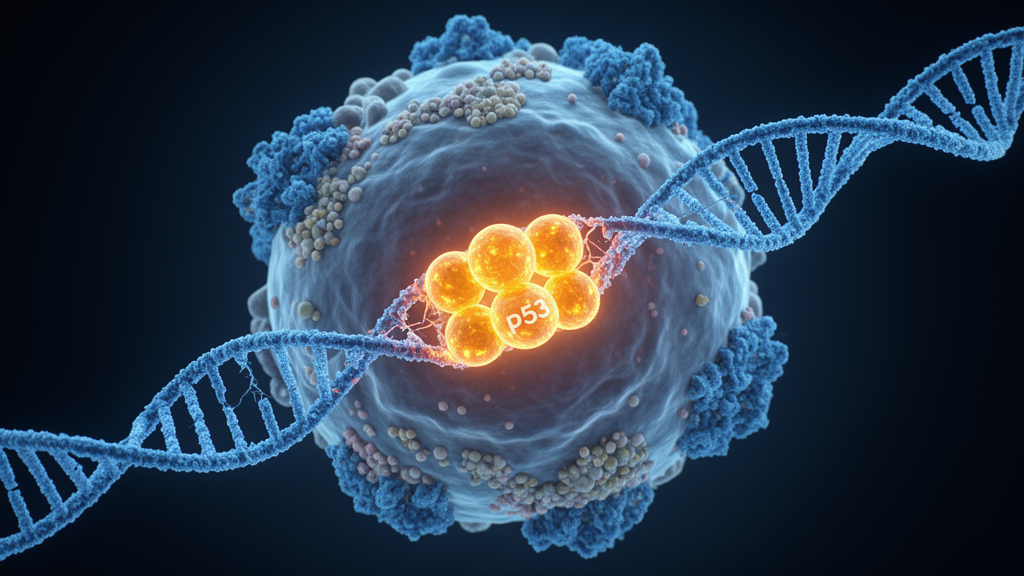
In one of the most striking recent developments in cancer biology, an international team of researchers spanning Japan, Portugal, and Italy has identified a previously unknown protein form of p53, arguably the most famous molecule in all of medicine. The new variant, named Δ246p53, is a compact protein of roughly 18 kilodaltons that is produced from an unexpected starting point within the TP53 gene. The discovery, published in Cell Death Discovery, adds a thirteenth member to the already crowded family of p53 protein isoforms and suggests that our understanding of how cells decide between life and death remains far from complete. What makes the finding particularly compelling is that Δ246p53 is not a genetic accident or a laboratory artifact. It appears to be a naturally occurring, evolutionarily conserved, and tightly regulated molecular player that responds directly to DNA damage and helps push damaged cells into senescence, the permanent growth arrest that serves as one of the body’s most important defenses against cancer.
To appreciate why this discovery matters, it helps to recall what p53 actually does. Often called the guardian of the genome, p53 sits at the center of a vast cellular decision network, determining whether a stressed cell should pause and repair its DNA, permanently stop dividing, or initiate its own destruction. When p53 malfunctions, the consequences can be catastrophic: uncontrolled cell division leads to cancer, while excessive p53 activity has been linked to degenerative conditions and premature aging. Because the stakes are so high, the TP53 gene is among the most complexly regulated in the human genome. It encodes at least ten different RNA variants and, until now, twelve widely accepted protein forms, each generated through alternative promoters, splicing patterns, or translation start sites. The sheer diversity of these forms reflects the gene’s central role in orchestrating cellular fate, and each new isoform discovered offers a fresh window into how that orchestration is fine-tuned.
The newly identified Δ246p53 arises through a mechanism known as alternative translation initiation. Rather than being produced from a separate RNA transcript, it is translated from the same messenger RNA that makes full-length p53, but the protein-building machinery of the cell starts reading at a different point: codon 246. This internal starting signal, or translation initiation site, is preceded by a strong Kozak sequence, a consensus motif that ribosomes recognize as an efficient place to begin protein synthesis. The result is a truncated protein that lacks the first 245 amino acids of the full-length protein but retains the critical DNA-binding domain and the C-terminal region. Remarkably, when the researchers compared TP53 sequences across vertebrate species, they found that this internal initiation site and its surrounding Kozak context are conserved all the way from sea lamprey, one of the most primitive living vertebrates, to humans. Such deep evolutionary conservation is a strong hint that the production of Δ246p53 is not random noise but a feature that natural selection has preserved for hundreds of millions of years.
One of the greatest challenges in studying small protein isoforms is proving that they genuinely exist in cells rather than appearing only under artificial laboratory conditions. The team, led by Shrutee N. Parkar and Marco M. Candeias of Kyoto University’s Graduate School of Medicine, together with colleagues at the National Institute of Health Doutor Ricardo Jorge, the University of Lisbon, the University of Coimbra, and the University of Trento, mounted an unusually rigorous verification campaign. They introduced frameshift mutations and start codon mutations into the TP53 sequence and showed that these alterations abolished production of the 18-kilodalton protein, confirming that translation truly begins at codon 246. They then detected Δ246p53 using five different antibodies, each recognizing a distinct epitope spanning from the N-terminus to the C-terminus of the protein. Critically, an antibody raised against a region of the DNA-binding domain just upstream of the new initiator methionine, a region that Δ246p53 by definition does not contain, failed to detect the protein, serving as an elegant negative control.
The researchers went further, deploying genetic tools that specifically silenced the new isoform without touching the full-length protein. Small interfering RNAs and an antisense oligonucleotide designed to target the translation initiation site at codon 246 knocked down Δ246p53 levels while leaving full-length p53 largely unaffected. This selective knockdown is technically significant because it demonstrates that the two protein forms can be independently manipulated, opening the door to functional studies that would otherwise be impossible. Together, the mutation analysis, the multi-antibody validation, and the targeted silencing build a case for the existence of Δ246p53 that is difficult to dismiss, meeting a standard of evidence that has sometimes been lacking in earlier reports of p53 isoforms.
Having established that Δ246p53 is real, the team turned to the question of what it does. The answer, in short, is that it behaves like a damage-activated amplifier of the p53 family’s senescence program. When cells were exposed to DNA-damaging agents, levels of Δ246p53 rose, indicating that the isoform is part of the cellular response to genotoxic stress. In colony formation assays, a standard test of a cell’s ability to proliferate and form visible colonies, the presence of Δ246p53 impaired tumor formation and growth, and the isoform triggered cellular senescence, the state of permanent proliferative arrest that stops potentially malignant cells in their tracks. These observations position Δ246p53 as a tumor-suppressive factor in its own right, capable of reinforcing the growth-arrest decisions that full-length p53 makes under stress.
The mechanistic story that emerged from the study is particularly intriguing because Δ246p53 does not simply mimic the full-length protein. Instead, it engages in two distinct interactions with different members of the p53 protein family. First, Δ246p53 physically interacts with full-length p53 itself. This interaction leads to a decrease in the expression of two well-known p53 target genes: HDM2, the negative feedback regulator that normally keeps p53 in check, and p21, the cyclin-dependent kinase inhibitor that executes cell cycle arrest. The reduction of these targets suggests that Δ246p53 modulates, rather than merely duplicates, the canonical p53 transcriptional program, potentially reshaping the balance of the feedback loops that govern p53 activity in damaged cells.
Second, and perhaps more surprisingly, Δ246p53 interacts with ΔNp63, an isoform of p63, a close evolutionary relative of p53 that plays essential roles in epithelial development and tumor suppression. Through this interaction, Δ246p53 enables the activation of p21 in a manner that depends on p63 rather than on p53. This p53-independent route to p21 induction is a significant conceptual advance, because p21 has long been viewed primarily as a direct transcriptional target of p53. The finding that a small p53 isoform can act as a bridge, recruiting the p63 pathway to drive p21 expression and thereby promote senescence, reveals an unexpected layer of crosstalk within the p53 family. It suggests that the family members, which include p53, p63, and p73, do not operate as parallel branches but can be physically and functionally coupled through their shorter isoforms in ways that biologists are only beginning to map.
The broader implications of the work extend in two directions at once, and both are likely to energize the field. On the cancer side, Δ246p53’s ability to impair tumor formation and growth marks it as a potential ally of tumor suppression, and understanding how its production is regulated could reveal vulnerabilities in cancers that evade senescence. On the aging side, senescence is a double-edged sword: while it protects against cancer in the young, the accumulation of senescent cells over a lifetime contributes to tissue degeneration and chronic inflammation, a phenomenon now widely studied under the banner of cellular aging. A naturally occurring factor that specifically promotes senescence through p21 regulation could therefore be a key to understanding, and perhaps eventually controlling, the trade-off between cancer prevention and aging that p53 sits at the heart of. As the authors note, future studies of Δ246p53 are likely to deepen our grasp of both tumor suppression and the biology of growing old.
There is also a methodological lesson embedded in this discovery. Δ246p53 was hiding in plain sight within one of the most intensively studied genes in biology, detectable only through careful attention to translation start sites and the use of antibodies mapped to precise epitopes. The fact that its initiating codon is conserved from sea lamprey to humans implies that other conserved internal initiation sites may lurk within the p53 family and beyond, waiting to be uncovered by similar approaches. For a gene that has been examined by tens of thousands of laboratories over more than four decades, the emergence of a thirteenth protein form is a humbling reminder that even the most familiar molecular landscapes still hold surprises. The identification of Δ246p53 does not rewrite the p53 story, but it adds an entirely new chapter, one that connects translation control, protein family crosstalk, and the ancient cellular decision to stop dividing in the face of damage.
Subject of Research: Discovery of the Δ246p53 protein isoform and its role in DNA damage response and cellular senescence
Article Title: New Δ246p53 isoform responds to DNA damage to enhance p53 family functions in cellular senescence
Article References: Parkar, S. N., Ramalho, A. C., López-Iniesta, M. J., Silva, R., Zhao, J., Kimura, K., Dassi, V., da Silva Rita, F., Ciribilli, Y., Bisio, A., Romão, L., & Candeias, M. M. (2026). New Δ246p53 isoform responds to DNA damage to enhance p53 family functions in cellular senescence. Cell Death Discovery. https://doi.org/10.1038/s41420-026-03374-7
Image Credits: AI Generated
DOI: 10.1038/s41420-026-03374-7
Keywords: p53, Δ246p53, protein isoform, DNA damage, cellular senescence, tumor suppression, p21, ΔNp63, alternative translation initiation, TP53, aging, cancer biology
News Source: Beatrice Stafford. (October 9, 2026). Hidden p53 Variant Δ246p53 Emerges as a DNA Damage Sentinel Driving Cellular Senescence. Scienmag.