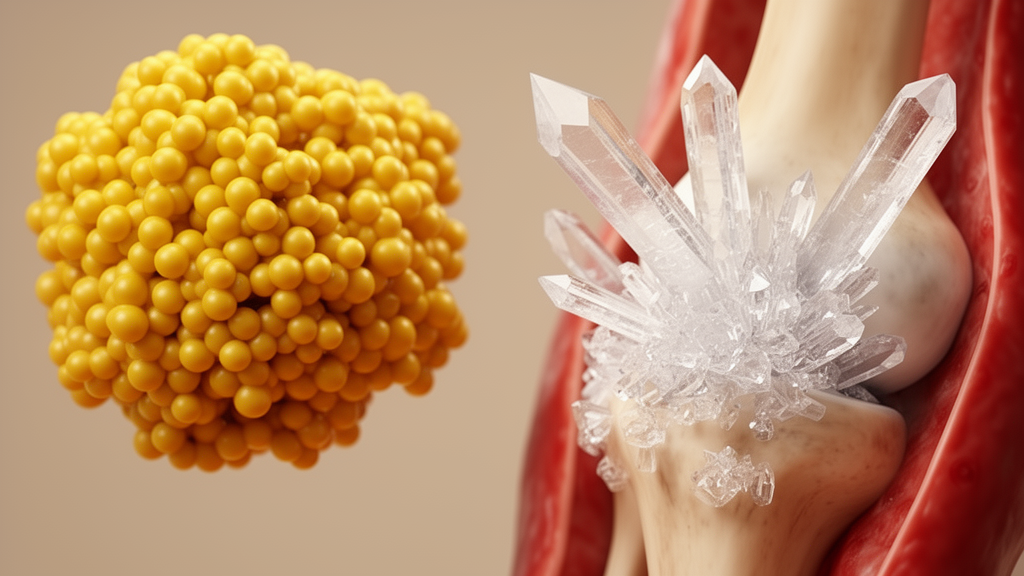
A simple number that cardiologists have quietly relied on for years is now drawing attention from an unexpected corner of medicine: the orthopedic ward. In a retrospective cross-sectional study published in BMC Endocrine Disorders, a team of Chinese researchers reports that adults hospitalized with fractures who carry a higher ratio of non-high-density lipoprotein cholesterol to high-density lipoprotein cholesterol, a measure known as the NHHR, are modestly more likely to also have hyperuricemia, the elevated serum uric acid condition that underlies gout and has been increasingly tied to metabolic disease. The finding is not a dramatic breakthrough, and the authors are unusually candid about its limits, but it adds a technically interesting piece to the puzzle of how lipid metabolism and uric acid homeostasis intertwine in aging bodies.
The study, led by Ming-xin Chen and colleagues at the Affiliated Kunshan Hospital of Jiangsu University and Wuxi Ninth People’s Hospital Affiliated to Soochow University, analyzed 2,699 adults aged 50 and older who were admitted with fractures. Each patient contributed a single index hospitalization, defined as the first eligible admission during the study period, and all biochemical measurements were drawn from fasting blood samples obtained within the first 24 hours of admission. That early sampling window was a deliberate design choice: later inpatient values were excluded because surgery, fasting, stress, and fluid shifts can distort lipid and uric acid readings as hospitalization proceeds. Hyperuricemia was defined using sex-specific thresholds, with serum uric acid at or above 416 micromoles per liter in men and at or above 357 micromoles per liter in women, cutoffs consistent with the solubility limit of monosodium urate in physiological conditions.
Across the cohort, 418 patients, or 15.5 percent, met the definition of hyperuricemia. When the researchers modeled the odds of prevalent hyperuricemia against the NHHR expressed per one standard deviation, they found a prevalence odds ratio of 1.188, with a 95 percent confidence interval of 1.061 to 1.330 and a p-value of 0.003. Translated into plain terms, each standard deviation increase in the cholesterol ratio was associated with roughly a 19 percent higher odds of having elevated uric acid. Because odds ratios can overstate effect sizes when an outcome is not rare, the team also computed modified-Poisson prevalence ratios, a technique that estimates the ratio of actual prevalences directly. That complementary estimate came in at 1.129, a 13 percent higher prevalence per standard deviation, still statistically robust with a confidence interval of 1.045 to 1.220.
The statistical machinery behind these numbers deserves attention, because it reflects how modern observational epidemiology tries to protect itself against its own weaknesses. Missing data were handled through multiple imputation across 20 datasets, with the pooled estimates drawn from that ensemble rather than from any single filled-in version of the data. Covariate selection was clinically informed rather than purely algorithmic, and kidney function was accounted for using flexible adjustment for estimated glomerular filtration rate, an important step since the kidneys are the primary route of uric acid excretion and reduced filtration capacity can inflate serum urate independently of any lipid effect. Sensitivity analyses using complete cases, selection weighting, and alternative uric acid thresholds were run to test whether the headline association was an artifact of any single modeling decision.
Those sensitivity checks told a more cautious story. The selection-weighted estimates, at an odds ratio of 1.191 and a prevalence ratio of 1.131, were nearly identical to the primary results, which is reassuring. But the complete-case analysis, restricted to patients with no missing values on the relevant variables, produced an odds ratio of 1.130 with a confidence interval of 0.999 to 1.277, brushing against the boundary of statistical significance. The authors attribute this fragility to lipid missingness and limited positivity, the technical term for situations where certain combinations of covariates are rare or absent in the data, making it hard to estimate effects across the full covariate distribution. In other words, the association is real enough to appear consistently, but its precise magnitude depends on assumptions about why some laboratory values were never measured.
Perhaps the most sobering result concerns what the NHHR adds beyond its component parts. When triglycerides and low-density lipoprotein cholesterol were included in the same joint model, the NHHR odds ratio shrank to 1.046 with a confidence interval of 0.876 to 1.248, comfortably spanning the null. This is a classic demonstration of collinearity in lipid epidemiology: the ratio is mathematically constructed from cholesterol fractions that travel together with triglycerides and LDL in the metabolic syndrome cluster, so much of the apparent signal is shared information rather than independent predictive power. Variance inflation factor and correlation analyses in the supplementary material quantify this overlap, and the joint model makes clear that the ratio does not carve out a large independent niche once its ingredients are accounted for.
The team also probed whether the ratio could improve actual risk prediction, using cross-validated area under the receiver operating characteristic curve as the yardstick. Adding NHHR to an existing model nudged the AUC from 0.777 to 0.780, an incremental gain of 0.0026 with a conditional 95 percent interval running from minus 0.0016 to 0.0070, an interval that includes zero. For readers unfamiliar with discrimination metrics, an AUC of 0.5 indicates performance no better than a coin flip, while 1.0 indicates perfect separation; the baseline model already performed respectably, and the cholesterol ratio contributed essentially nothing measurable on top of it. The authors explicitly state that no validated prediction role or clinical NHHR cutoff is established by this work, a disclaimer that guards against the common temptation to convert a statistical association into a screening recommendation overnight.
Nonlinearity, another fashionable question in modern epidemiology, fared no better. The researchers searched for threshold effects or U-shaped relationships between the ratio and uric acid, but the evidence proved unstable after trimming extreme NHHR values, meaning that any apparent curvature in the raw data was driven by a handful of outlying patients rather than a reproducible biological pattern. This matters because nonlinear claims, once published, tend to metastasize into clinical folklore about optimal target values. By reporting the instability transparently, the study models a kind of negative-result honesty that is still too rare in the literature on metabolic biomarkers.
There is also a deeper physiological caveat that the authors flag: fasting blood drawn within 24 hours of a fracture admission cannot fully separate chronic metabolic status from the acute physiology of hospitalization. Trauma, pain, immobility, and the inflammatory response to injury all shift lipid and uric acid levels, and while restricting sampling to the first day minimizes the most dramatic perturbations, it cannot eliminate them. The fracture-hospitalized population is itself a selected one, enriched for older adults, and often for osteoporosis and frailty, so extrapolating the findings to healthy community populations requires caution. Selection-weighted analyses attempted to correct for the gap between the 2,699 analyzed patients and a larger 4,719-person target population, with balance diagnostics confirming that weighting improved covariate balance, but no weighting scheme can conjure data that were never collected.
What, then, is the takeaway from this study? It is a carefully executed, honestly reported observation that a lipid ratio long used as a composite marker of atherogenic burden, capturing both the cholesterol carried in potentially harmful particles and the protective capacity of HDL, travels alongside elevated uric acid in a real-world clinical population. The association is modest, statistically fragile at the margins, largely redundant with triglycerides and LDL, and of no demonstrated predictive value. Yet the biological plausibility is genuine: insulin resistance, visceral adiposity, and renal handling of both urate and lipids form a tightly connected metabolic web, and elevated uric acid has been implicated in oxidative stress, endothelial dysfunction, and inflammation. Studies like this one, which quantify an association and then meticulously document how far it can and cannot be pushed, are the unglamorous scaffolding on which eventual mechanistic and interventional work is built. For now, the NHHR remains what it has always been, a useful lipid summary measure, with a newly documented, cautiously framed companion relationship to the uric acid that crystallizes in gouty joints.
Subject of Research: Association between the non-HDL-C/HDL-C cholesterol ratio and prevalent hyperuricemia in adults hospitalized with fractures
Article Title: Non-HDL-C/HDL-C ratio and prevalent hyperuricemia in adults hospitalized with fractures: a retrospective cross-sectional study
Article References: Chen, M.-X., Feng, L.-L., Huang, X.-Y., Wang, C., Lu, K., & Shan, H.-Q. (2026). Non-HDL-C/HDL-C ratio and prevalent hyperuricemia in adults hospitalized with fractures: a retrospective cross-sectional study. BMC Endocrine Disorders. https://doi.org/10.1186/s12902-026-02619-x
Image Credits: AI Generated
DOI: 10.1186/s12902-026-02619-x
Keywords: NHHR, hyperuricemia, serum uric acid, lipid ratio, HDL cholesterol, fracture, retrospective cross-sectional study, gout, metabolic syndrome, prevalence odds ratio, multiple imputation, BMC Endocrine Disorders
News Source: Ophelia Keating. (October 9, 2026). Cholesterol Ratio Linked to Higher Odds of Gout-Driving Uric Acid Buildup. Scienmag.