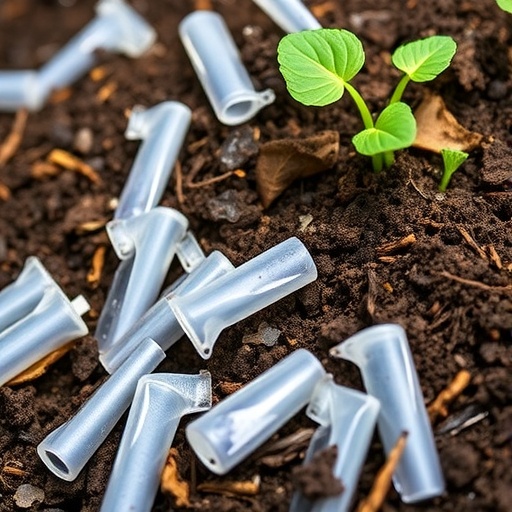
For decades, the specter of plastic pollution has loomed large over global agriculture, with plastic film mulch—a thin, protective sheeting spread across millions of hectares to boost crop yields—cast as a primary villain in the microplastic contamination of soils. The narrative has been straightforward and alarming: as this mulch degrades, it fragments into countless microscopic particles that persist in the earth, infiltrate the food web, and potentially threaten human health. Policymakers, environmental agencies, and the public have largely accepted that mulching is a direct pipeline for microplastics into the farmland that sustains us. But a sweeping new study published in npj Sustainable Agriculture is turning that assumption on its head, arguing that the contribution of plastic film mulch to soil microplastics has been wildly, almost systematically, overestimated. The research, led by Shuliang Ren and colleagues, deploys a rigorous meta-analysis and mass-balance modeling to suggest that the real numbers are far lower than previously reported, forcing a profound rethink of where agricultural microplastics actually come from and how we should regulate them.
To understand the magnitude of the claim, one must first appreciate the scale of plastic film mulching. Since its introduction in the mid-20th century, the technique has revolutionized farming in arid and semi-arid regions, particularly across China, which accounts for roughly 90% of global mulch film usage. By covering the soil, these films suppress weeds, conserve moisture, and raise soil temperature, enabling earlier planting and dramatically higher yields. The dark side, however, emerged as spent films proved difficult to remove entirely; fragments left behind would be plowed into the soil, visibly accumulating over time. Early studies, extrapolating from small field plots, produced alarming estimates: some suggested that mulching could contribute anywhere from tens to hundreds of kilograms of microplastics per hectare annually, with a substantial fraction of all soil plastic debris attributed directly to this single source. These figures fueled a sense of crisis and prompted calls for banning or replacing conventional polyethylene films with biodegradable alternatives, often without rigorous verification of the underlying numbers.
Ren and his team set out to scrutinize those numbers with a skeptical eye, suspecting that methodological flaws and a lack of standardized measurement protocols had systematically inflated the assumed contribution from mulch films. They conducted an exhaustive meta-analysis, pulling together every available study that reported microplastic concentrations in soils with and without mulch application, spanning diverse geographies, climates, and soil types. The raw data they gathered painted a chaotic picture: some studies reported staggering differences between mulched and non-mulched plots, while others found no significant difference at all. When the researchers harmonized the data using consistent extraction and counting techniques, a startling pattern emerged. The average microplastic concentration in mulched soils was indeed higher than in unmulched soils, but the effect size was orders of magnitude smaller than the most widely cited figures. The team calculated that the mean net increase attributable to mulch film was approximately 1.7 milligrams per kilogram of soil, a figure that stands in stark contrast to the grams or tens of grams per kilogram that had been bandied about in policy circles.
To double-check their meta-analytical findings, the researchers constructed a mass-balance model that traced the entire lifecycle of plastic mulch film from application to residual accumulation. They incorporated parameters such as film thickness, the fraction of film that is removed after harvest, the degradation rate under UV radiation and microbial activity, and the mechanical breakdown during tillage. The model revealed that even under worst-case scenarios—where farmers neglected to remove any film and degradation proceeded slowly—the theoretical maximum input of microplastics from mulch films into the soil was constrained by the simple fact that the films themselves are exceedingly thin. A typical polyethylene mulch film weighs only about 60 to 80 kilograms per hectare; even if all of it eventually fragmented into microplastics over decades, the annualized addition would be limited to a few kilograms per hectare at most, not the hundreds suggested by earlier extrapolations. The mass balance simply did not close for the more extreme estimates, indicating that they must have been contaminated by other sources of plastic or by analytical errors such as misidentifying natural fibers as microplastics.
One of the most compelling technical explanations for the historical overestimation lies in the pervasive problem of cross-contamination and the misidentification of particles. Microplastic research in environmental matrices is notoriously difficult, relying on a combination of density separation, chemical digestion, and spectroscopic confirmation. Many older studies, and even some recent ones, did not employ Raman or Fourier-transform infrared spectroscopy to verify the chemical identity of every particle, instead relying on visual sorting under a microscope. The team’s re-analysis found that a large proportion of particles visually classified as microplastics in mulched soils were actually organic matter, mineral fragments, or cotton fibers from clothing—materials that are ubiquitous in agricultural environments. When the data were corrected to include only chemically confirmed plastic particles, the apparent contribution of mulch films shrank dramatically. This finding underscores a critical need for the entire field to adopt standardized, spectroscopic validation to prevent the kind of false positives that have muddied the waters for years.
Beyond methodological issues, the study also highlights a crucial geographic and temporal blind spot that has skewed the global perception of the problem. The vast majority of the research on mulch-derived microplastics has been conducted in China, where mulching practices, soil types, and removal rates differ enormously from those in Europe, North America, or Africa. In China, where the technique is applied intensively and often on large-scale farms, the accumulation of visible film residues is an undeniable and well-documented problem. However, Ren’s team points out that even there, the conversion of these macroscopic residues into microplastics is a slow, nonlinear process governed by environmental factors. When they incorporated real-world degradation kinetics—accounting for the fact that polyethylene films buried in soil are shielded from the UV light that primarily drives fragmentation—the model showed that the residence time of intact films in soil can be decades, and the rate of microplastic generation is correspondingly low. The catastrophic short-term scenarios that dominated early headlines were, in essence, extrapolating a linear fragmentation rate from short-term laboratory experiments that bore little resemblance to actual field conditions, where films are often partially protected by soil aggregates and microbial biofilms.
The implications of this recalibration ripple outward into the entire debate on agricultural plastics and sustainability. For years, the narrative that mulch films are the dominant source of soil microplastics has driven policy recommendations, including subsidies for biodegradable alternative films, mandatory retrieval programs, and even outright bans on conventional polyethylene mulch. While these measures may still have merit for other reasons—such as preventing the visible aesthetic pollution of landscapes or the physical obstruction of root growth—they may not be the most effective way to tackle the invisible microplastic burden. The study suggests that the focus on mulch films as a microplastic source has diverted attention and resources away from other, potentially more significant pathways of plastic contamination in agricultural soils. These include atmospheric deposition of microfibers from cities, the application of sewage sludge and compost contaminated with plastic fragments, and the direct wear and tear from agricultural machinery and irrigation equipment. In many regions, these diffuse sources could collectively outweigh the contribution of mulch films by a wide margin, a possibility that urgently requires further investigation.
Ren’s group took care to emphasize that their findings do not absolve plastic mulch films of all environmental guilt. The visible fragmentation of films into smaller and smaller pieces is still a form of pollution that can alter soil physical properties, such as water infiltration and bulk density, and the long-term breakdown of polyethylene into nanoplastics remains a poorly understood frontier with potential toxicological consequences. The key point is one of proportionality and accuracy. By overestimating the contribution of mulch films to microplastics, the scientific community may have inadvertently created a distorted evidence base that leads to misinformed regulatory decisions. For instance, if a government sets a target to reduce soil microplastics by 80% and assumes that mulch films are 90% of the problem, it will inevitably mandate measures that cannot achieve the desired outcome, leading to wasted expenditure and erosion of public trust. The new study provides a more grounded framework for setting realistic reduction targets and for designing monitoring programs that can distinguish between different plastic sources using chemical fingerprinting and polymeric tracers.
Delving deeper into the mass-balance modeling, the researchers introduced a sophisticated compartmental model that divided the soil environment into a surface layer where UV-driven fragmentation can occur and a subsurface layer where degradation is dominated by microbial and mechanical processes. They calibrated the model using long-term field trials in which the fate of mulch films had been tracked for over a decade. The results showed that the flux of microplastics from the surface to the subsurface layer is surprisingly slow, mediated by the action of earthworms, root growth, and tillage. Even under intensive tillage regimes, the downward migration of plastic fragments is a gradual process, meaning that the total microplastic inventory in the soil profile builds up over many years rather than exploding in a short period. The model’s predictions aligned well with the corrected meta-analysis data, giving confidence that the low contribution estimate is not an artifact of any single methodology but a robust feature of the system. This convergence of empirical and theoretical evidence is a rare and powerful thing in environmental science, and it should prompt a re-examination of the assumptions embedded in existing global models of plastic pollution.
The global dimension of this research cannot be overstated. Microplastic pollution in terrestrial ecosystems is increasingly recognized as a planetary boundary threat, yet the data on sources and fluxes remain fragmented and uncertain. The Intergovernmental Negotiating Committee on Plastic Pollution, tasked with drafting a legally binding treaty, has been grappling with the challenge of setting science-based targets for reducing plastic emissions to soil. If the widely repeated estimates of mulch-derived microplastics have been exaggerated by a factor of ten or more, then the treaty’s baseline for agriculture will need to be revised downward. This could shift the regulatory focus toward other hotspots, such as the use of plastic-coated fertilizers, the release of pre-production pellets from industrial sites, or the staggering amounts of synthetic fibers released from laundry. The study by Ren and his colleagues is thus a timely corrective that could help align international policy with the actual distribution of pollution sources, making the global response more efficient and equitable.
Skeptics might argue that the study’s emphasis on overestimation risks downplaying a serious environmental problem, but the authors are careful to situate their work within a broader commitment to precision and accountability. They point out that the scientific method thrives on the continuous refinement of knowledge, and that the identification of past errors is not a repudiation of environmental concern but a strengthening of it. Only by knowing the true magnitude and sources of a problem can we design interventions that actually work. The team’s work also serves as a cautionary tale about the dangers of publication bias and the replication crisis that can plague fields where dramatic, high-impact results are rewarded over sober, incremental ones. The early studies that reported the highest mulch-derived microplastic concentrations were often small, unreplicated, and published in high-profile journals precisely because they were so alarming. The new meta-analysis, by systematically correcting for these biases, provides a more sober and ultimately more useful picture.
Looking ahead, the research opens up several urgent lines of inquiry. The first is a comprehensive global inventory of microplastic sources to agricultural soils, using standardized methods that include mandatory polymer identification and rigorous quality control. Such an inventory would clarify the relative contributions of mulch films, compost, atmospheric deposition, and other sources, enabling a Pareto-like prioritization of mitigation efforts. The second is a mechanistic understanding of the long-term fate of polyethylene in soil: does it truly mineralize over centuries, or does it fragment into ever smaller particles that can cross biological barriers? The third, and perhaps most pressing, is the development of truly sustainable mulch alternatives that do not simply swap one set of environmental problems for another. Biodegradable plastics, for instance, can break down quickly, but their additives and the conditions required for complete degradation are not always met in real soils, potentially creating a different kind of microplastic burden. The study by Ren et al. does not answer these questions, but it provides a clearer, more honest foundation upon which to build the answers.
The broader significance of this work lies in its demonstration of the power of meta-analysis and rigorous statistical scrutiny to overturn entrenched scientific narratives. The notion that plastic mulch films are the primary source of soil microplastics has become so deeply embedded in academic and public discourse that it is often stated as fact without citation. This study reminds us that even widely accepted “facts” can be built on a shaky edifice of small, biased studies and that the only way to achieve truth is through the messy, collaborative process of confronting data with countervailing evidence. It is a testament to the self-correcting nature of science, and it should encourage a wave of replication studies in other areas of microplastic research, from the ocean gyres to the human bloodstream. The finding also carries a practical message for farmers, who have been unfairly burdened with the image of unwittingly turning their fields into plastic dumps; their actual contribution to the microplastic problem, while not zero, is far less than was once thought, and their efforts to remove film residues after harvest can make a meaningful difference in limiting the visible debris that initiates the fragmentation cascade.
In the end, the study’s conclusion is both humbling and empowering. It is humbling because it reveals how easily scientific consensus can be led astray by measurement error and the human tendency to prefer dramatic narratives over messy, uncertain reality. It is empowering because it suggests that the microplastic problem in agriculture, while still serious, may be more tractable than we feared. If the largest source of soil microplastics is not mulch films but something else—something that might be easier to control at source, such as the fibers in our wastewater—then we have a clearer path forward. The work of Ren and his colleagues is a tour de force of environmental accounting, and it will undoubtedly be cited, debated, and built upon for years to come. It is a reminder that in the fight against plastic pollution, the first weapon must always be a calibrated instrument of truth, and that sometimes the most revolutionary act is to correct an error.
Subject of Research: The contribution of plastic film mulch to microplastics in agricultural soils
Article Title: The contribution of plastic film mulch to microplastics in agricultural soils was highly overestimated
Article References:
Ren, S., Wang, K., Zhang, J. et al. The contribution of plastic film mulch to microplastics in agricultural soils was highly overestimated.
npj Sustain. Agric. 4, 59 (2026). https://doi.org/10.1038/s44264-026-00169-2
Image Credits: AI Generated
DOI: https://doi.org/10.1038/s44264-026-00169-2
Keywords: plastic film mulch, microplastics, agricultural soils, overestimation, meta-analysis, mass-balance modeling, soil contamination, polyethylene mulch, spectroscopic validation, source apportionment