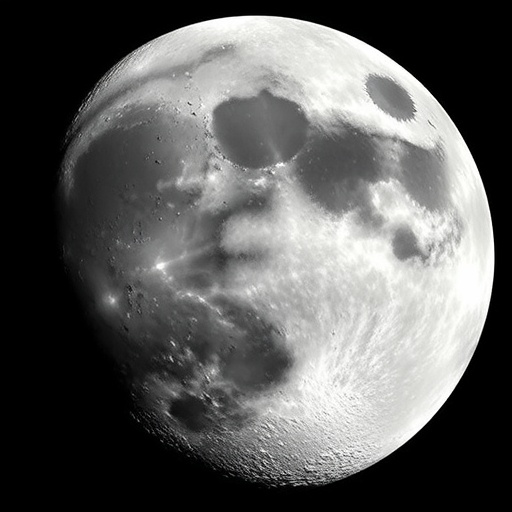
SAN ANTONIO — The Moon, a silent witness to the solar system’s violent infancy, records its history in a language of circular scars. For decades, planetary scientists have painstakingly read that scar tissue by manually cataloging impact craters, a task as tedious as it is fundamental. These databases are the bedrock of lunar chronology: count the craters on a given surface, and a reliable model spits out its age, because small asteroids have been pelting the inner worlds at a roughly steady rate for the past four billion years. Now, a new study from the Southwest Research Institute (SwRI) has poured cold water on the dream that artificial intelligence could instantly decipher that ancient script. The research, published in The Planetary Science Journal, audited eight AI-generated global or large-coverage lunar crater catalogs and found that their dazzling published performance metrics often crumble when held to the same exacting standards expected of human analysts.
The promise of automated crater detection has been nothing short of revolutionary in planetary science because the field is fundamentally data-starved when it comes to ground-truth measurements. Manual crater counting demands months or years of meticulous screen-staring, during which a trained scientist examines high-resolution orbital imagery and digital elevation models to mark each pit’s center coordinates and measure its rim-to-rim diameter. For a world like the Moon, with millions of craters larger than a kilometer, a complete human census is a career-defining endeavor; Dr. Stuart J. Robbins, the lead author of the new study, spent years constructing one such authoritative catalog that now serves as the benchmark for the community. Meanwhile, AI tools held out the tantalizing prospect of reducing that effort to a few hours of GPU time, enabling researchers to tackle problems—like building catalogs for every solid body in the solar system—that would otherwise be impossible within a human lifetime.
Yet the SwRI-led investigation reveals that the chasm between what an AI claims to have found and what is actually scientifically usable has been dangerously obscured by the metrics commonly borrowed from computer vision. In the classic machine-learning paradigm, an object detection system is judged by precision (how many of its detections are real objects) and recall (what fraction of all real objects it found), often summarized via the F1 score. The trouble, as Robbins and co-author Dr. Rachael H. Hoover demonstrated, is that these numbers can be inflated by adopting lax matching criteria that tolerate enormous location offsets or grossly incorrect diameters. If the algorithm simply needs to place a circle somewhere near a real crater to count as a hit, a catalog might appear 90% complete while systematically misplacing craters by dozens of kilometers or misjudging their sizes by a factor of two—errors that would send a human analyst’s work straight back to the drawing board. The study’s central insight is that scientific utility demands a far stricter definition of a match than what computer vision conferences typically reward.
To expose this gap, the team applied a uniform set of matching criteria rooted in the known repeatability limits of manual crater analysts. When a skilled human repeatedly catalogs the same terrain, their crater centers tend to cluster within a small fraction of the crater’s radius, and their diameter estimates typically agree within about 10 to 20 percent. Robbins and Hoover therefore defined a scientifically valid match as one where an AI-detected crater’s center lies within 1.5 times the manual crater’s radius—tight enough to ensure genuine spatial association—and its diameter falls between 0.5 and 2.0 times the manual diameter. This may sound generous, but many of the automated catalogs had been trained or evaluated with criteria so permissive that a detection could be offset by half the crater’s own diameter or more and still be tallied as correct. When the team retroactively assessed each of the eight databases against Robbins’ manual ground truth using the stringent definition, the numbers collapsed, with some reported recall rates dropping by more than an order of magnitude.
The consequences of such hidden inaccuracies go far beyond a few disappointing charts. Crater catalogs are not merely academic inventories; they are the raw material for deciphering planetary surface ages through the crater size-frequency distribution technique. This method relies on the fact that the production rate of impact craters as a function of diameter follows a well-calibrated power-law distribution, which has been painstakingly tied to absolute ages using radiometric dates from returned lunar samples. If an AI catalog spuriously duplicates a fraction of the crater population, it artificially inflates the crater density and makes a surface appear twice as old as it really is—a chilling prospect if the surface in question belongs to a future landing site being assessed for water ice stability or volcanic history. Similarly, misclassifying a degraded ancient basin as several overlapping smaller craters can fragment the record of the largest and most informative impacts, distorting our understanding of the early bombardment that shaped the Earth-Moon system.
Robbins is careful to note that not all AI catalogs performed uniformly poorly; some handled certain crater size ranges remarkably well. However, the study found a pervasive “diameter dependence” that single-number summaries hide. A database might achieve respectable recall and precision for craters between 5 and 20 kilometers in diameter, the sweet spot where training data are abundant and morphological crispness helps algorithms, while completely failing below 2 kilometers, where shadows and subtle topography confuse even the best convolutional neural networks. Alternatively, a catalog built primarily to capture large ancient basins might miss 80 percent of the small, fresh craters that are crucial for dating young features like impact melt flows or volcanic terrains. This means that a lunar geologist who naively trusts a published F1 score could end up building a robust chronology for a mare surface while completely missing the fact that the same catalog is worthless for the adjacent highlands, simply because the error profile is size-dependent and spatially heterogeneous.
The paper, titled “A Comparison of Lunar AI-Based Crater Databases Using Uniform Criteria,” stands as a methodological manifesto for the entire planetary AI community. It argues forcefully that the era of reporting off-the-shelf computer vision metrics without disclosing the matching protocol, positional tolerance, and diameter tolerance must end. Robbins and Hoover propose a transparent benchmarking framework in which any new AI catalog is validated not only against a trusted manual database but also against the intrinsic variability of human mappers themselves. After all, if a neural network’s uncertainty significantly exceeds the disagreement between two experienced analysts redrawing the same area, that catalog is not ready to replace the human eye. The authors also stress the need for independent validation on regions that were withheld from the AI’s training set, because many of the evaluated catalogs had used segments of Robbins’ manual database during their development, inadvertently contaminating their test results.
The implications of these findings ripple outward to every branch of solar system exploration, from Mars rover navigation to the mapping of icy moons like Europa and Enceladus. Impact craters are the unifying currency of planetary stratigraphy: they cross-cut other features, they expose subsurface materials, and they reset the clock on surface evolution. When a spacecraft images a new world for the first time, the very first scientific question is often, “how old is this surface?”—a question answered by craters. If an AI-driven pipeline produces a crater map for, say, Ganymede, on the basis of metrics validated only on lunar data under loose matching criteria, any derived ages could be systematically off in ways that no one would catch without an exhaustive manual audit. The study thus serves as a cautionary tale against the premature operationalization of automated crater detectors without thorough, criteria-conscious vetting.
Despite the sobering results, Robbins emphasizes that the work is not an indictment of artificial intelligence as a tool for planetary science. On the contrary, he believes AI has an essential role to play, particularly in sifting through the ever-growing flood of high-resolution imagery pouring down from missions like the Lunar Reconnaissance Orbiter or the European Space Agency’s BepiColombo at Mercury. The key, he says, is to stop treating a neural network’s output as a final scientific product and instead treat it as a high-quality first draft that must still be carefully edited by a domain expert. Some of the evaluated catalogs, when manually corrected for duplicates and gross mis-measurements, could still shave years off the manual mapping process. The danger lies in researchers—especially those outside the crater-counting specialty—importing an AI catalog, reading its published precision and recall values, and directly feeding the data into age-determination software without ever inspecting the crater population with their own eyes.
One of the most striking demonstrations embedded in the paper is a geographical comparison that paints the Moon’s surface in three layers of color: the human consensus catalog in green, one AI catalog in red, and another in blue. Where all three agree, the map is white; where an AI diverges, the landscape is streaked with crimson and sapphire patches that vividly reveal systematic offsets. In some highland regions, whole chains of secondary craters from the Copernicus impact are completely missed by the algorithms, while in others, subtle rheological boundaries of ancient lava flows confuse the detectors into hallucinating crater rings that do not exist. Robbins and Hoover have released an animation that sweeps across these comparative lunar maps, offering the public and the scientific community an intuitive glimpse into the scale of the discrepancy. The animation, available on YouTube, brings the abstract statistics to life, showing how innocuous a 15 percent false positive rate sounds in a paper yet how catastrophic it looks when splashed across the man-in-the-moon’s serene face.
The study also highlights the subtle but insidious problem of duplicate detections, a flaw that plagues many automated systems that use overlapping sliding-window approaches or ensemble methods that merge multiple models. Imagine an algorithm that, because of noise in a digital elevation model, identifies the same 1.5-kilometer crater as three separate but co-located detections with slightly different center coordinates. A human auditor would instantly collapse these into one, but the raw catalog may include all three, artificially boosting the small-crater count in that region. When those numbers are fed into a crater size-frequency distribution, the excess small craters can masquerade as a younger surface age, or they can warp the shape of the distribution in ways that mimic a resurfacing event like a volcanic flow that never actually happened. Such errors could propagate into global age maps and even influence the targeting of future landed missions, making this study’s call for robust post-processing and validation a matter of immediate practical consequence.
Robbins and Hoover’s analysis arrives at a pivotal moment, as several major lunar mapping initiatives, including those by national space agencies and private companies, are exploring AI-assisted crater detection to accelerate their scientific returns. The Moon is no longer just an object of pure research; it is a destination for commercial landers, resource prospectors, and crews under the Artemis program. If a geological map underpins a decision about where to land a rover to sample ancient crustal material, and that map is built on an AI crater catalog with a hidden 30 percent error in crater density, the rover could end up sampling material millions of years younger or older than intended, with cascading consequences for our understanding of lunar evolution. Therefore, the new study is not just a methodological critique—it is a vital piece of risk communication, reminding the exploration community that artificial intelligence, for all its power, remains a tool that must be wielded with the same rigor and skepticism as any other instrument.
Looking ahead, the researchers hope their benchmarking framework will be adopted by developers as a standard hurdle before publication. The ideal, Hoover suggests, is a community-vetted validation suite that includes manual crater catalogs for multiple solar system bodies, standardized scripted matching algorithms that implement the same strict spatial and size tolerances, and a requirement to report performance not as a single number but as a multi-dimensional matrix that quantifies recall, precision, and positional errors as functions of both crater diameter and surface terrain type. Such a regime would not only guard against the inflation of metrics but would also help identify the specific regimes where a given AI excels, allowing end-users to select the right catalog for their particular science question. Some catalogs might be perfect for studying large impact basins but unsuitable for dating young lava flows, and a transparent performance matrix would make that trade-off explicit.
The publication in The Planetary Science Journal comes with a digital object identifier (DOI) of 10.3847/PSJ/ae6b82, and the supporting materials, including the comparative animation and the underlying data tables, are accessible through the journal’s website and the SwRI planetary science webpage. The study’s rigorous yet accessible approach has already sparked conversations across the planetary science and computer vision communities, with several groups working on next-generation crater detectors already reaching out to incorporate the Robbins-Hoover criteria into their training loops. The message is clear: the race to automate crater counting will not be won by the algorithm that publishes the flashiest precision-recall curve on a cherry-picked test set, but by the one that survives the unblinking scrutiny of the same standards that have made manual catalogs the gold standard for over half a century. AI may indeed one day count craters better than any human, but that day, as this study makes painfully clear, has not yet arrived.
Subject of Research: Lunar impact craters, artificial intelligence performance evaluation, planetary surface dating
Article Title: A Comparison of Lunar AI-Based Crater Databases Using Uniform Criteria
News Publication Date: July 6, 2026
Web References:
https://youtu.be/Z5BiesDc7eo (comparative animation)
https://www.swri.org/markets/earth-space/space-research-technology/space-science/planetary-science (SwRI planetary science page)
References: 10.3847/PSJ/ae6b82
Image Credits: NASA/GSFC/Arizona State University/SwRI
Keywords
planetary science, lunar surface, impact craters, crater detection, artificial intelligence, machine learning, crater catalogs, surface dating, crater size-frequency distribution, computer vision metrics, benchmarking, lunar chronology, geologic mapping, remote sensing