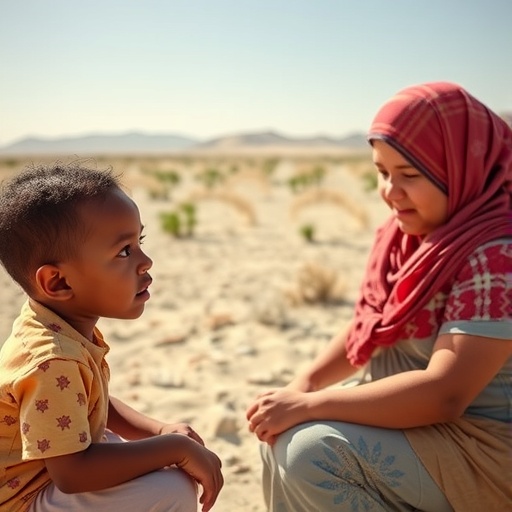
A groundbreaking study emerging from the University of California, Riverside (UCR) is shedding new light on the complex interplay between environmental degradation, housing inequality, and respiratory health among vulnerable communities. Centered on the Salton Sea region in Southern California, this research integrates quantitative air quality data with qualitative insights from Latina mothers caring for children with asthma and related respiratory conditions. The findings offer a stark depiction of how deteriorating ecological conditions combined with systemic social inequities exacerbate health risks for children, emphasizing the urgent need for multidimensional public health interventions.
The Salton Sea, California’s largest inland body of water, has undergone rapid transformation in recent decades due to declining inflows and rising temperatures linked to climate change. As the water volume recedes, vast expanses of lakebed have become exposed, generating persistent dust storms laden with particulate matter. This phenomenon not only compromises regional air quality but imposes significant health burdens on nearby residents, particularly children whose developing respiratory systems are highly susceptible to airborne irritants. Researchers have thus focused their efforts on measuring indoor air quality within homes proximate to the sea to grasp the full extent of exposure.
Led by social medicine expert Professor Ann Cheney, the interdisciplinary research team combined state-of-the-art air quality monitoring with a novel photovoice methodology. This approach empowered 15 Latina caregivers to document their lived experiences through photography and personal narratives, providing an authentic window into everyday struggles with environmental threats. The coupling of rigorous scientific measurement with community-sourced storytelling marks a methodological innovation, allowing for a more nuanced understanding of how particulate matter from outdoor dust events infiltrates domestic environments, often doubling typical indoor levels.
Quantitative data collected by atmospheric scientist Dr. William Porter revealed a direct correlation between wind-driven dust occurrences and spikes in indoor concentrations of particulate matter. This finding underscores the permeability of even sealed housing structures to environmental pollutants. Families reported that fine dust penetrates through windows, doors, and ventilation systems, aggravating respiratory symptoms and forcing behavioral adaptations to limit exposure. These adaptations, such as keeping children indoors during high dust episodes, inadvertently disrupt daily life, limiting physical activity, social interaction, and educational engagement.
Beyond the immediate physiological effects, the study illuminated the broader sociopolitical context shaping these health disparities. Historical land-use policies and intensive agricultural practices have geographically confined low-income Latinx and Indigenous Mexican families to high-risk zones with inadequate housing infrastructure. These structural inequities perpetuate environmental injustice by concentrating pollution exposure within marginalized communities, illustrating that health outcomes are inextricably linked to socioeconomic determinants and systemic neglect.
The emotional testimony of participants vividly conveyed the lived realities behind the data. One mother described the relentless intrusion of ultra-fine sand particles capable of bypassing physical barriers intended to protect indoor air quality, highlighting the inadequacy of existing housing stock to shield vulnerable populations. These narratives humanize the quantitative findings and emphasize the resilience and resourcefulness of community members grappling with interwoven health and environmental crises.
Analysis of behavioral responses revealed complex trade-offs. Families’ strategies to mitigate dust exposure, such as restricting outdoor activities and reliance on indoor environments, resulted in unintended consequences including decreased school attendance and caregivers’ limited workforce participation. These disruptions not only affect immediate health but contribute to cycles of economic and social disadvantage, reinforcing the need for holistic policy approaches that address both environmental and social determinants of health.
Importantly, the research demonstrated that particulate matter exposure in this context transcends measurable scientific phenomena to embed deeply within the fabric of everyday life. The photovoice component facilitated a participatory form of knowledge generation, validating community expertise and fostering an inclusive dialogue around environmental health challenges. This approach represents a shift away from extractive research towards collaborative, equity-centered scientific inquiry.
The implications for public health policy are profound. The study advocates for comprehensive interventions aimed at improving housing conditions, enhancing environmental health literacy, and providing access to effective air filtration technologies. It also calls for a reexamination of regulatory frameworks governing environmental emissions, particularly targeting dust reduction strategies for the desiccating Salton Sea. Central to these efforts must be community empowerment and ensuring that affected populations possess genuine influence over decisions impacting their health and environment.
Reflecting on the broader landscape of environmental justice, co-author Ashley Trinidad emphasized that disparities in respiratory health cannot be reduced to individual behaviors. Instead, they are symptomatic of systemic social and environmental inequalities that delineate where people live and the quality of the air they breathe. This perspective challenges conventional public health paradigms and underscores the necessity of addressing root causes through transformative policy action.
To amplify community voices and catalyze change, the research team curated both digital and physical photovoice exhibitions showcasing participants’ photographs and narratives. These forums created critical spaces for dialogue among residents, policymakers, and legislative representatives, fostering a collaborative atmosphere conducive to developing meaningful, community-centered solutions.
In conclusion, the innovative mixed-methods study from UCR offers a compelling portrait of environmental health vulnerability in the Salton Sea area—highlighting how toxic dust exposure, compounded by inadequate housing and structural inequities, imperils the respiratory health and quality of life of children. The research calls for urgent, multifaceted interventions rooted in environmental justice principles—reminding us that safeguarding public health requires concerted efforts that transcend scientific measurement to encompass social empowerment and policy transformation.
Subject of Research: People
Article Title: A mixed-methods study of indoor air quality on children’s respiratory health and quality of life
News Publication Date: 1-Jul-2026
Web References:
DOI Link to Article
References:
Cheney, A., Trinidad, A., Porter, W., Rodriguez, S., Ortiz, G., & Pozar, M. (2026). A mixed-methods study of indoor air quality on children’s respiratory health and quality of life. BMC Environmental Science.
Keywords:
Indoor Air Quality, Particulate Matter, Salton Sea, Respiratory Health, Environmental Justice, Latinx Communities, Structural Inequality, Dust Storms, Housing Quality, Photovoice, Mixed-Methods Research
Tags: air quality and dust stormsasthma in vulnerable communitiesclimate change impacts on inland lakesenvironmental justice in Southern Californiahousing inequality and healthindoor air pollution near Salton SeaLatina mothers and child healthparticulate matter exposurepublic health interventions for respiratory diseasesrespiratory health in childrenSalton Sea environmental healthsocial determinants of health and environment