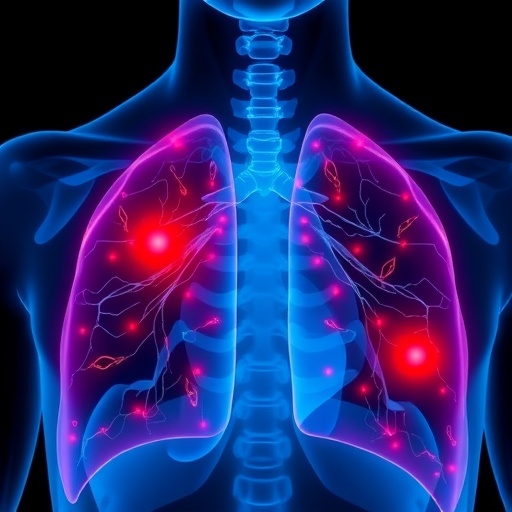
In a groundbreaking study published in the prestigious journal Cell, researchers from the Francis Crick Institute and University College London (UCL) have unveiled a novel 14-protein signature detectable in blood that can predict the risk of lung cancer development up to five years before diagnosis. This discovery marks a pivotal advance in the early detection of lung cancer, a disease notoriously diagnosed at late stages with poor prognosis. Funded by leading institutions including Cancer Research UK and the European Research Council, the international research team employed cutting-edge machine learning techniques on extensive plasma protein datasets derived from over 48,000 UK Biobank participants, followed longitudinally for cancer outcomes.
The identification of this 14-protein signature represents a significant leap beyond traditional risk stratification, which typically relies heavily on factors such as age, smoking history, and lung disease background. While cigarette smoking remains the primary established risk factor for lung cancer, this paradigm excludes a substantial subset of patients such as never-smokers and those exposed to environmental pollutants that incite chronic lung inflammation. Recognizing this gap, the researchers integrated comprehensive biological insights linking inflammation to carcinogenesis with advanced computational modeling to isolate a molecular fingerprint indicative of a pro-tumorigenic lung microenvironment. Their model robustly predicted lung cancer incidence within a five-year horizon, validated across eight diverse international cohorts including populations never exposed to tobacco smoke, underscoring its broad applicability.
At the heart of this signature lies a reflection of an altered inflammatory state in the lungs, long recognized as a fertile ground for malignant transformation. Prior investigations by the team demonstrated that environmental triggers such as air pollution—emanating from combustion engines, coal burning, and tobacco smoke—stimulate immune cells in the lung to release interleukin-1 beta (IL-1β), a potent inflammatory cytokine. This cytokine orchestrates an immune milieu that reawakens dormant epithelial cells harboring oncogenic mutations, propelling them towards malignancy. The current study elucidates that the 14 proteins characterizing the signature are elevated in this inflammatory context, and their heightened presence correlates with an expansion of a specialized cell population termed KAC cells. These cells represent a stress-responsive adaptive state commonly induced by injury but prone to malignant conversion if mutations persist.
The clinical implications of capturing this inflammatory signature are profound. Existing lung cancer screening programs, which predominantly target older individuals with significant smoking histories, inadvertently overlook at-risk persons lacking these classic clinical characteristics. Identifying individuals exhibiting this blood-based signature could redefine screening paradigms, enabling precision targeting of groups who might benefit from prophylactic interventions prior to tumor emergence. The study insightfuly links this signature to other inflammatory lung diseases such as idiopathic pulmonary fibrosis and chronic obstructive pulmonary disease (COPD), suggesting it encapsulates a shared, pre-disease inflammatory state that predisposes to lung cancer.
Therapeutically, the study charts a path toward molecular cancer prevention strategies. The team revisited data from the landmark CANTOS phase III trial, which tested canakinumab, an IL-1β blocking antibody initially developed to reduce cardiovascular risk. Remarkably, the trial’s exploratory analyses revealed a reduced incidence of lung cancer in recipients of canakinumab. However, this protective effect was relatively modest when considered across the broader population. By integrating their 14-protein signature to stratify patients, researchers demonstrated that canakinumab dramatically lowers lung cancer risk among participants with high baseline signature levels, nearly halving their risk. This nuanced stratification highlights the potential for tailored anti-inflammatory therapies to intercept cancer development in genetically and environmentally susceptible individuals.
Experimental validation in murine models reinforced the pathogenic role of IL-1β and the KAC cell state in the transition from chronic inflammation to malignancy. Pharmacologic inhibition of IL-1β curtailed the expansion of KAC cells and impeded early tumor formation following pollution exposure. These mechanistic insights illuminate a crucial window of opportunity—where therapeutic modulation of the inflammatory milieu and mutant cell dynamics could forestall the initiation of lung tumors. This biologically grounded preventive approach aligns with paradigms successful in other fields, such as cardiovascular disease prevention, wherein biomarkers like low-density lipoprotein cholesterol guide statin therapy.
The research embodies a convergence of computational biology, immunology, and clinical oncology, leveraging high-throughput proteomics and machine learning to decode complex biomolecular patterns. The interdisciplinary collaboration spans continents and bridges laboratory science with epidemiology and clinical trials, setting a new standard for translational cancer research. The identified protein signature not only serves as an early-warning system but also advances fundamental understanding of inflammation-driven carcinogenesis. This work supports an emerging concept that multiple age-related diseases share common pre-symptomatic inflammatory states, potentially enabling cross-disease preventive strategies.
Prominent cancer scientists emphasize the transformational potential of this discovery. Dr. Tej Pandya from UCL and the Crick Institute highlights the rigorous validation across diverse datasets and the profound biological insights gleaned from mouse models, underscoring the feasibility of future blood-based tests for lung cancer risk prediction. Professor Charlie Swanton, leading the TRACERx lung cancer evolution study, likens the signature to an “LDL marker” for lung cancer risk, paving the way for precision prevention mirroring successful interventions in cardiovascular health.
Cancer Research UK emphasizes the overarching benefit of earlier diagnosis and intervention implied by this research, envisioning a future where the anguish of late-stage cancer diagnosis is substantially reduced. The broad consortium spanning academia, clinical centers, and industry partners embodies the cooperative spirit necessary to translate these findings into clinical practice. Funded by multiple esteemed bodies including the Mark Foundation, the Ruth Strauss Foundation, and the UK Research and Innovation, the work underscores the critical role of sustained investment in biomedical discovery.
The study’s implications reach beyond lung cancer to potentially transform management of chronic inflammatory lung conditions. By elucidating a shared inflammatory signature preceding diverse lung pathologies, it opens avenues for integrated preventive care targeting inflammation. This research heralds an era of molecularly informed cancer prevention, with the promise of repurposing existing anti-inflammatory drugs guided by robust biomarkers to intervene before malignancy arises.
As the global burden of lung cancer remains profound, innovations like this protein signature detection system symbolize hope for shifting the diagnostic landscape from reactive to proactive. The synergy of advanced proteomics, sophisticated computational modeling, and mechanistic biology offers a powerful toolkit to intercept cancer at its earliest inception, embodying the ultimate precision medicine goal—preventing disease before it begins.
Subject of Research: Lung cancer prediction using a plasma protein signature reflecting pre-cancerous lung inflammation.
Article Title: Plasma signals of lung tumour promotion stratify benefit for molecular cancer prevention
News Publication Date: 4 June 2026
Web References:
Article DOI link: 10.1016/j.cell.2026.05.005
Previous related research on air pollution and lung cancer by the Crick Institute: https://www.crick.ac.uk/news/2022-09-10_scientists-reveal-how-air-pollution-can-cause-lung-cancer-in-people-who-have-never-smoked
References:
Pandya, T., Zagorulya, M., Leung, M., Augustine, M., et al. (2026). Plasma signals of lung tumour promotion stratify benefit for molecular cancer prevention. Cell.
Keywords: Lung cancer, inflammation, interleukin-1 beta, IL-1β, protein signature, precision cancer prevention, air pollution, KAC cells, machine learning, biomarker, immune microenvironment, cancer prediction, proteomics
Tags: 14-protein lung cancer biomarkercomputational modeling lung cancer riskinflammation and lung cancer risklung cancer early detection blood testlung cancer molecular signature researchlung cancer prevention candidateslung cancer risk assessment plasma proteinsmachine learning lung cancer predictionnon-smoking lung cancer biomarkersplasma protein cancer biomarkerspredictive lung cancer risk proteinsUK Biobank lung cancer study