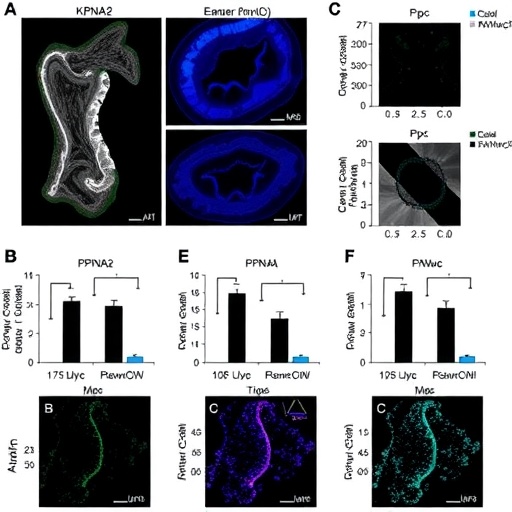
Advanced colorectal cancer remains one of oncology’s toughest challenges, especially in pathological T4 (pT4) disease where outcomes are often grim. A new study now points to a molecular driver that could help explain why some pT4 tumors progress aggressively and may even offer a prognostic handle. The work centers on Karyopherin alpha 2 (KPNA2), a nuclear transport protein best known for shuttling cargo to the nucleus.
KPNA2 functions as part of the import machinery that regulates the localization—and therefore the activity—of transcription factors. Among its suspected clients is c-Myc, an oncogenic regulator frequently amplified across cancers. When c-Myc reaches the nucleus efficiently, it can reprogram gene expression to support proliferation and survival.
To clarify KPNA2’s clinical significance in pT4 colorectal cancer, Dorjkhorloo and colleagues examined how KPNA2 levels associate with patient outcomes and with the tumor-suppressive pathway governed by p53. p53 normally triggers cell-cycle restraint through downstream targets such as p21, helping limit damaged-cell expansion.
The study reports that high KPNA2 expression predicts poor prognosis specifically in pathological T4 CRC. Mechanistically, the authors show that KPNA2 enhances the nuclear import of c-Myc, boosting its ability to influence transcriptional programs inside the nucleus. This c-Myc nuclear enrichment appears to suppress p53-dependent p21 expression, weakening a key checkpoint response.
In effect, the pathway links nuclear transport to a breakdown of p53 signaling output. By dampening p21, tumors may evade the growth arrest that would otherwise slow them after cellular stress. The findings therefore connect an intracellular trafficking step to a recognizable tumor-suppressor axis.
Crucially, the work frames KPNA2 not merely as a correlation marker, but as a functional contributor to a pro-tumor regulatory network. That makes KPNA2 a potential biomarker for risk stratification and a candidate target for therapeutic strategies aimed at disrupting nuclear import.
From a translational perspective, targeting the import step could, in principle, reduce c-Myc-driven transcriptional pressure while restoring aspects of p53 pathway signaling. While further validation is needed, the study provides a clear mechanistic rationale for follow-up.
If confirmed in larger cohorts, KPNA2 measurement could help identify pT4 patients most likely to experience adverse outcomes, supporting more tailored clinical decision-making. For a disease subtype defined by its invasive depth, the study offers a molecular explanation with tangible prognostic implications.
Subject of Research: Advanced pathological T4 colorectal cancer and nuclear transport biology
Article Title: High KPNA2 expression predicts poor prognosis in pathological T4 colorectal cancer by importing c-Myc into the nucleus to suppress p53-dependent p21 expression.
Article References: Dorjkhorloo, G., Erkhem-Ochir, B., Shiraishi, T. et al. Br J Cancer (2026). https://doi.org/10.1038/s41416-026-03552-5
DOI: 10.1038/s41416-026-03552-5
Keywords: KPNA2, colorectal cancer, pT4, c-Myc, p53, p21, nuclear transport
Tags: advanced colorectal cancer molecular mechanismsc-Myc and p21 interaction in cancer cellsc-Myc oncogene in colorectal cancercolorectal cancer prognosisimpact of KPNA2 overexpression in cancer outcomesKPNA2 nuclear transportmolecular markers for colorectal cancer prognosisnuclear import proteins in cancerprognostic significance of KPNA2 in colorectal cancerpT4 colorectal tumor progressionregulation of gene expression by nuclear transportrole of p53 and p21 in tumor suppression