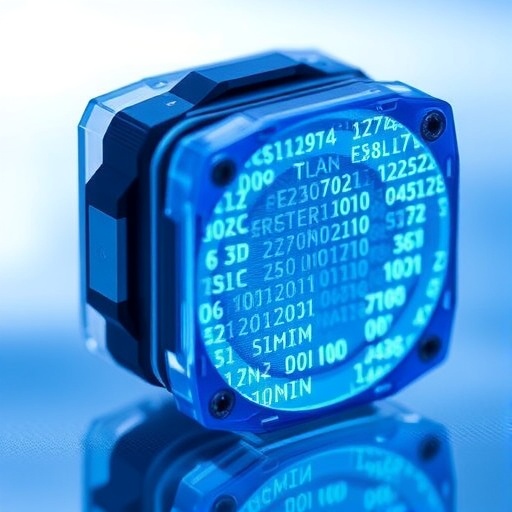
Engineers at the University of California San Diego have unveiled a groundbreaking optical device that dynamically alters its images and colors in response to humidity fluctuations. This innovation, recently published in Light: Science & Applications, introduces a new paradigm in smart materials, offering transformative potential in anti-counterfeiting technologies, secure data storage, interactive displays, and environmental sensing. The optical chip, roughly the size of a postage stamp, houses a bilayer structure whose properties evolve instantly with ambient moisture, exemplifying a bold step forward in responsive photonics.
At the core of this technology lies a remarkable humidity-responsive mechanism that toggles between two distinct images. Under normal or low-humidity conditions, the device prominently displays the UC San Diego Triton logo. However, as humidity rises, a second image — the UC San Diego library logo — emerges so seamlessly that it conceals the initial image entirely. This dynamic image transition is swift, triggered in just fractions of a second, and is reversible, meaning the device can cycle between states countless times without degradation.
Asad Nauman, the study’s lead author and postdoctoral researcher in electrical and computer engineering, explains the significance of such environmental modulation. “Imagine embedding a built-in security feature in everyday items where the environment acts as a key to unlock hidden information,” he states. Breathing onto the device, he adds, acts as a quick and simple way to reveal secret codes or data, transforming mundane physical objects into interactive, secure platforms through environmental stimuli.
The engineering behind this innovation involves integrating fundamentally different materials in a two-layer composite. The bottom layer is fabricated from antimony trisulfide, a phase-change material renowned for its capability in reversible optical data storage. This layer functions as a rewriteable medium where images can be inscribed or erased using laser technology, supporting dynamic data manipulation at a microscopic scale. On top of this, a hydrogel—specifically azido-grafted carboxymethyl cellulose—is applied. This soft, biocompatible polymer swells and contracts based on humidity levels, creating mechanical changes that directly impact optical properties.
Intriguingly, the images embedded in these layers are patterned through distinct mechanisms. The bottom phase-change layer supports laser-driven inscription of images, enabling rewritable storage. Conversely, the hydrogel top layer’s image is fixed, shaped permanently by ultraviolet light patterning. The interplay of these two layers under varying humidity conditions generates the seamless toggling between visual states, embodying a sophisticated marriage of materials science and photonic engineering.
This interdisciplinary vision emerges from the collaborative efforts within the Nano Devices and Applied Optics (NDAO) laboratory, under the leadership of Professor Abdoulaye Ndao. By harnessing expertise spanning phase-change photonic materials to responsive hydrogels, the team ingeniously integrated these complementary layers to build a unified device with unprecedented optical behavior. The synergy between these components enables data encoding in multidimensional spaces, potentially revolutionizing methods of information storage and encryption.
Beyond images, this device exhibits vibrant color-changing capabilities intimately linked to its structural design. The key lies in the nanoscale gap between the two layers. As the hydrogel swells with humidity, it modulates the inter-layer distance, altering the interference patterns of reflected light. This variable spacing modifies perceived colors instantaneously, resulting in a vivid visual transformation that enhances sensory feedback and broadens application scope.
The responsiveness to humidity is remarkably rapid, occurring within approximately 300 milliseconds of environmental change. This near-instantaneous reaction lends itself to real-time sensing applications, enabling devices that can monitor ambient moisture and provide immediate optical cues. Moreover, the fabrication process is scalable and cost-effective, utilizing accessible materials and methods compatible with large-area production, paving the way for widespread implementation.
Anticipating future directions, the research team plans to refine this technology for electrical control. Electrically actuated versions could grant more precise and programmable modulation over the optical state, elevating functionality for use in computing, security tags, and dynamic displays. Such advances would unify environmental and electronic stimuli into seamless integration, propelling this innovation into versatile next-generation smart devices.
This optical system’s ability to encode layered information accessible via environmental triggers introduces novel avenues in data encryption and storage. By stacking multiple information strata within a single device and dialing into particular layers through humidity adjustment, users gain access to complex datasets in a compact footprint. This capability offers profound implications for computing architectures and intellectual property protection.
In summary, the UC San Diego team’s humidity-responsive optical device embodies an elegant confluence of materials innovation and photonic engineering. Its rapid, reversible image and color shifts harness ambient moisture as an interactive key, opening possibilities ranging from anti-counterfeiting to environmental sensing. Crafted via the ingenious integration of phase-change materials and dynamic hydrogels, this discovery charts new territory in smart optical materials science, poised to inspire transformative technologies in both daily life and advanced computing.
Subject of Research: Humidity-Responsive Optical Devices for Data Storage and Encryption
Article Title: Reversible Optical Data Storage and Encryption Enabled by Phase-Change and Hydrogel Integration
News Publication Date: 18-May-2026
Web References:
DOI: 10.1038/s41377-026-02330-5
Nano Devices and Applied Optics Lab: https://ndao.ucsd.edu/
Image Credits: NDAO lab, University of California San Diego
Keywords
Humidity-responsive devices, optical data storage, phase-change materials, hydrogels, reversible encryption, smart photonics, interactive displays, environmental sensors, dynamic color modulation, secure data storage, nanotechnology, UC San Diego.
Tags: anti-counterfeiting optical chipsdynamic image display technologyenvironmental sensing photonicshumidity-responsive optical deviceinnovative smart material applicationsinteractive humidity sensorsmoisture-activated data encryptionresponsive bilayer nanostructuresreversible image transition technologysecure data storage solutionssmart photonic materialsUC San Diego optical innovation