When it comes to kitchen spills, paper towels and rags do the job. But using a hydrogel—a gelatin-like material in the form of a dry sheet—researchers have crafted a better picker-upper that absorbs and holds about three times more water-based liquid. The method, presented on December 21 in the journal Matter, produces an absorbent, foldable, and cuttable “gel sheet” that may one day find use in our kitchens or operating rooms to soak up liquids.
Credit: Matter/Choudhary et al.
When it comes to kitchen spills, paper towels and rags do the job. But using a hydrogel—a gelatin-like material in the form of a dry sheet—researchers have crafted a better picker-upper that absorbs and holds about three times more water-based liquid. The method, presented on December 21 in the journal Matter, produces an absorbent, foldable, and cuttable “gel sheet” that may one day find use in our kitchens or operating rooms to soak up liquids.
There are generally two types of materials that absorb liquids—porous materials and hydrogels. Porous materials like cloth and paper are flexible, foldable, and easy to use, but not very absorbent. On the other hand, superabsorbent hydrogels that are made of polymer, a web of large molecules, can soak up more than 100 times their weight in water. However, when dried, these hydrogels become brittle solids that crumble.
“We reimagined what a hydrogel can look like,” says corresponding author Srinivasa Raghavan of the University of Maryland. “What we’ve done is combine the desired properties of a paper towel and a hydrogel.”
To craft the gel sheets, the research team first mixed in acid, base, and other ingredients for the hydrogel in a zip-top bag. Like vinegar meeting baking soda, the mixture released carbon dioxide bubbles within the gel, creating a porous and foam-like material. Next, the zip-top bag was sandwiched between glass slabs to form a sheet and then exposed to UV light, which sets the liquid around the bubbles, leaving pores behind. Lastly, the team dipped the set sheet in alcohol and glycerol and air-dried it. This enabled the dried gel sheet to remain soft and flexible, similar to a fabric’s texture.
“To our knowledge, this is the first hydrogel that has been reported to have such tactile and mechanical properties,” says Raghavan. The gel sheets also stayed soft and flexible in ambient conditions for a year, indicating stability. “We are trying to achieve some unique properties with simple starting materials.”
Compared to a commercial cloth pad and a paper towel, a gel sheet the same size can absorb more than three times the amount of liquid than others. When researchers placed the gel sheet over 25 mL (0.8 oz) of spilled water, the sheet swelled and soaked it up within 20 seconds, holding the water without dripping. However, the cloth pad only absorbed about 60% of the water, leaving drips behind.
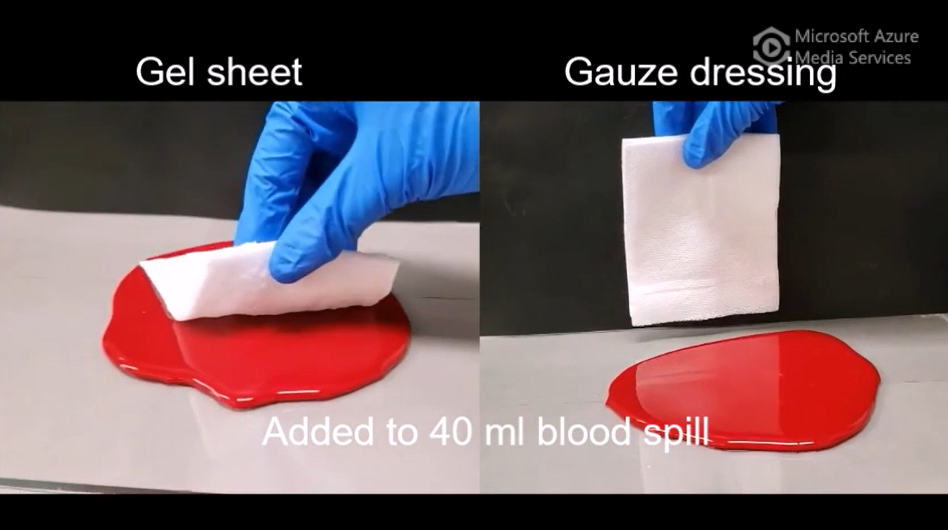
The gel sheet also performed well with thick liquids, such as syrup, blood, and even fluids that are a million times thicker than water. The researchers found that the gel sheet could absorb nearly 40 mL (1.4 oz) of blood within 60 seconds, while gauze dressing soaked up only 55% of the blood. The gel sheet also holds its liquid well, whereas the blood-soaked gauze trickles. Compared to sanitary pads, sponges, and gauze, the gel sheet absorbed over two times more blood than the others.
Next, the team plans to optimize their gel sheetsby increasing absorbency, strengthening the material, lowering the cost, and making the sheets reusable. The researchers are also looking to develop gel sheets for absorbing oil.
“In principle, the gel sheets could be a superior form of paper towels,” says Raghavan. He envisions the gel sheets picking up spills in kitchens and laboratories, as well as cleaning up blood from surgeries and menstrual bleeding. Because of their flexible and absorbent nature, gel sheets also have the potential to stop bleeding from severe wounds as dressing. “I’m always interested in taking our inventions further than just publishing a paper. It would be wonderful to take it to actual practical use.”
###
This work was supported by a grant from the Maryland Industrial Partnerships (MIPS) program.
Matter, Choudhary et al.: “A Better Picker-Upper: Superabsorbent ‘Gel Sheets’ with Fabric-Like Flexibility” https://www.cell.com/matter/fulltext/S2590-2385(22)00652-X
Matter (@Matter_CP), published by Cell Press, is a new journal for multi-disciplinary, transformative materials sciences research. Papers explore scientific advancements across the spectrum of materials development—from fundamentals to application, from nano to macro. Visit https://www.cell.com/matter. To receive Cell Press media alerts, please contact [email protected].
Journal
Matter
DOI
10.1016/j.matt.2022.11.021
Method of Research
Experimental study
Subject of Research
Not applicable
Article Title
A Better Picker-Upper: Superabsorbent “Gel Sheets” with Fabric-Like Flexibility
Article Publication Date
21-Dec-2022