Did you know that silk fabric is made from … well, worm spit? The way that silkworms wind their cocoons from fibers in their slimy saliva is now helping scientists more easily make new biomedical materials. Researchers reporting in ACS’ Nano Letters have mimicked the seemingly simple head bobbing of silkworms to create more consistent micro- and nanofibers with less equipment than other approaches. Watch a video of the new method in action here.
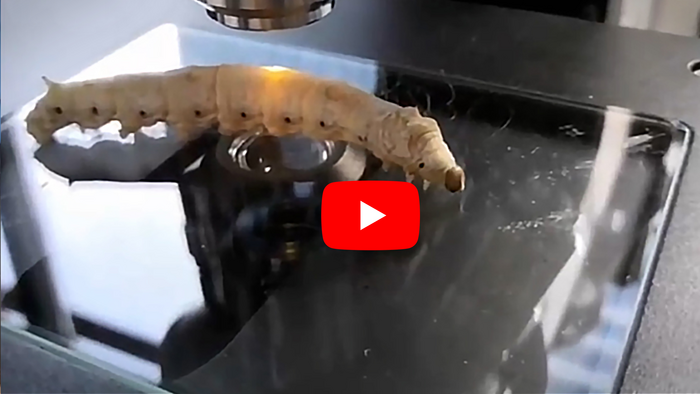
Credit: American Chemical Society
Did you know that silk fabric is made from … well, worm spit? The way that silkworms wind their cocoons from fibers in their slimy saliva is now helping scientists more easily make new biomedical materials. Researchers reporting in ACS’ Nano Letters have mimicked the seemingly simple head bobbing of silkworms to create more consistent micro- and nanofibers with less equipment than other approaches. Watch a video of the new method in action here.
Nanofibers have become an increasingly attractive material for a variety of applications, including wound dressings and flexible electronics. But producing the fibers isn’t always easy, especially because they’re only a few nanometers thick — that’s a few thousand times thinner than the width of a human hair. Most recently developed nanofiber spinning methods are complicated or slow, or they produce clumpy fibers. However, one “scientist” that seems to have solved the problem is the silkworm. This wriggly critter secretes a two-protein solution in its saliva that it continuously pulls into a long, skinny silk thread. The worm then sticks and pulls this single strand repeatedly until it’s wrapped in a silk cocoon, which people unwind to weave into silk textiles. So, Yu Wang, Wei Yang, Xuewei Fu and colleagues wanted to design a nanofiber spinning method inspired by the silkworm that could produce continuous, uniform filaments in a quick and easy way with minimal equipment.
To create the threads, the researchers poked an array of tiny microneedles into a piece of foam soaked with a poly(ethylene oxide) solution, then pulled the needles away in a process called microadhesion-guided (MAG) spinning. Different types of filaments were created by mimicking the way silkworms move their heads when making silk: Pulling straight back resulted in ordered, oriented fibers; swaying or vibrating created cross-linked fibers; and turning the needle array produced a twisted, “all-in-one” fiber. Additionally, these threads didn’t wad together, which could occur in previously developed methods.
An even more simplified version of MAG spinning didn’t require microneedles. In this case, the foam’s natural roughness acted as the microneedle adhesion points. The researchers simply soaked two pieces of foam with the polymer solution and pulled them apart, easily and instantly spinning threads between them. Using this strategy, they pulled the strands and placed them directly on a person’s skin to create an instant, custom bandage. These bandage fibers also contained an antibiotic, which successfully inhibited bacterial growth. The researchers say that this work could open up new possibilities for future biomedical applications of nanofibers.
The authors acknowledge funding from the National Natural Science Foundation of China and the Fundamental Research Funds for the Central Universities.
The American Chemical Society (ACS) is a nonprofit organization chartered by the U.S. Congress. ACS’ mission is to advance the broader chemistry enterprise and its practitioners for the benefit of Earth and all its people. The Society is a global leader in promoting excellence in science education and providing access to chemistry-related information and research through its multiple research solutions, peer-reviewed journals, scientific conferences, eBooks and weekly news periodical Chemical & Engineering News. ACS journals are among the most cited, most trusted and most read within the scientific literature; however, ACS itself does not conduct chemical research. As a leader in scientific information solutions, its CAS division partners with global innovators to accelerate breakthroughs by curating, connecting and analyzing the world’s scientific knowledge. ACS’ main offices are in Washington, D.C., and Columbus, Ohio.
To automatically receive news releases from the American Chemical Society, contact [email protected].
Follow us: Twitter | Facebook | LinkedIn | Instagram
Journal
Nano Letters
DOI
10.1021/acs.nanolett.2c03297
Article Title
“Biomimetic Microadhesion Guided Instant Spinning”
Article Publication Date
21-Nov-2022